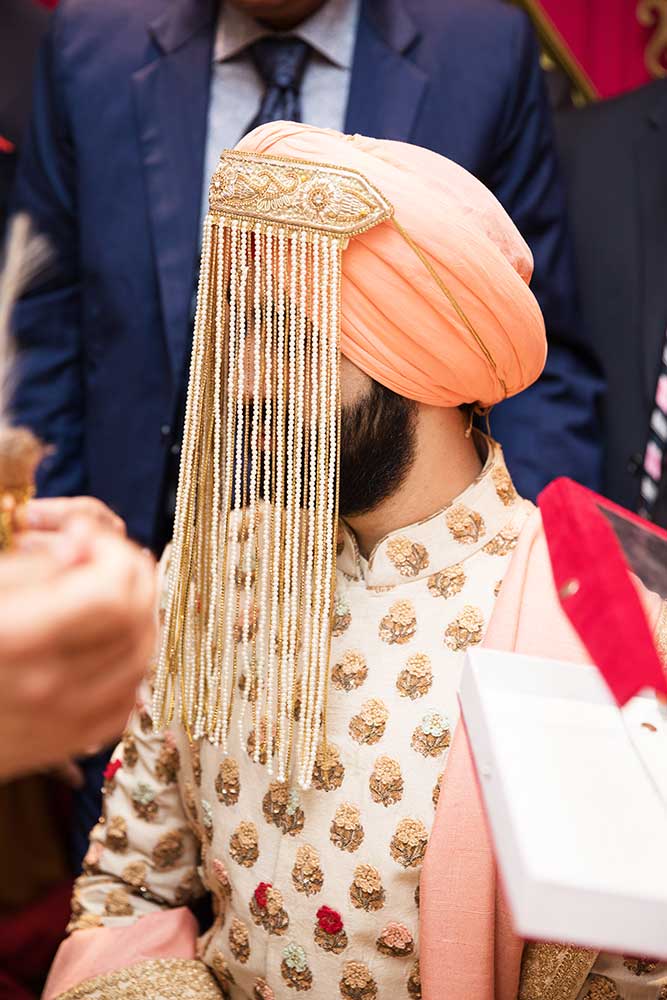
Covering or crowning the head of the couple is one of the oldest wedding gestures. The bride's veil, the groom's turban, the Orthodox crowns, the Indian ghunghat and the Jewish bedeken each carry a meaning that those who keep them can explain. Some hide, some honour, some mark a change of status, and some simply keep the hair tidy and the head warm.
A veil, many meanings
In ancient Rome the bride wore a flame-coloured veil, the flammeum. In the Jewish bedeken the groom veils the bride before the ceremony, recalling Jacob and Rachel. In the Christian West the white veil became a symbol of modesty and purity, and lifting it is the climax of the ceremony. In the Hindu ghunghat, a veil drawn over the face, the bride shows respect for her elders. In many Muslim communities the bride's headscarf or veil is part of her everyday dress and the wedding outfit is chosen to match.
Crowns, turbans and wreaths
Crowns raise the couple to a kind of royalty for a day. Orthodox Christians crown the pair with stefana, linked by a ribbon. Scandinavian brides wear silver crowns, Polish and Ukrainian brides wear wreaths of flowers and herbs, and Greek brides have crowns tied to each other. Grooms may wear the safa or turban in North India, the sehra of flowers or beads hanging from the turban, and a ceremonial hat in Korea, Japan and Central Asia.
Why cover the head
Reasons given include modesty, respect for elders, protection from the evil eye, a sign of being between two states and a way of marking the bride as someone special on the day. For some communities it is a religious requirement, for others a family habit. In many places the veil is lifted only when the vows are made, so the face is the surprise.
How it is changing
Brides today choose long, short or no veils, flower crowns or jewelled hair combs, and the veil may be an keepsake. Women who cover their hair every day may choose a decorated headscarf for the wedding. Debates about veiling in public life are separate from the ritual veil, and what a wearer thinks it means is what counts.
Veils, crowns and the covered head around the world
🇮🇳 India
In many North Indian communities the bride's face is covered by the ghunghat or an odhni, and the groom wears a sehra of flowers or pearls over his face that is removed before the ceremony. The sehra is a blessing and a defence against the evil eye.
Read: Sehra🇵🇰 Pakistan
The bride's face is covered by a dupatta, and the couple are shown a mirror under a shawl in the rite of arsi mushaf. The Quran is placed before them as a blessing.
Arsi Mushaf, being written🇹🇭 Thailand
In the Thai Buddhist rite, the couple's heads are joined by the mongkhon, a pair of linked cords, and water is poured over their hands from a conch shell. It is blessed by monks and elders.
Sai Monkhon, being written🇨🇳 China
The Han bride wore a red cloth, the hong gaitou, over her head to the groom's house, where the groom lifts it with a rod or a fan. The phoenix crown and a red veil are now used mostly as costume.
Chinese marriage, being written🇯🇵 Japan
The shiromuku bride wears the wataboshi, a large white hood, or the tsunokakushi, which hides the "horns". The reason given is to hide jealousy and to show humility before her new family.
Read: Tsunokakushi🇬🇪 Georgia
In an Orthodox wedding the priest places crowns on the heads of the bride and groom and exchanges them three times. In the Svan highlands, brides wear a heavy decorated headdress.
Stefana, being writtenCompare all 15 places
Traditions to start with
Also part of it, and being written: Bridal veil (The history of the wedding veil.), Bedeken (The Jewish veiling of the bride.), Stefana (The Orthodox wedding crowns.), Sai Monkhon (The Thai head-linking cord.), Oczepiny (The Polish capping of the bride.).
Questions people ask
Why does the bride wear a veil?
Reasons given include modesty, a sign of a change in status, protection from the evil eye, and the surprise of the first look. For many people today it is simply part of the dress.
Do grooms wear veils or crowns?
In several traditions, yes: the Indian sehra, the Orthodox crown, the Korean hat and the Central Asian skullcap.
Is a veil the same as hijab?
No. A wedding veil is part of the ceremony, while hijab is a religious head covering worn in daily life by many Muslim women. Some brides wear both.
What does lifting the veil mean?
In Western weddings it marks the moment the couple are united. In others it is the first time the groom sees the bride's face.
About this pageWritten by the EveryShaadi desk with AI assistance. Customs differ from place to place and family to family. If this is your tradition and we have it wrong, tell us.