Wedding dress and clothingSouth AsiaHindu
Sehra
In its own language: सेहरा (Hindi)
A floral or beaded veil tied to the groom's turban before he departs for the wedding ceremony.
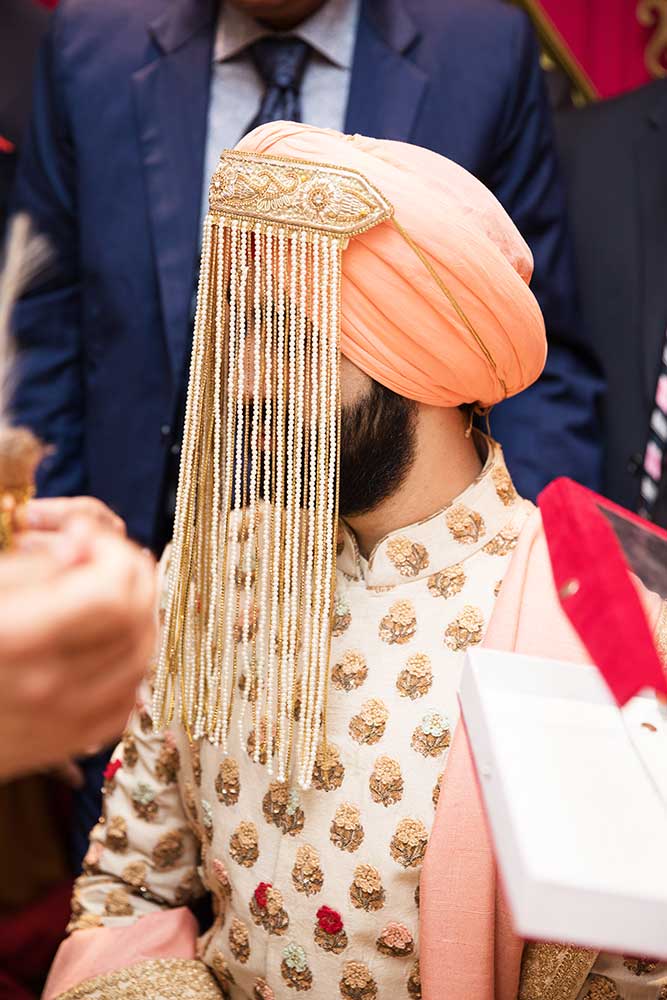
The sehra is a decorative forehead garland worn by the bridegroom during weddings across the Indian subcontinent. It serves as a veil that covers the groom's face and is attached to his headwear. The ritual of tying this garment holds deep familial significance in many communities.
When is Sehra kept?
Sehra is kept on just before the groom leaves for the bride's house.
A sehra is a traditional veil worn by grooms in South Asian weddings. Made from flowers or beads, it hangs over the forehead and attaches to the turban. This adornment marks the transition from the groom's home to the wedding venue. Family members tie it on while singing songs, symbolizing protection and blessing for the couple.
What the sehra is
This item is a decorative garland placed on the groom's head. It functions as a veil that partially obscures the face. Crafters use fresh flowers or small beads to create these strands. The ends are secured to the groom's turban or pagdi. Variations exist across different languages and regions. In Hindi, it is called sehra. Gujarati speakers refer to it as sehro. Rajasthani traditions name it sevrau. Marathi communities call it mundavalya. Sindhi people use the term morrah. Telugu speakers know it as basikam. Each version serves the same protective purpose.
Origins and history
The term comes from the Sanskrit word shirshahara. This translates directly to a garland for the head. Ancient texts reference this concept of head decoration. Specific mentions appear in Braj poetry by the saint Suradasa. His verses highlight the cultural importance of such adornments. Over centuries, the practice evolved into a specific wedding ritual. The physical object remains consistent with its ancient roots. Families continue to value the historical continuity of this tradition.
How the ritual works
The tying ceremony is known as sehra bandi. This happens right before the groom departs for the bride's residence. Female relatives perform this duty. Sisters, cousins, and sisters-in-law take turns. The order follows family hierarchy. The mother starts, followed by older sisters. Younger relatives then complete the sequence. As they work, women sing traditional wedding songs. This musical accompaniment adds joy to the moment. The act binds the family together in support of the marriage.
Regional variations
While common in India, the custom appears elsewhere. Caribbean Hindu communities also observe this practice. Grooms there wear the sehra during their ceremonies. The core elements remain similar to South Asian traditions. Local adaptations may influence materials used. However, the symbolic meaning stays intact. The veil continues to represent familial blessing. Communities maintain this link to their heritage through the ritual.
How Sehra is kept
Female relatives gather around the groom. They take turns attaching the flower or bead garland to his turban. The mother usually begins the process. Older sisters follow, then younger ones. Sisters-in-law join later in the sequence. Everyone sings traditional songs during the tying. The groom stands still while this occurs. The ritual happens just before he leaves for the wedding site. This ensures he carries family blessings into the ceremony.
When and where
It takes place before the main ceremony. Specifically, it occurs when the groom prepares to leave his home. The timing marks the start of his journey to the bride's house. No specific calendar date applies. The event depends on the wedding schedule.
The custom originates in the Indian subcontinent. It is widely practiced across India. Different regions use local names for the item. The tradition has spread to Caribbean Hindu communities. These groups maintain the practice despite geographical distance.
What Sehra means
The sehra protects the groom from evil eyes. It shields him during the transition between homes. The veil represents the family's collective wish for his safety. Singing during the tying invokes divine blessings. The hierarchical order of relatives shows respect for elders. The act strengthens bonds between siblings and in-laws.
Who takes part
- Groom's mother: Starts the tying ritual first
- Sisters: Take turns attaching the garland after the mother
- Sisters-in-law: Participate later in the sequence
- Female cousins: Join the group performing the ritual
- Wedding singers: Perform traditional songs during the tying
If you are a guest
Guests watch the sehra bandi ceremony quietly. They do not participate in the tying. Observers appreciate the family hierarchy displayed. The singing provides entertainment for attendees. Guests witness the emotional connection between relatives. The moment highlights the support network surrounding the groom.
Then and now
The practice remains strong in traditional families. Some modern couples simplify the ritual. Urban settings may shorten the song list. However, the core act of tying persists. Diaspora communities keep the tradition alive. The custom adapts slightly but retains its essence.
Questions people ask about Sehra
When is Sehra kept?
Sehra is kept on just before the groom leaves for the bride's house.
What is a sehra?
It is a decorative veil made of flowers or beads. The groom wears it on his forehead. It attaches to his turban. This item is part of South Asian wedding attire.
Who ties the sehra?
Female relatives perform this task. The mother usually starts. Sisters and cousins follow in order. Sisters-in-law join later. They sing songs while doing so.
Is the sehra only for grooms?
Traditionally, yes. It is a groom's accessory. Some modern variations might differ. The sources describe it as a male adornment.
See also
 SvayamvaraA ceremony where a bride selects her husband from assembled suitors or through a public contest.
 MayianThe turmeric paste ceremony held the day before Punjabi weddings in India and Pakistan.
 Odia Hindu weddingThe traditional Hindu marriage ceremony of the Odia people in Odisha, India.
Good reading and sources
The facts on this page come from the Wikipedia article "Sehra (headdress)", written by its contributors and used under the CC BY-SA 4.0 licence, and from its Wikidata record (CC0). EveryShaadi rewrote the text in its own words, with AI assistance, and compares every page with the article to make sure no passage is copied. It may be reused under the same CC BY-SA 4.0 licence with a link back.
It may contain mistakes. Wedding customs differ from one family, village and community to the next, and the people who keep them know them best. If something is wrong, tell us. Last refreshed 2026-10-05.
More from India
All the traditions of India 🇮🇳 Kanchipuram, IndiaKanchipuram silk sari
The heavy silk bridal garment woven in Kanchipuram with contrasting borders and gold zari.Attire · The ceremony
🇮🇳 Kanchipuram, IndiaKanchipuram silk sari
The heavy silk bridal garment woven in Kanchipuram with contrasting borders and gold zari.Attire · The ceremony
 🇮🇳 Bhuj, India and 1 moreBandhani
A traditional Indian tie-dye method that creates intricate dot patterns by binding small sections of cloth before dyeingAttire · Engagement and betrothal
🇮🇳 IndiaMadisarமடிசார் (Madisar)
The nine-yard sari drape worn by Tamil Brahmin women during weddings and religious rites.Attire · The ceremony
🇮🇳 Kochi, IndiaKasavuകസാവ്
The white cotton and gold border attire worn by Malayalis for weddings and festivals.Attire · The weeks before
🇮🇳 Bhuj, India and 1 moreBandhani
A traditional Indian tie-dye method that creates intricate dot patterns by binding small sections of cloth before dyeingAttire · Engagement and betrothal
🇮🇳 IndiaMadisarமடிசார் (Madisar)
The nine-yard sari drape worn by Tamil Brahmin women during weddings and religious rites.Attire · The ceremony
🇮🇳 Kochi, IndiaKasavuകസാവ്
The white cotton and gold border attire worn by Malayalis for weddings and festivals.Attire · The weeks before
The same idea elsewhere
The wedding dress and what the couple wear compared 🇳🇬 Iseyin, Nigeria and 2 moreAso okeAṣọ òkè
Hand-woven cloth worn by the Yoruba for weddings and formal gatheringsAttire · The ceremony
🇳🇬 Iseyin, Nigeria and 2 moreAso okeAṣọ òkè
Hand-woven cloth worn by the Yoruba for weddings and formal gatheringsAttire · The ceremony
 🇲🇽 Oaxaca, Mexico and 1 moreHuipilhuīpīlli
The traditional tunic worn by indigenous women in Mexico and Central America for weddings and daily life.Attire · The weeks before
🇲🇽 Oaxaca, Mexico and 1 moreHuipilhuīpīlli
The traditional tunic worn by indigenous women in Mexico and Central America for weddings and daily life.Attire · The weeks before
 🇬🇭 Ghana and 2 moreKente clothnwentoma
Hand-woven silk and cotton strips from Ghana that mark weddings and graduationsAttire · The ceremony
🇬🇭 Ghana and 2 moreKente clothnwentoma
Hand-woven silk and cotton strips from Ghana that mark weddings and graduationsAttire · The ceremony
 🇮🇩 Palembang, Indonesia and 2 moreSongketᬲᭀᬂᬓᬾᬢ᭄
A hand-woven brocade cloth patterned with gold or silver threads for traditional weddings in Southeast Asia.Attire · Engagement and betrothal
🇮🇩 Palembang, Indonesia and 2 moreSongketᬲᭀᬂᬓᬾᬢ᭄
A hand-woven brocade cloth patterned with gold or silver threads for traditional weddings in Southeast Asia.Attire · Engagement and betrothal