Procession and arrival
The groom's baraat, the bridal escort, the blocked gate and the arrival at the venue.
The procession is the journey. The groom rides to the bride's house, the bride is escorted to the ceremony, or the whole village walks together. It is loud, public and festive, and often includes a mock challenge at the door.
The groom arrives
The Indian baraat brings the groom, often on a decorated mare, with dancers and a band, to the bride's family, who greet him at the milni. In Nigeria and Ghana the groom's family makes a formal entry. In Pakistan the barat arrives from the groom's side. In Mongolia and Kazakhstan the groom travels with his family to the bride's home, and in Greece the groom's party arrives with music and the bride's family offers a toast.
The bride is escorted
In Western weddings the bride travels in a car or carriage to the church and then walks the aisle, often with her father. In Egypt and Lebanon a zaffe leads the couple. In Morocco the bride is carried in the amariya on a platform. In parts of China the bride was historically carried in a red sedan chair and is now brought in a decorated car, and in Japan she may walk in a procession of priests and family to the shrine, under a red umbrella.
The blocked gate
At many weddings the door is blocked until a payment or a task is completed: the groom's friends in China and Korea, in India the sisters of the bride, and in Scotland children who tie a ribbon across the church gate for a coin. The point is play and welcome, and a way for the two sides to test one another.
Written by the EveryShaadi desk with AI assistance. Background on Procession and arrival (stage of the wedding). Customs differ from place to place and family to family. If this is your tradition and we have it wrong, tell us.
 🇺🇦 Ukraine and 2 moreRushnykрушник (Ukrainian), ручнік (Belarusian), ручник/рушник (Russian)
The embroidered linen cloth that marks life stages and guides the couple through the wedding ceremony in East Slavic culAdornment · The weeks before
🇺🇦 Ukraine and 2 moreRushnykрушник (Ukrainian), ручнік (Belarusian), ручник/рушник (Russian)
The embroidered linen cloth that marks life stages and guides the couple through the wedding ceremony in East Slavic culAdornment · The weeks before
 🇩🇪 Hamburg, Germany and 3 moreWimpelווימפל
A linen sash made from a baby boy's circumcision cloth that binds the Torah scroll.Adornment · The weeks before
🇩🇪 Hamburg, Germany and 3 moreWimpelווימפל
A linen sash made from a baby boy's circumcision cloth that binds the Torah scroll.Adornment · The weeks before
 🇮🇳 IndiaGana
A sacred red thread tied to wrists for protection during wedding rituals in parts of India.Adornment · The weeks before
🇮🇳 IndiaGana
A sacred red thread tied to wrists for protection during wedding rituals in parts of India.Adornment · The weeks before
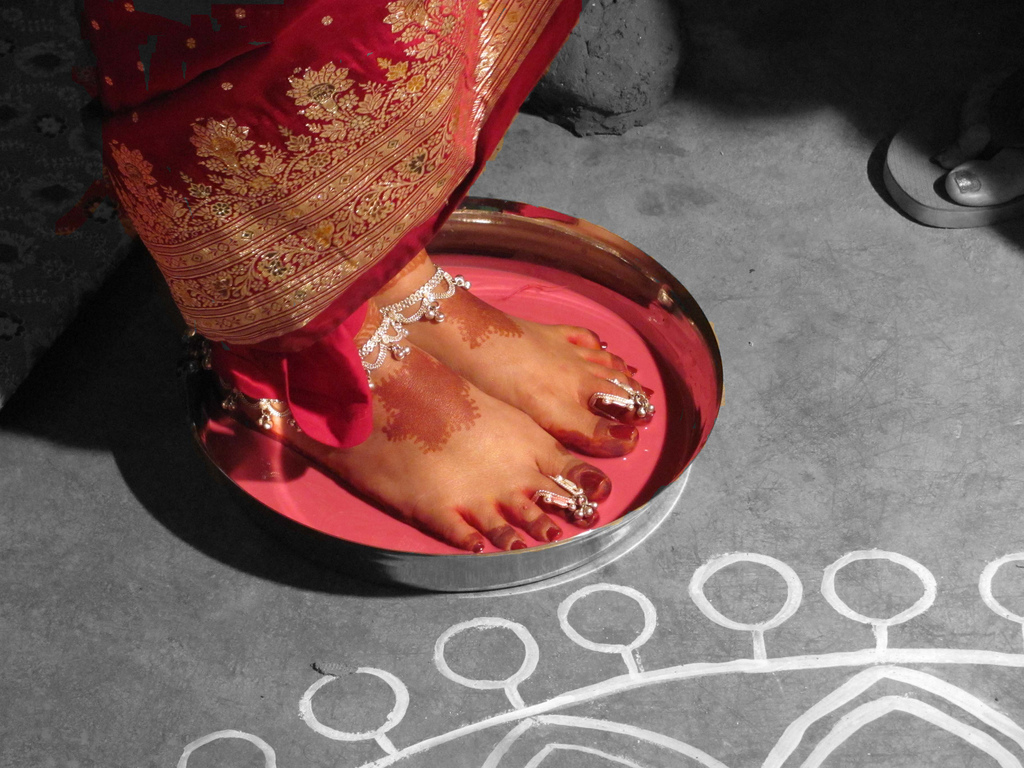 🇮🇳 India and 2 moreAltaআলতা (Bengali)
A red dye applied to hands and feet as an auspicious adornment in South Asian weddings and festivals.Adornment · The weeks before
🇮🇳 India and 2 moreAltaআলতা (Bengali)
A red dye applied to hands and feet as an auspicious adornment in South Asian weddings and festivals.Adornment · The weeks before
Photo credits on this page
The small pictures above come from Wikimedia Commons under free licences. Some are cropped to fit.
- Gana: William J Sisti, CC BY-SA 2.0, source
- Rushnyk: Pavlo Boyko, CC BY-SA 2.0, source
- Wimpel: Wikipedia Loves Art participant " The_Grotto ", CC BY-SA 2.5, source
- Alta: Shounak Ray, CC BY-SA 2.0, source