Blessings, luck and omensSouth AsiaHindu
Vadhu Pravesha
In its own language: Bou Boron
The ritual welcoming the bride into her husband's home with blessings and symbolic acts.
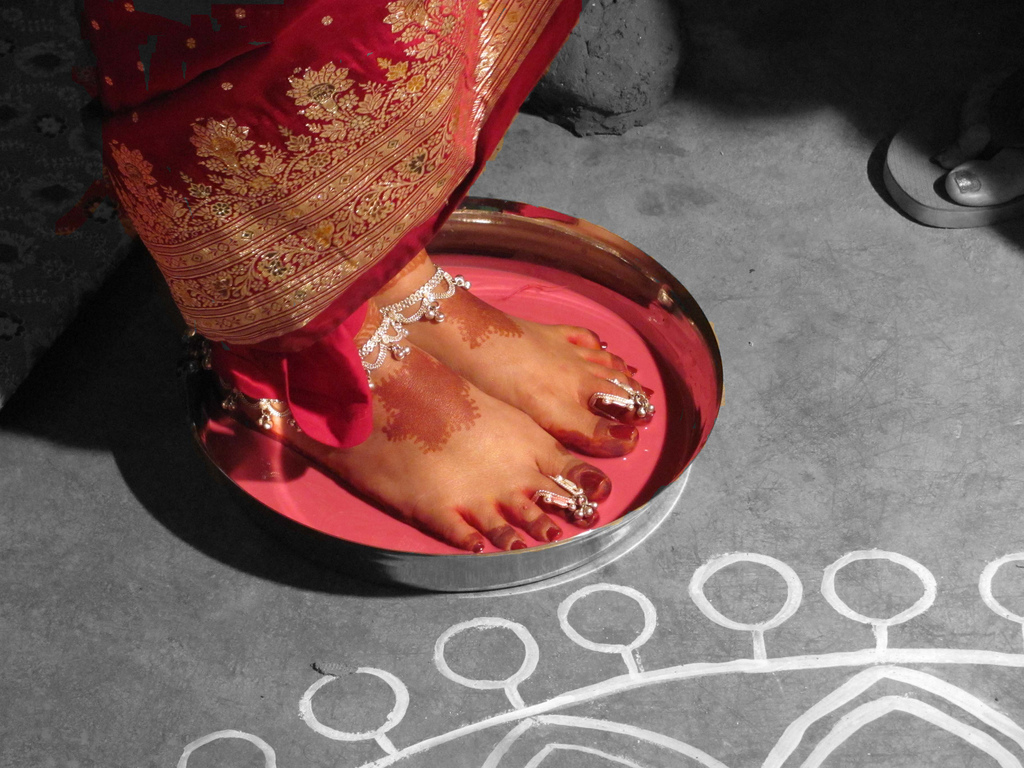
This Hindu ceremony marks the moment a bride enters her new family's residence in India. The event blends ancient customs with regional Bengali practices to ensure prosperity and divine favor for the couple as they begin their life together.
When is Vadhu Pravesha kept?
Vadhu Pravesha is kept on upon arrival at the groom's house.
Vadhu Pravesha is a traditional Hindu rite that welcomes a bride into her new marital home. It serves as a formal introduction to the husband's household, combining historical symbolism with specific regional customs to bless the union and ensure future prosperity for the couple.
Historical origins
Ancient texts describe a scenario where a wife was symbolically transported to her new home by chariot alongside her husband. During this journey, he would request that she bear him sons and devote herself to caring for his parents and managing his property. This early depiction highlights the traditional expectations placed upon women within the marital structure of that era.
Bengali traditions
In Bengali culture, the ceremony involves specific actions performed by female relatives. Women pour water on the ground beneath the vehicle before the bride steps out. She then stands on a wooden square platform while elders spread Durba grass on her forehead as a blessing. A pot filled with rice is positioned near her feet, which she gently kicks to symbolize a wish for abundant wealth.
Symbolic objects
Various items play crucial roles in the ritual. A plate containing lac and milk is often held by the groom's elder brother's wife. The bride places her feet on a dish of alta, a red cosmetic dye, leaving an imprint on the soles. These objects represent fertility, prosperity, and the marking of her new status within the household community.
How Vadhu Pravesha is kept
Female relatives pour water on the ground before the bride alights from her transport. She stands on a wooden square structure while elders place Durba grass on her forehead. A pot of rice sits near her feet, which she kicks to signify abundance. Another relative holds a plate with lac and milk. Finally, she steps onto a plate of alta dye, marking her soles, before entering the house to receive blessings from elders.
When and where
The ritual occurs immediately after the wedding ceremony, specifically when the couple arrives at the groom's residence. It marks the transition from the wedding venue to the new home.
This custom is practiced in India, particularly within Bengali Hindu communities. It takes place at the entrance or threshold of the groom's family home.
What Vadhu Pravesha means
The kicking of the rice pot represents a desire for material abundance and prosperity. The application of alta leaves a permanent mark of the bride's presence and new role. Pouring water signifies purification, while the Durba grass offers spiritual protection and good fortune for the marriage.
Who takes part
- The bride: Stands on a wooden platform, kicks a rice pot, and imprints her feet in dye.
- Female relatives: Pour water on the ground and hold plates of ritual items.
- Elders: Apply grass to the bride's forehead and offer final blessings.
On the wedding table
Symbols: Rice and grain Water and washing
Questions people ask about Vadhu Pravesha
When is Vadhu Pravesha kept?
Vadhu Pravesha is kept on upon arrival at the groom's house.
What is Vadhu Pravesha?
It is a Hindu ritual that welcomes a bride into her husband's home. It involves specific symbolic actions like kicking a rice pot and applying dye to her feet to ensure prosperity and mark her new status.
Why is rice kicked?
Kicking the pot of rice symbolizes the wish for abundant wealth and prosperity in the new home. It reflects a belief that the family will have more than enough resources.
See also
Good reading and sources
The facts on this page come from the Wikipedia article "Vadhu Pravesha", written by its contributors and used under the CC BY-SA 4.0 licence, and from its Wikidata record (CC0). EveryShaadi rewrote the text in its own words, with AI assistance, and compares every page with the article to make sure no passage is copied. It may be reused under the same CC BY-SA 4.0 licence with a link back.
It may contain mistakes. Wedding customs differ from one family, village and community to the next, and the people who keep them know them best. If something is wrong, tell us. Last refreshed 2026-10-05.
More from India
All the traditions of IndiaThe same idea elsewhere
Parents, giving away and the in-laws compared 🇨🇱 Santiago, Chile and 3 moreCueca
A courtship dance from Chile and the Andes where couples trace circles with handkerchiefs to reenact a rooster and hen.Performance · The eve
🇨🇱 Santiago, Chile and 3 moreCueca
A courtship dance from Chile and the Andes where couples trace circles with handkerchiefs to reenact a rooster and hen.Performance · The eve
 🇩🇪 Hamburg, Germany and 3 moreWimpelווימפל
A linen sash made from a baby boy's circumcision cloth that binds the Torah scroll.Adornment · The weeks before
🇩🇪 Hamburg, Germany and 3 moreWimpelווימפל
A linen sash made from a baby boy's circumcision cloth that binds the Torah scroll.Adornment · The weeks before
 🇳🇪 In-Gall, Niger and 2 moreGuérewol
A week-long courtship dance where Wodaabe men display their beauty to win the attention of marriageable women.Rite · The weeks before
🇳🇪 In-Gall, Niger and 2 moreGuérewol
A week-long courtship dance where Wodaabe men display their beauty to win the attention of marriageable women.Rite · The weeks before
 🇱🇦 Laos and 1 moreBaciບາສີ (Lao); บายศรี (Thai)
The wrist-tying ceremony that calls the soul back to restore balance and good luck.Blessing · The ceremony
🇱🇦 Laos and 1 moreBaciບາສີ (Lao); บายศรี (Thai)
The wrist-tying ceremony that calls the soul back to restore balance and good luck.Blessing · The ceremony