Games, humour and mock resistanceEurope
Garter toss
The groom removes the bride's garter and throws it to unmarried men at the reception.

A Western wedding custom where the groom takes off a special garter worn by the bride during the reception. He then tosses it to the single male guests, mirroring the bouquet throw for women. The catcher is believed to be next in line to marry.
When is Garter toss kept?
Garter toss is kept at the end of the wedding reception.
This tradition involves the groom removing a decorative garter from the bride's leg during the wedding reception. He then throws it into a crowd of unmarried male guests. The man who catches it is thought to be the next person to find love and get married. It serves as a playful counterpart to the bride tossing her bouquet.
Origins and history
The practice likely began in the Middle Ages when wedding guests would rush the couple to take pieces of their clothing as lucky charms. Over time, this chaotic behavior was replaced by a more structured ritual. By the modern era, the removal of the garter became a specific duty of the groom. The act symbolizes intimacy and good fortune for those who participate in the catch.
How the ritual works
The bride wears a special garter that is not needed for holding up stockings. After the main meal and dances, the groom removes this item. He stands near the unmarried men and throws the garter over his shoulder or toward the group. The first man to grab it wins the prize. This usually happens right after the bride throws her flowers to the single women.
Meaning and superstition
Some believe the garter represents the loss of virginity, though most view it as a fun game today. The core belief is luck. Catching the garter suggests that the man will be the next among his friends to wed. It does not mean he will marry the woman who caught the bouquet. The two events are separate but linked by the theme of future marriage.
How Garter toss is kept
The bride wears a dedicated garter on her leg. During the reception, the groom removes it. He then tosses it to the unmarried men gathered nearby. The man who catches it is declared the next to marry. This occurs after the bouquet toss.
When and where
It takes place late in the wedding reception. It follows the bouquet toss and precedes other closing rituals. The timing allows all unmarried guests to gather for the event.
Common in Western weddings. It is found in countries like France and the United Kingdom. The setting is typically the reception hall or banquet room.
What Garter toss means
The garter acts as a token of good luck. Catching it predicts that the holder will marry soon. It also marks a moment of shared joy and anticipation among the younger guests. The removal itself is a private act made public for entertainment.
Who takes part
- The bride: Wears a special garter on her leg
- The groom: Removes the garter and throws it
- Unmarried men: Gather to catch the thrown garter
If you are a guest
Unmarried men should stand ready to catch the garter. They do not need to bring anything. The goal is to be the first to grab the item. Success brings a claim to being the next to marry.
Then and now
The custom remains popular in many Western cultures. Some couples skip it for privacy or comfort. Others adapt it to include same-sex partners or mixed groups. The focus has shifted from superstition to lighthearted fun.


Questions people ask about Garter toss
When is Garter toss kept?
Garter toss is kept at the end of the wedding reception.
What is the garter toss?
It is a wedding reception game where the groom removes a garter from the bride and throws it to unmarried men. The catcher is believed to be next to marry.
Is it legal?
Yes, it is a social custom with no legal restrictions. It is a voluntary part of the celebration.
See also
 PolonaiseA Polish partner dance in triple metre that opens weddings and formal celebrations with measured steps.Gift registryA public wish list managed by retailers to coordinate wedding gifts and prevent duplicates.
 Gimmal ringA split band of two or three hoops that join to form a single wedding ring.
Good reading and sources
- Garter on WikipediaEncyclopedia
- More photos on Wikimedia CommonsPhotos and video
- Wikidata recordOpen data
The facts on this page come from the Wikipedia article "Garter", written by its contributors and used under the CC BY-SA 4.0 licence, and from its Wikidata record (CC0). EveryShaadi rewrote the text in its own words, with AI assistance, and compares every page with the article to make sure no passage is copied. It may be reused under the same CC BY-SA 4.0 licence with a link back.
It may contain mistakes. Wedding customs differ from one family, village and community to the next, and the people who keep them know them best. If something is wrong, tell us. Last refreshed 2026-11-08.
More from France
All the traditions of France
🇵🇱 Krakow, Poland and 4 morePolonaisePolonez, chodzony
A Polish partner dance in triple metre that opens weddings and formal celebrations with measured steps.Performance · Reception, dance and gifts
 🇺🇸 United States and 5 moreBridesmaid
A female attendant who supports the bride during a Western wedding ceremony.Family role · Engagement and betrothal
 🇷🇺 Russia and 2 moreLoving cup
A two-handled vessel shared by the couple to seal their union at a wedding feast.Feast custom · The wedding feast
 🇫🇷 France and 1 moreAcrostic ring
A gemstone band where the initials spell a romantic word like dearest or loveAdornment · Engagement and betrothal
The same idea elsewhere
Rings, knots and tokens of promise compared 🇳🇬 NigeriaYoruba traditional weddingIgbeyawo
The multi-day Yoruba celebration of marriage featuring traditional attire, gift lists, and lively dancing.Feast custom · Engagement and betrothal
 🇮🇱 Jerusalem, Israel and 3 moreJewish wedding
The ceremony and laws that bind a couple in Jewish marriage, from the canopy to the glass.Rite · Engagement and betrothal
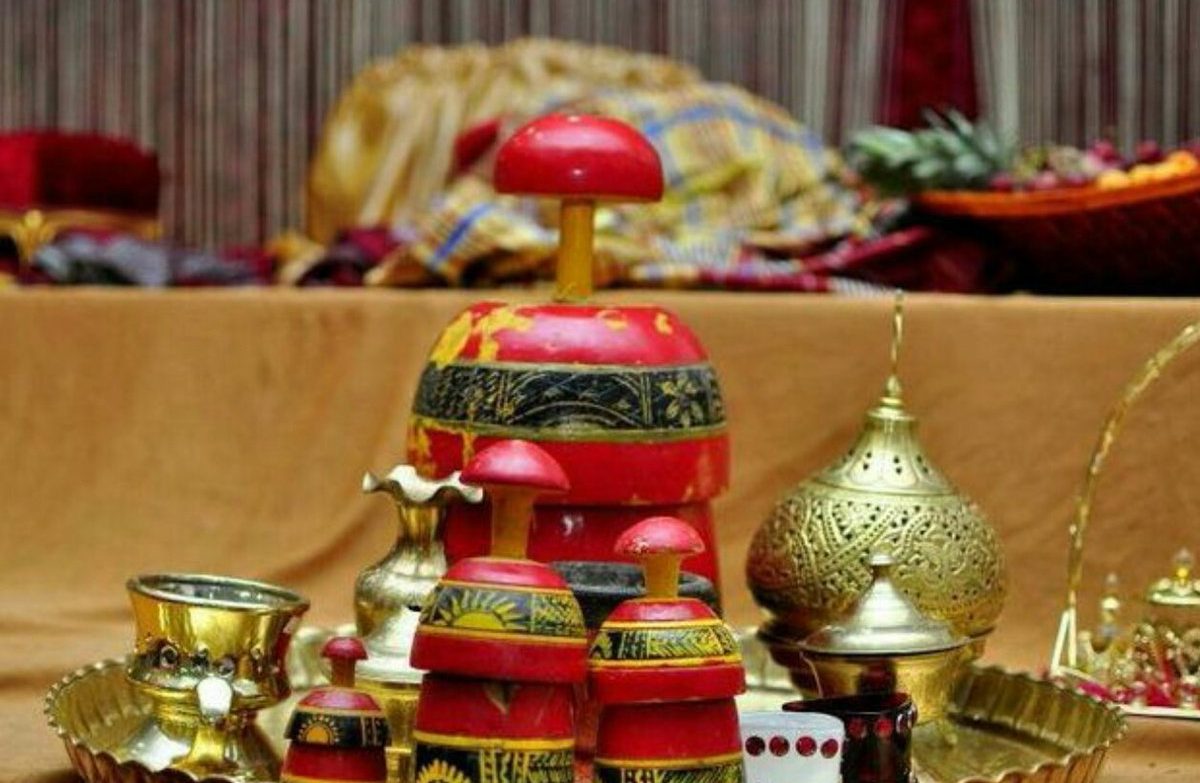 🇸🇩 SudanJirtigالجَرْتِقْ
A Sudanese rite where the groom is symbolically crowned as king before the wedding procession.Rite · The weeks before
 🇮🇳 IndiaChaklong
The traditional Ahom marriage system from Assam involving clan rules and specific ritual exchanges.Rite · Finding a match