Wedding dress and clothingEast AsiaSecular and civil
Qungua
In its own language: 裙褂
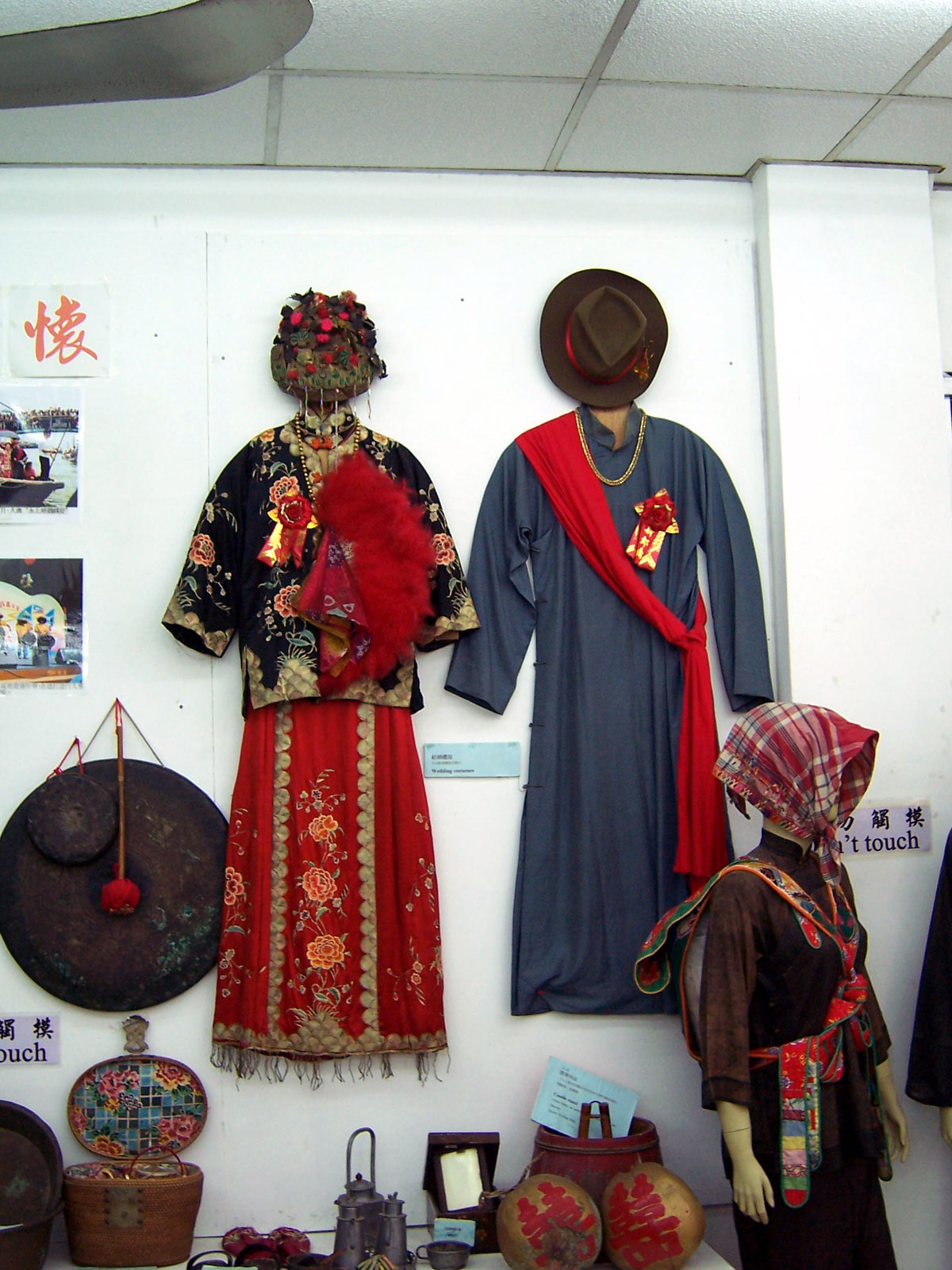
A two-piece embroidered jacket and skirt worn by Cantonese brides for their wedding ceremony.

The qungua is a traditional Han Chinese wedding outfit consisting of a jacket and a long skirt. It originated in the Guangdong region during the Qing dynasty and became the standard attire for Cantonese brides. The garment is valued for its intricate hand embroidery featuring dragons and phoenixes.
When is Qungua kept?
Qungua is kept during the wedding ceremony.
Brides in southern China wear the qungua to mark their marriage. This two-piece ensemble includes a buttoned jacket and a straight skirt. The outfit displays detailed embroidery that symbolizes good fortune and union. Families often prepare these garments as part of a daughter's dowry before her wedding day.
Origins and history
The custom began in the eighteenth century within the Guangdong province. A local official named Liang Zhu received an embroidered silk outfit from the emperor for his daughter's wedding. This royal gift inspired local families to adopt similar attire. Before this period, nobles wore fengguan xiapei sets. The qungua replaced those earlier styles as the preferred choice for commoners and elites alike in the region.
Construction and design
The outfit consists of two distinct parts: a gua jacket and a qun skirt. The jacket closes at the front with buttons. The skirt features a straight cut and may include pleats. Traditional construction involves hand-sewing every detail. Mothers often begin stitching the garment when their daughters are born. This practice ensures the dress is ready for the bride decades later.
Embroidery and symbols
Designs typically feature dragons and phoenixes to represent harmony. Other motifs include pomegranates for fertility, peonies, lotuses, bats, and goldfish. The density of the embroidery determines the specific type of qungua. Categories range from thirty percent coverage to one hundred percent full embroidery. Higher coverage indicates greater value and effort invested in the creation.
Colors and variations
Historically, the jacket was black and the skirt was red. Modern versions often use entirely red fabric for both pieces. This shift occurred in the nineteen sixties. Today, the original black and red combination is reserved for the bride's mother. The bride wears the fully red or gold-embroidered version. These colors contrast with Western white wedding dresses.
How Qungua is kept
The bride wears the qungua during the main wedding ceremony. The outfit comprises a fitted jacket and a long skirt. Family members, usually the mother, may have handmade the garment years in advance. The bride pairs it with traditional hair accessories. Guests admire the detailed threadwork that covers the fabric. The ensemble remains a central visual element of Cantonese weddings.
When and where
It is worn on the wedding day itself. The date depends on the couple's schedule and auspicious calendar selections. The garment is not used for engagement parties or post-wedding events.
The practice is strongest in Guangdong province and its surrounding areas. It is also common in Hong Kong and Macau. These regions maintain the tradition among Han Chinese communities.
What Qungua means
Dragons and phoenixes symbolize balance and marital harmony. Pomegranates represent fertility and many children. Goldfish signify abundance. The extensive embroidery reflects the family's dedication and the bride's worth. The garment serves as a tangible link between generations.
Who takes part
- The bride: Wears the two-piece outfit during the ceremony
- The mother: Often sews the garment or wears the traditional black and red version
- The embroiderer: Creates the intricate dragon and phoenix designs by hand
If you are a guest
Guests observe the bride wearing the elaborate red and gold attire. They admire the craftsmanship of the embroidery. No specific gifts or actions are required regarding the dress itself. Guests simply witness the traditional presentation.
Then and now
The qungua remains popular in southern China. Many couples choose it over Western gowns. Some modern adaptations simplify the embroidery or adjust the fit. However, the core two-piece structure and symbolic motifs persist unchanged.
On the wedding table
Symbols: The colour red Gold and jewellery



Questions people ask about Qungua
When is Qungua kept?
Qungua is kept during the wedding ceremony.
What is a qungua?
It is a traditional two-piece Chinese wedding outfit. It includes a buttoned jacket and a long skirt. The garment is heavily embroidered with dragons and phoenixes.
Who makes the qungua?
Traditionally, mothers sew the dress by hand. They often start years before the wedding. It becomes part of the bride's dowry.
See also
 Traditional Chinese wedding dressThe wedding attire worn by Han Chinese couples, from the fengguan xiapei to the qungua
 Fengguan xiapeiThe traditional Han Chinese wedding ensemble of a phoenix crown and embroidered robes worn by brides in the Ming and QinXiuhefuA modern two-piece Chinese bridal outfit inspired by Qing dynasty styles and popularized by a 2001 television drama.
 Bridal bouquetThe handheld flower arrangement carried by the bride during her wedding ceremony.
Good reading and sources
The facts on this page come from the Wikipedia article "Qungua", written by its contributors and used under the CC BY-SA 4.0 licence, and from its Wikidata record (CC0). EveryShaadi rewrote the text in its own words, with AI assistance, and compares every page with the article to make sure no passage is copied. It may be reused under the same CC BY-SA 4.0 licence with a link back.
It may contain mistakes. Wedding customs differ from one family, village and community to the next, and the people who keep them know them best. If something is wrong, tell us. Last refreshed 2026-10-05.
More from China
All the traditions of China
🇨🇳 ChinaFengguan xiapei凤冠霞帔
The traditional Han Chinese wedding ensemble of a phoenix crown and embroidered robes worn by brides in the Ming and QinAttire · The ceremony
🇨🇳 ChinaXiuhefu秀禾服
A modern two-piece Chinese bridal outfit inspired by Qing dynasty styles and popularized by a 2001 television drama.Attire · The ceremony
🇬🇧 United Kingdom and 3 moreBridal bouquet
The handheld flower arrangement carried by the bride during her wedding ceremony.Attire · The ceremony
🇨🇳 China and 1 moreTraditional Chinese wedding dress
The wedding attire worn by Han Chinese couples, from the fengguan xiapei to the qunguaAttire · The ceremony
The same idea elsewhere
The wedding dress and what the couple wear compared 🇼🇸 Samoa and 3 moreʻIe tōga
Prestige woven mats exchanged at Samoan weddings to honor family ties and chiefly status.Attire · The ceremony
🇼🇸 Samoa and 3 moreʻIe tōga
Prestige woven mats exchanged at Samoan weddings to honor family ties and chiefly status.Attire · The ceremony
 🇲🇱 MaliWeddings in Mali
Multi-day Malian wedding traditions blending Islamic rites, civil law, and local customs with bazin attire.Rite · Engagement and betrothal
🇲🇱 MaliWeddings in Mali
Multi-day Malian wedding traditions blending Islamic rites, civil law, and local customs with bazin attire.Rite · Engagement and betrothal
 🇳🇬 Lagos, Nigeria and 3 moreAso ebiAsọ-Ẹbí
Matching outfits worn by groups to show solidarity at Yoruba weddings and other ceremoniesAttire · The weeks before
🇳🇬 Lagos, Nigeria and 3 moreAso ebiAsọ-Ẹbí
Matching outfits worn by groups to show solidarity at Yoruba weddings and other ceremoniesAttire · The weeks before
 🇳🇬 NigeriaYoruba traditional weddingIgbeyawo
The multi-day Yoruba marriage ceremony featuring traditional attire, family introductions, and the Eru Iyawo gift list.Attire · Engagement and betrothal
🇳🇬 NigeriaYoruba traditional weddingIgbeyawo
The multi-day Yoruba marriage ceremony featuring traditional attire, family introductions, and the Eru Iyawo gift list.Attire · Engagement and betrothal