Feasts, food and drinkSouth AsiaHindu
Golu
In its own language: Bommai kolu (Tamil), Bommala Koluvu (Telugu), Gombe Habba (Kannada)
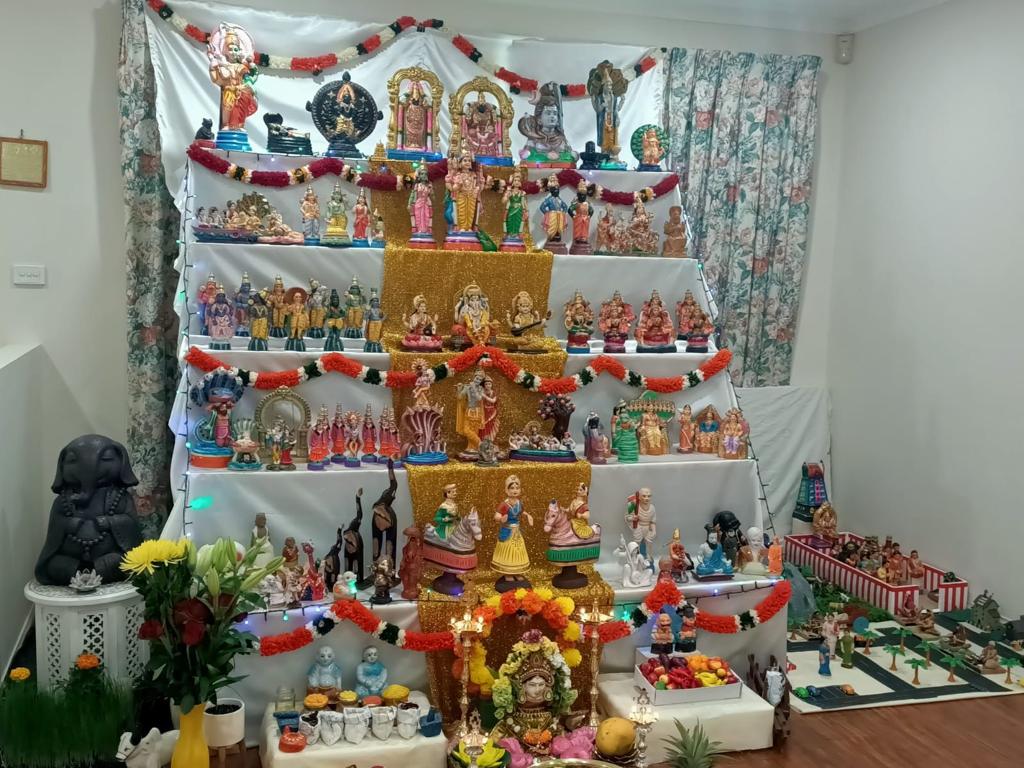
A tiered display of dolls and figurines arranged in South Indian homes during the Navaratri festival.

Golu is a festive doll display kept by Hindu families across Tamil Nadu, Andhra Pradesh, Karnataka, and parts of Kerala. It takes place during the autumn Navaratri season, where households arrange themed figurines on stepped racks to tell stories from mythology and daily life.
When is Golu kept?
Golu is kept during the nine nights of Navaratri in the autumn.
Families in South India set up elaborate shelves of dolls and figurines to celebrate the arrival of the goddesses during Navaratri. This tradition turns homes into miniature worlds of myth and daily life. Guests visit to share sweets and blessings, strengthening community bonds through shared storytelling and visual artistry.
Origins and history
The custom likely began in the courts of the Vijayanagara empire and later Nayak states. Royal celebrations called Mahanavami featured grand displays that influenced household practices in the southern Deccan. By the late nineteenth century, the practice spread beyond royal circles to the urban bourgeoisie in Madras. It was adopted by upper-caste Hindu families and gradually diffused to broader social groups. Today, major temples like the Meenakshi Temple in Madurai host public displays, while artisans in places like Kondapalli and Channapatna continue to craft the wooden figures.
How it is kept
Families build a rack of odd-numbered steps, usually three, five, or seven. They cover the wooden planks with fabric and arrange dolls according to size, placing deities at the top. The display often includes scenes from Hindu epics, court processions, and everyday domestic life. A key feature is the Marapacchi Bommai, a pair of bride and groom dolls made of sandalwood or teak. These are given to brides as part of their wedding trousseau to start their own collection. Visitors light lamps, chant hymns, and offer food to the goddesses before sharing sweets with guests.
Dress and objects
The dolls are typically made from clay, wood, or paper mache. Artisans paint them brightly and dress them in miniature clothing. The Marapacchi dolls symbolize prosperity and fertility, representing the union of husband and wife. Families often wear new clothes during the visits. The steps are decorated with rangoli patterns made from colored powders or rice flour. Lamps are lit in the center of these designs to create a warm atmosphere for the evening gatherings.
Meaning and significance
The display serves as a votive offering to the goddesses Durga, Lakshmi, and Saraswati. It represents a miniature reproduction of the world and its consecration to the divine. The tradition promotes social bonding as neighbors and relatives visit each other to view the displays. It also supports local artisans and preserves traditional crafts like pottery and woodworking. For many, it marks a new beginning and a time for seeking protection and blessings for the coming year.
How Golu is kept
Families construct stepped racks and arrange dolls in thematic groups. They begin with prayers to the goddesses and light lamps. Guests arrive to view the display, exchange gifts, and share festive foods. The ritual concludes on the tenth day when one doll is put to sleep and the setup is dismantled.
When and where
It occurs during the nine nights of Navaratri in the autumn. The display starts after Ganapati puja and ends on Vijayadashami.
It is strongest in Tamil Nadu, Andhra Pradesh, Karnataka, and parts of Kerala. Major temples in cities like Madurai and Thanjavur host large public exhibitions.
What Golu means
The dolls represent a microcosm of society and the divine. The bride and groom dolls specifically symbolize marital bliss, prosperity, and the continuation of family traditions. The arrangement reflects the order of the universe and the reverence for knowledge, wealth, and power.
Who takes part
- The bride: Receives the Marapacchi Bommai dolls as a gift from her parents to start her collection.
- Artisans: Crafts the wooden and clay figurines using traditional techniques passed down through generations.
- Family members: Arranges the dolls on the stepped racks and performs the daily prayers and lamp lighting.
- Guests: Visits homes to view the display, offers blessings, and shares sweets with the hosts.
If you are a guest
Guests visit the home to admire the doll arrangements. They bring gifts and sweets to share with the family. They participate in the chanting of hymns and accept prasad, which is food offered to the goddesses. The interaction strengthens social ties and community spirit.
Then and now
The practice has expanded from elite households to broader middle-class communities. Modern dolls now include pop culture characters and freedom fighters alongside traditional figures. Collapsible steps make the setup easier for urban apartments.
On the wedding table
- Sweets: Shared among visitors and offered to the goddesses as part of the ritual hospitality.
- Pongal: A savory dish prepared and offered to the deities during the festival days.
Symbols: Rice and grain The colour red Gold and jewellery Garlands and flowers Candles and lamps Water and washing



Questions people ask about Golu
When is Golu kept?
Golu is kept during the nine nights of Navaratri in the autumn.
What is Golu?
Golu is a festive display of dolls and figurines arranged on stepped racks in South Indian homes during the Navaratri festival. It features themes from mythology and daily life.
What do the bride and groom dolls represent?
The Marapacchi Bommai dolls symbolize marital bliss, prosperity, and fertility. They are given to brides to start their own annual display tradition.
Is it legal?
Yes, Golu is a cultural and religious tradition practiced openly by Hindu communities in India without any legal restrictions.
See also
 Aiburo BhaatThe final bachelor feast for the bride and groom before their Bengali weddingBou BhatA feast hosted by the groom's family to welcome the bride into her new home.UlulationA high-pitched trilling sound made by women to celebrate weddings and share good news across many cultures.MadisarThe nine-yard sari drape worn by Tamil Brahmin women during weddings and religious rites.
Good reading and sources
- Golu (festival) on WikipediaEncyclopedia
- More photos on Wikimedia CommonsPhotos and video
- Wikidata recordOpen data
The facts on this page come from the Wikipedia article "Golu (festival)", written by its contributors and used under the CC BY-SA 4.0 licence, and from its Wikidata record (CC0). EveryShaadi rewrote the text in its own words, with AI assistance, and compares every page with the article to make sure no passage is copied. It may be reused under the same CC BY-SA 4.0 licence with a link back.
It may contain mistakes. Wedding customs differ from one family, village and community to the next, and the people who keep them know them best. If something is wrong, tell us. Last refreshed 2026-10-05.
More from India
All the traditions of India
🇮🇳 India and 1 moreAiburo Bhaatআইবুড়ো ভাত
The final bachelor feast for the bride and groom before their Bengali weddingFeast custom · The weeks before
🇧🇩 Bangladesh and 1 moreBou Bhatবউ ভাত
A feast hosted by the groom's family to welcome the bride into her new home.Feast custom · After the wedding
🇮🇷 Shiraz, Iran and 5 moreUlulation
A high-pitched trilling sound made by women to celebrate weddings and share good news across many cultures.Performance · Procession and arrival
🇮🇳 IndiaMadisarமடிசார் (Madisar)
The nine-yard sari drape worn by Tamil Brahmin women during weddings and religious rites.Attire · The ceremony
The same idea elsewhere
The wedding dress and what the couple wear compared 🇮🇹 Rome, ItalyWeddings in ancient Rome
The religious ceremonies and attire that marked a union in the city of Rome before the rise of Christianity.Rite · The weeks before
🇮🇹 Rome, ItalyWeddings in ancient Rome
The religious ceremonies and attire that marked a union in the city of Rome before the rise of Christianity.Rite · The weeks before
 🇸🇿 Ludzidzini Royal Village, Eswatini and 1 moreUmhlanga
The annual Swazi and Zulu gathering where young women cut reeds to preserve chastity and offer tribute labour.Rite · The eve
🇺🇦 UkraineSong about the RushnykПісня про рушник (Pisnia pro rushnyk)
A Ukrainian song that celebrates the embroidered cloth used in weddings and family life.Performance · The ceremony
🇸🇿 Ludzidzini Royal Village, Eswatini and 1 moreUmhlanga
The annual Swazi and Zulu gathering where young women cut reeds to preserve chastity and offer tribute labour.Rite · The eve
🇺🇦 UkraineSong about the RushnykПісня про рушник (Pisnia pro rushnyk)
A Ukrainian song that celebrates the embroidered cloth used in weddings and family life.Performance · The ceremony
 🇲🇽 Oaxaca, Mexico and 1 moreHuipilhuīpīlli
The traditional tunic worn by indigenous women in Mexico and Central America for weddings and daily life.Attire · The weeks before
🇲🇽 Oaxaca, Mexico and 1 moreHuipilhuīpīlli
The traditional tunic worn by indigenous women in Mexico and Central America for weddings and daily life.Attire · The weeks before