Music, dance and processionEuropeSecular and civilIndigenous and traditional
Song about the Rushnyk
In its own language: Пісня про рушник (Pisnia pro rushnyk)
A Ukrainian song that celebrates the embroidered cloth used in weddings and family life.
This popular Ukrainian song tells of a mother giving her son an embroidered ritual cloth called a rushnyk. The cloth serves as a talisman throughout life and is central to handfasting and wedding blessings in Ukraine.
When is Song about the Rushnyk kept?
Song about the Rushnyk is kept at weddings and family gatherings.
The Song about the Rushnyk is a well-known Ukrainian musical piece centered on a traditional embroidered cloth. A mother gives this cloth to her child as a lifelong talisman. It appears at weddings during handfasting rituals and as a blessing for prosperity. The song highlights deep family bonds and cultural heritage through its lyrics and melody.
The embroidered cloth
The rushnyk is an embroidered ritual cloth that holds deep meaning for Ukrainians. It acts as a familial talisman throughout a person's life cycle. Families drape these cloths over religious icons and place them on ritual foods like bread. At weddings, the rushnyk is used for handfasting ceremonies. Couples may stand on or hold these cloths as they exchange vows. The cloth also serves as a symbol of prosperity and blessing for the new marriage.
Origins of the song
Andriy Malyshko wrote the original poem that inspired the song. Composer Platon Maiboroda set the words to music in 1958. He created the track for the soundtrack of the Soviet film Young Years. Oleksandr Taranets performed the song first in the movie. Dmytro Hnatyuk later popularized the track, becoming most associated with it. The song has since been covered by many singers across different languages.
Themes and meanings
The lyrics focus on motherly love and the bond between parent and child. The mother gives the rushnyk to her son as a protective gift. This act symbolizes care and guidance through life's challenges. The song is often titled Ballad to Mother to reflect this dedication. It resonates with families who value maternal support and tradition. The cloth represents continuity and protection within the family unit.
Global reach today
The song remains popular within Ukraine and among the Ukrainian diaspora. It has been translated into several languages including English and Polish. An English version appeared in the magazine Soviet Life. Ukrainian-Canadian groups have adopted the name Rushnychok. The track continues to be performed at cultural events and weddings worldwide.
How Song about the Rushnyk is kept
The rushnyk is prepared by embroidering traditional patterns onto linen or cotton. During the wedding ceremony, the couple stands on or holds the cloth while exchanging vows. Family members may drape additional cloths over icons or food tables. The song is played or sung during the reception or procession. Guests witness the ritual and celebrate the union under the blessing of the cloth.
When and where
The song was released in 1958 for a film soundtrack. The rushnyk custom is kept at weddings and during religious festivals. It appears throughout the life cycle of Ukrainian families.
The custom is strongest in Ukraine. It is also observed in Ukrainian communities abroad. The Poltava Region is noted as the composer's home.
What Song about the Rushnyk means
The rushnyk symbolizes protection, prosperity, and family unity. It connects the couple to their ancestors and faith. The embroidery patterns carry specific wishes for happiness. The cloth bridges the sacred and domestic spheres of life.
Who takes part
- the mother: gives the rushnyk to her child as a talisman
- the couple: stands on or holds the rushnyk during handfasting
- the composer: sets the poem to music for the film soundtrack
- the singer: performs the song at weddings and cultural events
If you are a guest
Guests may bring gifts of money or food placed on rushnyks. They watch the handfasting ritual with reverence. Some guests sing along to the song during the reception. They respect the sacred nature of the embroidered cloths.
Then and now
The song continues to be performed by modern artists. Ukrainian diaspora groups keep the tradition alive. The rushnyk remains a key element in contemporary Ukrainian weddings. Legal status is not contested as it is a cultural practice.
On the wedding table
- ritual foods: placed on rushnyks during weddings and festivals
- bread: draped with cloths as a symbol of prosperity
Symbols: The ring The veil Garlands and flowers The colour red The colour white Gold and jewellery Bread Water and washing Money and envelopes
Questions people ask about Song about the Rushnyk
When is Song about the Rushnyk kept?
Song about the Rushnyk is kept at weddings and family gatherings.
What is the Song about the Rushnyk?
It is a Ukrainian song from 1958 based on a poem by Andriy Malyshko. The lyrics describe a mother giving her son an embroidered cloth called a rushnyk. The song celebrates family bonds and cultural traditions.
How is the rushnyk used at weddings?
The rushnyk is used for handfasting rituals. Couples stand on or hold the embroidered cloth during their ceremony. It serves as a blessing for prosperity and protection. The cloth is also draped over religious icons and food.
Who made the song famous?
Dmytro Hnatyuk popularized the song after its initial performance by Oleksandr Taranets. The composer Platon Maiboroda created the music for the 1958 film Young Years. Many other artists have covered the track since then.
See also
 RomvongA circular folk dance across Southeast Asia where couples hold hands and step in time with drums.
 DabkeA Levantine line dance performed at weddings to celebrate union and community.UlulationA high-pitched trilling sound made by women to celebrate weddings and share good news across many cultures.TamboritoA Panamanian courtship dance performed in a circle with drums and female chorus
Good reading and sources
The facts on this page come from the Wikipedia article "Song about the Rushnyk", written by its contributors and used under the CC BY-SA 4.0 licence, and from its Wikidata record (CC0). EveryShaadi rewrote the text in its own words, with AI assistance, and compares every page with the article to make sure no passage is copied. It may be reused under the same CC BY-SA 4.0 licence with a link back.
It may contain mistakes. Wedding customs differ from one family, village and community to the next, and the people who keep them know them best. If something is wrong, tell us. Last refreshed 2026-10-05.
More from Ukraine
All the traditions of Ukraine 🇺🇦 UkraineMnohaya litaМногая літа
A Ukrainian song sung at weddings to wish the couple many years of life.Performance
🇺🇦 UkraineMnohaya litaМногая літа
A Ukrainian song sung at weddings to wish the couple many years of life.Performance
 🇺🇦 Kolomyia, Ukraine and 2 moreKolomyikaколомийка
A fast Ukrainian folk dance with rhymed verses, celebrated at weddings in western Ukraine and Canada.Performance · Reception, dance and gifts
🇺🇦 Kolomyia, Ukraine and 2 moreKolomyikaколомийка
A fast Ukrainian folk dance with rhymed verses, celebrated at weddings in western Ukraine and Canada.Performance · Reception, dance and gifts
 🇺🇦 Ukraine and 2 moreRushnykрушник (Ukrainian), ручнік (Belarusian), ручник/рушник (Russian)
The embroidered linen cloth that marks life stages and guides the couple through the wedding ceremony in East Slavic culAdornment · The weeks before
🇺🇦 Ukraine and 2 moreRushnykрушник (Ukrainian), ручнік (Belarusian), ручник/рушник (Russian)
The embroidered linen cloth that marks life stages and guides the couple through the wedding ceremony in East Slavic culAdornment · The weeks before
The same idea elsewhere
The wedding dress and what the couple wear compared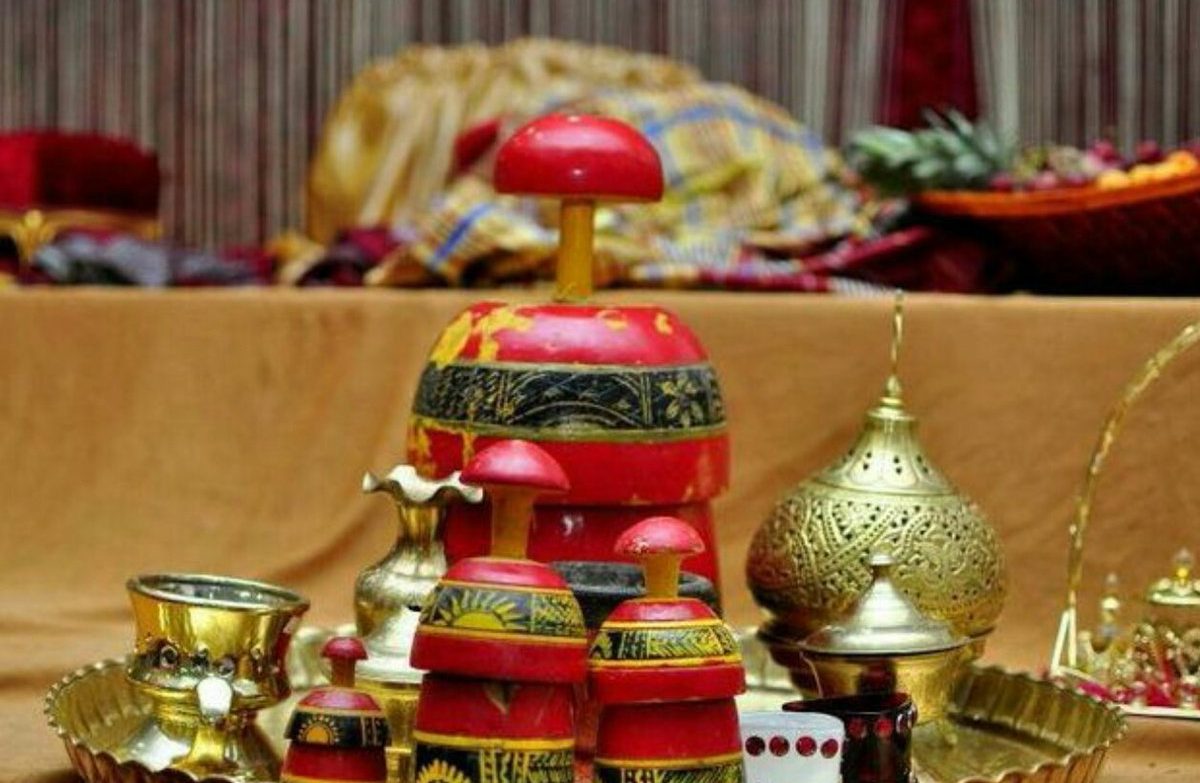 🇸🇩 Khartoum, SudanJirtigالجَرْتِقْ (Arabic)
A Sudanese inauguration ritual where the groom is symbolically crowned as a king.Rite · The weeks before
🇸🇩 Khartoum, SudanJirtigالجَرْتِقْ (Arabic)
A Sudanese inauguration ritual where the groom is symbolically crowned as a king.Rite · The weeks before
 🇯🇵 Tokyo, JapanShinto wedding神前結婚 (Shinzen kekkon)
A Shinto purification ritual featuring sake sharing and kimono attire held at a shrine or venue.Rite · The ceremony
🇯🇵 Tokyo, JapanShinto wedding神前結婚 (Shinzen kekkon)
A Shinto purification ritual featuring sake sharing and kimono attire held at a shrine or venue.Rite · The ceremony
 🇲🇽 Oaxaca, Mexico and 1 moreHuipilhuīpīlli
The traditional tunic worn by indigenous women in Mexico and Central America for weddings and daily life.Attire · The weeks before
🇲🇽 Oaxaca, Mexico and 1 moreHuipilhuīpīlli
The traditional tunic worn by indigenous women in Mexico and Central America for weddings and daily life.Attire · The weeks before
 🇮🇳 IndiaOdia Hindu weddingBahaghara (ଓଡ଼ିଆ ବାହାଘର)
The traditional Hindu marriage ceremony of the Odia people in Odisha, India.Rite · Engagement and betrothal
🇮🇳 IndiaOdia Hindu weddingBahaghara (ଓଡ଼ିଆ ବାହାଘର)
The traditional Hindu marriage ceremony of the Odia people in Odisha, India.Rite · Engagement and betrothal