Matchmaking, courtship and engagementSouth AsiaHindu
Karva Chauth
In its own language: करकचतुर्थी (Karakachaturthī)
A Hindu festival where married women fast from sunrise to moonrise for their husband's health and life.

Married Hindu women in North India, Western India, and Nepal observe a strict day-long fast on this lunar festival. They pray for the well-being of their spouses, breaking the fast only after viewing the moon and receiving water from their husbands.
When is Karva Chauth kept?
Karva Chauth is kept on the fourth day of the waning moon in the Kartika month.
This observance centers on a rigorous daily fast kept by wives for the protection of their partners. Women gather in the evening to perform rituals before looking at the moon through a sieve. The celebration reinforces marital bonds and community ties among female relatives and friends across South Asia.
Origins and history
The name derives from Sanskrit words meaning 'pot' and 'fourth', referring to the earthen vessels used and the specific lunar day. Historically, the practice may have started as prayers for good harvests during wheat-sowing seasons or as requests for the safe return of warriors. It also celebrates close female friendships formed after arranged marriages, creating lifelong sisterhoods between brides and their companions.
Rituals and preparation
Women prepare clay pots decorated with designs, filling them with bangles, sweets, and small gifts. On the morning of the fast, they wake before sunrise for a pre-dawn meal called sargi, traditionally provided by their mother-in-law. Throughout the day, participants apply henna, wear jewelry, and avoid household chores while meeting friends to exchange gifts and listen to religious stories.
Evening ceremonies
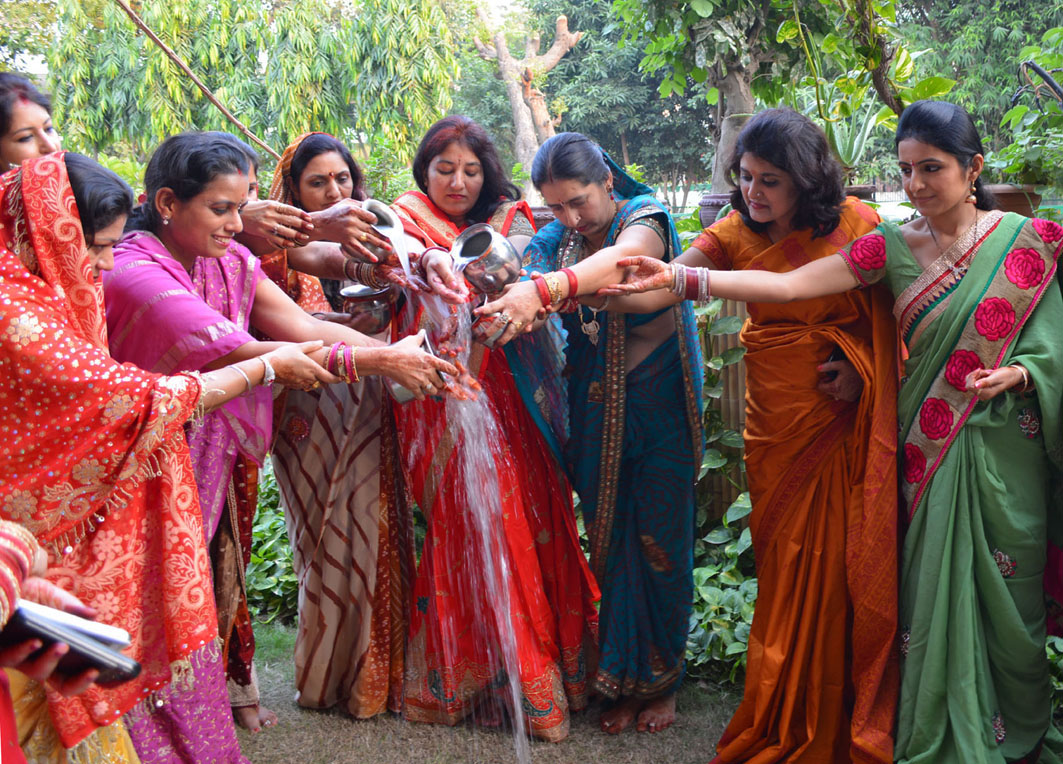
As night falls, women dress in bright traditional clothing like red or gold saris. They sit in circles to sing devotional songs and narrate tales of divine couples. Participants offer food to idols of Shiva, Parvati, and Ganesha. The ceremony concludes when the moon rises, allowing the fasting woman to view it through a sieve and then look at her husband's face.
Breaking the fast
After the moon sighting, the husband offers water to his wife to break her fast. She drinks the first sip, ending her day-long abstinence from food and drink. This moment marks the culmination of her prayers for his longevity. Families often share a full meal together afterward, celebrating the successful completion of the vows.
Modern context
Today, the festival is viewed as a romantic expression of love between spouses. It appears frequently in Bollywood films and advertising campaigns. While traditionally focused on marital devotion, some urban observers now see it as a symbol of mutual partnership. Unmarried women sometimes keep the fast for future partners, reflecting changing social attitudes toward romance.
How Karva Chauth is kept
Women wake before dawn for a special meal given by their mothers-in-law. They apply henna and wear festive clothes while avoiding work. In the evening, they gather to listen to stories and sing hymns. After the moon rises, they view it through a sieve, look at their husbands, and receive water to end the fast. Friends exchange decorated clay pots filled with gifts throughout the day.
When and where
It occurs on the fourth day of the dark fortnight in the Kartika month. The date changes yearly based on the lunisolar Hindu calendar. Observances typically happen in October or November.
The custom is strongest in Northern and Western India, including states like Punjab, Rajasthan, and Delhi. It is also observed in Nepal and among diaspora communities in Fiji.
What Karva Chauth means
The fast represents deep devotion and the desire for a spouse's long life. The exchange of clay pots symbolizes friendship and support among women. Viewing the moon signifies spiritual strength and the fulfillment of marital promises.
Who takes part
- The wife: Keeps a strict fast and performs evening rituals
- The husband: Offers water to break the fast after moonrise
- The mother-in-law: Provides the pre-dawn meal and participates in rituals
- Female friends: Exchange decorated pots and share stories
If you are a guest
Guests are primarily other women participating in the circle. They bring decorated clay pots filled with sweets and bangles to exchange. Attendees wear bright traditional attire and join in singing devotional songs while listening to religious narratives.
Then and now
Urban interpretations increasingly frame the fast as a symbol of mutual love rather than strict duty. Advertising campaigns use the festival to promote romantic gestures. Some unmarried women now observe the fast for potential partners, shifting its traditional focus.
On the wedding table
- Soot feni: Eaten with milk and sugar before dawn in Uttar Pradesh to sustain energy
- Halwa: Offered to deities and shared during the post-fast meal
- Puri: Part of the ceremonial offering to idols before breaking the fast
- Mathri: Savory snacks included in the baayna offering to family members
Symbols: Water and washing Rice and grain Henna The colour red Gold and jewellery Garlands and flowers


Questions people ask about Karva Chauth
When is Karva Chauth kept?
Karva Chauth is kept on the fourth day of the waning moon in the Kartika month.
What is Karva Chauth?
It is a Hindu festival where married women fast from sunrise to moonrise for their husband's health and longevity. The fast ends after viewing the moon and receiving water from the spouse.
Who participates in the fast?
Married Hindu women in North India, Western India, and Nepal are the primary participants. In some regions, unmarried women also observe the fast for future partners.
What is the significance of the clay pot?
The decorated earthen pot, or karva, is exchanged between friends and family. It contains gifts like bangles and sweets, symbolizing friendship and marital blessings.
See also
 Maithil VivahThe arranged Hindu marriage of Maithils in the Mithila region, guided by Vedic texts and local customs.
 MatchmakingThe practice of pairing two people for marriage through an intermediary or system.
 SvayamvaraA ceremony where a bride selects her husband from assembled suitors or through a public contest.
Good reading and sources
- Karva Chauth on WikipediaEncyclopedia
- More photos on Wikimedia CommonsPhotos and video
- Wikidata recordOpen data
The facts on this page come from the Wikipedia article "Karva Chauth", written by its contributors and used under the CC BY-SA 4.0 licence, and from its Wikidata record (CC0). EveryShaadi rewrote the text in its own words, with AI assistance, and compares every page with the article to make sure no passage is copied. It may be reused under the same CC BY-SA 4.0 licence with a link back.
It may contain mistakes. Wedding customs differ from one family, village and community to the next, and the people who keep them know them best. If something is wrong, tell us. Last refreshed 2026-10-07.
More from India
All the traditions of India
🇮🇳 India and 1 moreMaithil Vivahमैथिल विवाह
The arranged Hindu marriage of Maithils in the Mithila region, guided by Vedic texts and local customs.Betrothal · Finding a match
🇸🇬 Singapore and 3 moreMatchmaking
The practice of pairing two people for marriage through an intermediary or system.Betrothal · Finding a match
🇮🇳 India and 1 moreSvayamvaraस्वयंवर (svayaṃvara)
A ceremony where a bride selects her husband from assembled suitors or through a public contest.Betrothal · Engagement and betrothal
The same idea elsewhere
Auspicious dates, seasons and days to avoid compared 🇸🇿 Ludzidzini Royal Village, Eswatini and 1 moreUmhlanga
The annual Swazi and Zulu gathering where young women cut reeds to preserve chastity and offer tribute labour.Rite · The eve
🇸🇿 Ludzidzini Royal Village, Eswatini and 1 moreUmhlanga
The annual Swazi and Zulu gathering where young women cut reeds to preserve chastity and offer tribute labour.Rite · The eve
 🇲🇲 MyanmarMarriage in Myanmar
A blend of Buddhist rites, astrological timing, and family negotiations that defines union across Myanmar's diverse ethnRite · Finding a match
🇲🇲 MyanmarMarriage in Myanmar
A blend of Buddhist rites, astrological timing, and family negotiations that defines union across Myanmar's diverse ethnRite · Finding a match
 🇪🇬 Egypt and 4 moreWaist beads
Strands of glass or seed worn around the hips to mark womanhood and track body changes in West and North Africa.Adornment · Engagement and betrothal
🇪🇬 Egypt and 4 moreWaist beads
Strands of glass or seed worn around the hips to mark womanhood and track body changes in West and North Africa.Adornment · Engagement and betrothal
 🇩🇪 GermanyLandshut WeddingLandshuter Hochzeit
A four-year historical pageant in Bavaria re-enacting the 1475 royal marriage of George and Hedwig.Setting · Engagement and betrothal
🇩🇪 GermanyLandshut WeddingLandshuter Hochzeit
A four-year historical pageant in Bavaria re-enacting the 1475 royal marriage of George and Hedwig.Setting · Engagement and betrothal