Henna, jewellery and body artEurope
Lovespoon
In its own language: Llwy garu
A carved wooden spoon given as a romantic gift to show skill and intent.

A lovespoon is a hand-carved wooden spoon traditionally gifted by a suitor to a woman in Wales. It served as proof of the giver's woodworking ability and his capacity to provide for a future family. Today it remains a cherished folk craft symbolizing love and commitment.
When is Lovespoon kept?
Lovespoon is kept during courtship or at weddings.
The lovespoon is a decorative wooden spoon carved with intricate symbols of love and security. Originating in Wales during the seventeenth century, it was presented by a suitor to demonstrate his craftsmanship and readiness to support a household. The practice evolved from a practical tool into a lasting token of affection.
Origins and history
This tradition emerged in Wales during the seventeenth century. Carvers added elaborate designs over generations, shifting the object from a kitchen utensil to a wall-hung decoration. The earliest dated Welsh example comes from 1667, though the custom likely began earlier. An older German example exists from 1664, showing the craft's regional spread.
Symbols and meaning
Each carving held specific significance for the recipient. A horseshoe promised luck, while a cross represented faith. Bells signified marriage, hearts denoted love, and a lock offered security. Caged balls indicated hopes for children. Sailors often included anchors during long voyages. Complex chains displayed the carver's technical skill alongside these heartfelt messages.
Norwegian wedding custom
In Norway, linked spoons played a role in mid-nineteenth-century weddings. Newlyweds ate using connected spoons on the second day of ceremonies to symbolize their union. These items were often carved from one piece of wood. Couples hung them above their door after the event, preserving the memory of their linkage.
How Lovespoon is kept
A suitor carves a wooden spoon using traditional tools, embedding symbols like hearts, locks, or bells to communicate his intentions. He presents this item to the woman and her father as proof of his ability to build a home. In Norwegian traditions, couples use linked spoons during wedding meals to represent their joined lives, later hanging the spoons in their new house.
When and where
Given during courtship in Wales, or used during the second day of a wedding in Norway. The craft dates back to the seventeenth century.
Strongest in Wales as a courtship gift, and historically in Norway for wedding ceremonies. Examples are found in museums across both regions.
What Lovespoon means
The spoon represents the suitor's skill and promise to provide. Symbols convey specific wishes: security, faith, luck, and family growth. Linked spoons in Norway physically join the couple, emphasizing unity and shared life through shared craftsmanship.
Who takes part
- The suitor: Carves the spoon and presents it to the woman and her father.
- The bride: Receives the spoon as a token of romantic intent and skill.
- The groom: Uses a linked spoon during the wedding meal to symbolize union.
Then and now
Lovespoons are now primarily decorative folk crafts. They are given as gifts for weddings, anniversaries, birthdays, and holidays like Valentine's Day, rather than as part of active courtship rituals.
On the wedding table
Symbols: The ring
Questions people ask about Lovespoon
When is Lovespoon kept?
Lovespoon is kept during courtship or at weddings.
What is a lovespoon?
It is a hand-carved wooden spoon decorated with symbols of love, traditionally given by a suitor to a woman in Wales to show his woodworking skills and serious intent.
What do the symbols mean?
Common symbols include hearts for love, locks for security, bells for marriage, and caged balls for hoped-for children. Chains demonstrate the carver's high level of skill.
See also
 Gimmal ringA betrothal ring with separate hoops that join to form the wedding band.Wedding registryA service that helps couples share their gift preferences with guests to avoid duplicates and unwanted items.
 QuaichA shallow two-handled cup used in Scottish weddings to share a drink and symbolise union.
 KransekakeA towering almond ring cake central to Scandinavian wedding and holiday traditions.
Good reading and sources
- Lovespoon on WikipediaEncyclopedia
- More photos on Wikimedia CommonsPhotos and video
- Wikidata recordOpen data
The facts on this page come from the Wikipedia article "Lovespoon", written by its contributors and used under the CC BY-SA 4.0 licence, and from its Wikidata record (CC0). EveryShaadi rewrote the text in its own words, with AI assistance, and compares every page with the article to make sure no passage is copied. It may be reused under the same CC BY-SA 4.0 licence with a link back.
It may contain mistakes. Wedding customs differ from one family, village and community to the next, and the people who keep them know them best. If something is wrong, tell us. Last refreshed 2026-10-05.
More from the United Kingdom
All the traditions of the United Kingdom
🇬🇧 United Kingdom and 1 moreGimmal ring
A betrothal ring with separate hoops that join to form the wedding band.Adornment · Engagement and betrothal
 🇫🇷 France and 1 moreAcrostic ring
A jewelled band where gemstone initials spell a secret romantic wordAdornment · Engagement and betrothal
🇫🇷 France and 1 moreAcrostic ring
A jewelled band where gemstone initials spell a secret romantic wordAdornment · Engagement and betrothal
 🇺🇸 United States and 5 moreEngagement ring
A ring given to signify a formal agreement to future marriage.Adornment · Engagement and betrothal
🇺🇸 United States and 5 moreEngagement ring
A ring given to signify a formal agreement to future marriage.Adornment · Engagement and betrothal
 🇬🇧 Edinburgh, United KingdomLuckenbooth brooch
A Scottish heart-shaped silver token of love and protection worn at weddings.Adornment · Engagement and betrothal
🇬🇧 Edinburgh, United KingdomLuckenbooth brooch
A Scottish heart-shaped silver token of love and protection worn at weddings.Adornment · Engagement and betrothal
The same idea elsewhere
Rings, knots and tokens of promise compared 🇮🇳 India and 1 moreToe ring
A silver band worn on the second toe to mark a woman as married in India.Adornment · The ceremony
🇮🇳 India and 1 moreToe ring
A silver band worn on the second toe to mark a woman as married in India.Adornment · The ceremony
 🇪🇬 Egypt and 4 moreWaist beads
Strands of glass or seed worn around the hips to mark womanhood and track body changes in West and North Africa.Adornment · Engagement and betrothal
🇪🇬 Egypt and 4 moreWaist beads
Strands of glass or seed worn around the hips to mark womanhood and track body changes in West and North Africa.Adornment · Engagement and betrothal
 🇱🇦 Laos and 1 moreBaciບາສີ (Lao); บายศรี (Thai)
The wrist-tying ceremony that calls the soul back to restore balance and good luck.Blessing · The ceremony
🇱🇦 Laos and 1 moreBaciບາສີ (Lao); บายศรี (Thai)
The wrist-tying ceremony that calls the soul back to restore balance and good luck.Blessing · The ceremony
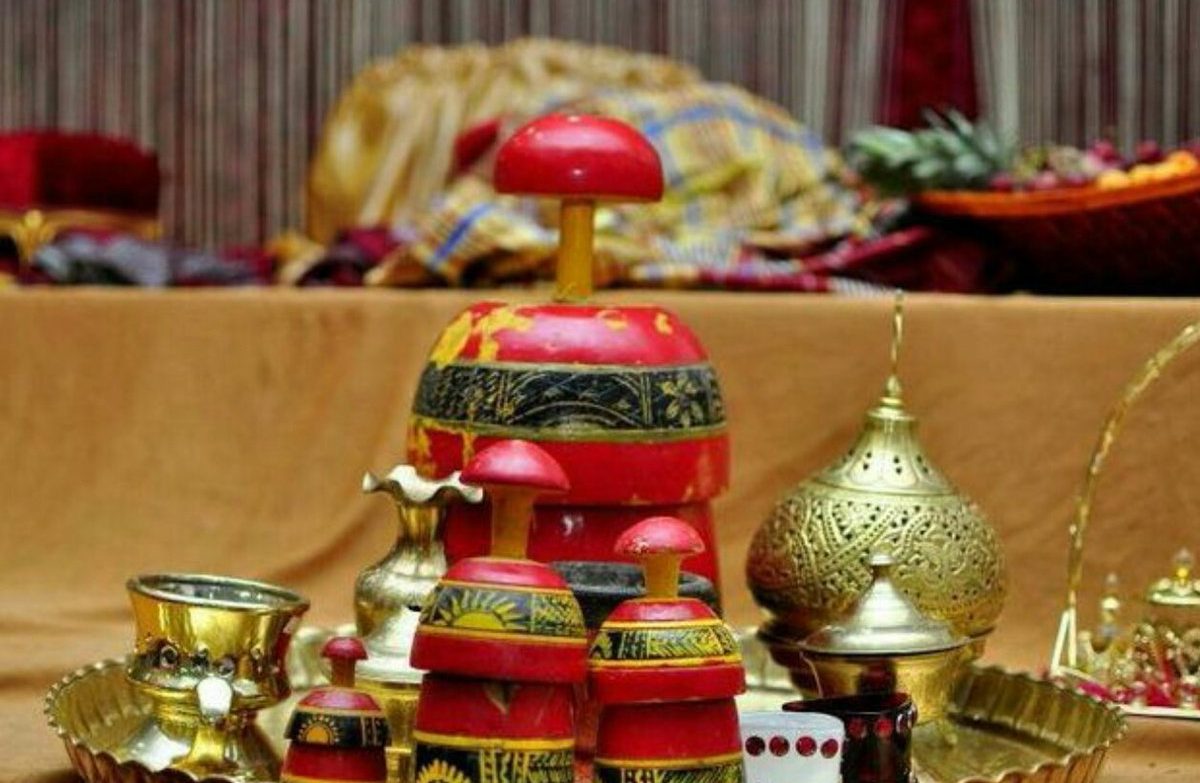 🇸🇩 Khartoum, SudanJirtigالجَرْتِقْ (Arabic)
A Sudanese inauguration ritual where the groom is symbolically crowned as a king.Rite · The weeks before
🇸🇩 Khartoum, SudanJirtigالجَرْتِقْ (Arabic)
A Sudanese inauguration ritual where the groom is symbolically crowned as a king.Rite · The weeks before