Matchmaking, courtship and engagementEurope
Knottekistje
A silver Frisian box that replaced a knotted cloth as the token of engagement.
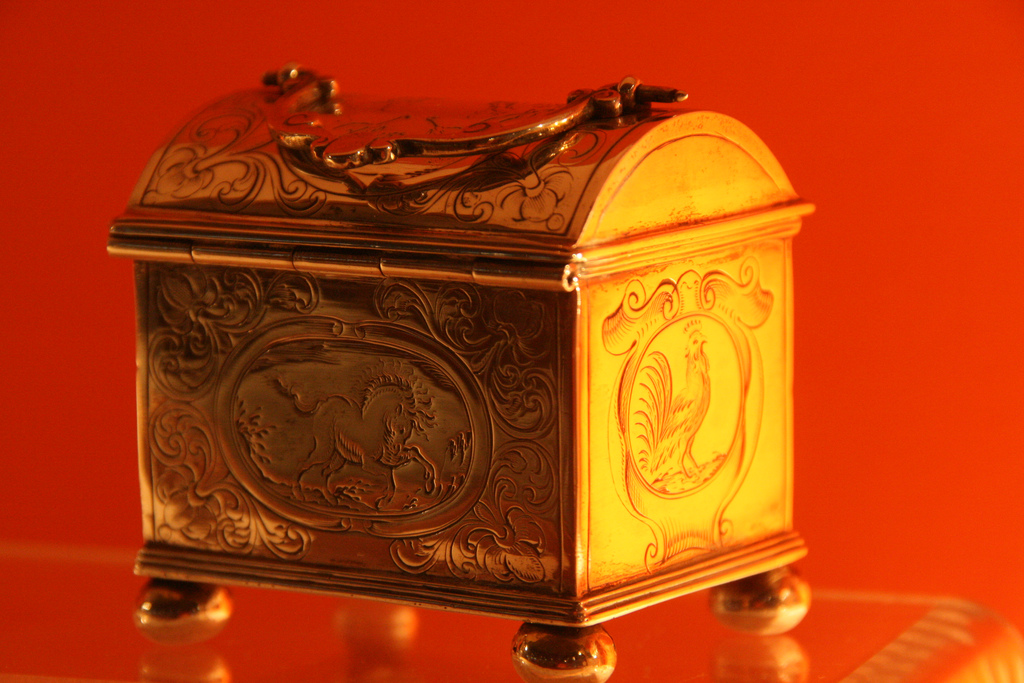
The knottekistje is a small silver money casket from Friesland, Netherlands. It evolved from a sixteenth-century tradition where a boy offered a girl a coin tied in a knotted cloth to propose. The silver box serves as a durable symbol of engagement and a financial reserve for the wife.
When is Knottekistje kept?
Knottekistje is kept during the proposal or engagement period.
In Frisian culture, the knottekistje marks the moment a couple becomes engaged. This small silver box holds coins and replaces an older cloth ritual. It acts as both a romantic token and a practical savings account for the bride.
Origins of the ritual
The custom began in the sixteenth century with a simple exchange. A boy would offer a single coin to a girl when asking for her hand. If she accepted, they were considered engaged. To present more coins, he used a special cloth called a knotte. This fabric was tied in a loose knot. The girl could tighten the knot to show acceptance. As families became wealthier, the cloth gave way to a silver casket. This metal box preserved the tradition while offering greater value.
Design and symbolism
These caskets are rectangular with semicircular lids and stand on ball feet. They are typically made of silver, making them valuable heirlooms. The surface features delicate engravings of love and marriage scenes. Many boxes include proverbs or mottos about union. The contents remain the property of the wife. Families kept these boxes as a financial safety net for difficult times.
The proposal poem
The boy recites a specific verse during the offering. The Frisian lines ask if she wants the knottekistje. He states that if she accepts, it becomes hers. If she refuses, she must return the item. This poetic exchange formalizes the agreement between the two parties. It ensures clear consent before the engagement begins.
How Knottekistje is kept
A boy presents a silver casket to a girl. He recites a traditional poem asking for her acceptance. She tightens the symbolic knot or accepts the box to agree. The casket contains coins and remains her personal property. It serves as a long-term savings tool for the future.
When and where
It occurs during the betrothal stage, specifically at the moment of proposal. The date depends on when the couple decides to engage.
This practice is rooted in Friesland within the Netherlands. It reflects local Frisian folkloric traditions.
What Knottekistje means
The box represents security and commitment. It shifts from a temporary cloth to permanent silver. It ensures the bride has financial independence. The engraved scenes celebrate marital love.
Who takes part
- the boy: offers the casket and recites the poem
- the girl: accepts the gift by tightening the knot
Then and now
Modern versions still exist today. Some are featured in Dutch media. The tradition persists as a cultural artifact.
On the wedding table
Symbols: Knots, cords and threads
Questions people ask about Knottekistje
When is Knottekistje kept?
Knottekistje is kept during the proposal or engagement period.
What is a knottekistje?
It is a small silver Frisian casket used for engagement. It holds coins and replaces an older knotted cloth ritual.
Who owns the casket?
The box and its contents belong solely to the wife. It acts as her personal savings.
See also
 Wedding ringA metal circle worn on the finger to show that a person is married.
 Banns of marriageThe public announcement of an impending marriage in church or town hall to allow for legal objections.SambandamThe traditional matrilineal marriage alliance of Kerala's Nairs and Nambudiris.
 Maithil VivahThe arranged Hindu marriage of Maithils in the Mithila region, guided by Vedic texts and local customs.
Good reading and sources
- Knottekistje on WikipediaEncyclopedia
- More photos on Wikimedia CommonsPhotos and video
- Wikidata recordOpen data
The facts on this page come from the Wikipedia article "Knottekistje", written by its contributors and used under the CC BY-SA 4.0 licence, and from its Wikidata record (CC0). EveryShaadi rewrote the text in its own words, with AI assistance, and compares every page with the article to make sure no passage is copied. It may be reused under the same CC BY-SA 4.0 licence with a link back.
It may contain mistakes. Wedding customs differ from one family, village and community to the next, and the people who keep them know them best. If something is wrong, tell us. Last refreshed 2026-10-05.
More from the Netherlands
All the traditions of the Netherlands 🇺🇸 United States and 5 moreBridesmaid
A female attendant who supports the bride during a Western wedding ceremony.Family role · Engagement and betrothal
🇫🇮 Finland and 5 moreBanns of marriagekuulutukset avioliittoon (Finnish)
The public announcement of an impending marriage in church or town hall to allow for legal objections.Vow · The weeks before
🇬🇷 Greece and 5 moreWedding ring
A metal circle worn on the finger to show that a person is married.Attire · Engagement and betrothal
🇺🇸 United States and 5 moreBridesmaid
A female attendant who supports the bride during a Western wedding ceremony.Family role · Engagement and betrothal
🇫🇮 Finland and 5 moreBanns of marriagekuulutukset avioliittoon (Finnish)
The public announcement of an impending marriage in church or town hall to allow for legal objections.Vow · The weeks before
🇬🇷 Greece and 5 moreWedding ring
A metal circle worn on the finger to show that a person is married.Attire · Engagement and betrothal
 🇬🇧 United Kingdom and 5 moreRing fingerdigitus annularis
The fourth digit of the hand where wedding and engagement rings are traditionally worn.Attire · The ceremony
🇬🇧 United Kingdom and 5 moreRing fingerdigitus annularis
The fourth digit of the hand where wedding and engagement rings are traditionally worn.Attire · The ceremony
The same idea elsewhere
Rings, knots and tokens of promise compared 🇪🇬 Egypt and 4 moreWaist beads
Strands of glass or seed worn around the hips to mark womanhood and track body changes in West and North Africa.Adornment · Engagement and betrothal
🇪🇬 Egypt and 4 moreWaist beads
Strands of glass or seed worn around the hips to mark womanhood and track body changes in West and North Africa.Adornment · Engagement and betrothal
 🇮🇱 Israel and 2 moreKetubahכְּתוּבָּה
The Jewish marriage contract that outlines the groom's financial and personal obligations to the bride.Vow · Engagement and betrothal
🇮🇶 Mosul, IraqWedding traditions in Iraq
The arranged courtship, religious rites and multi-day celebrations that mark marriage in Iraqi society.Betrothal · Finding a match
🇮🇳 IndiaZoroastrian wedding
A Zoroastrian marriage ceremony featuring hand-fastening, rice sprinkling, and shared meals.Rite · Engagement and betrothal
🇮🇱 Israel and 2 moreKetubahכְּתוּבָּה
The Jewish marriage contract that outlines the groom's financial and personal obligations to the bride.Vow · Engagement and betrothal
🇮🇶 Mosul, IraqWedding traditions in Iraq
The arranged courtship, religious rites and multi-day celebrations that mark marriage in Iraqi society.Betrothal · Finding a match
🇮🇳 IndiaZoroastrian wedding
A Zoroastrian marriage ceremony featuring hand-fastening, rice sprinkling, and shared meals.Rite · Engagement and betrothal