Modern and changing weddingsEuropeSecular and civil
Same-sex marriage
The legal union of two people of the same sex or gender, recognized in dozens of countries.

Same-sex marriage is the legal recognition and solemnization of a union between two people of the same sex or gender. As of 2026, it is legally performed and recognized in 38 countries across Europe, the Americas, and parts of Asia and Africa. The practice grants couples equal marital rights, including adoption and inheritance, under the law.
When is Same-sex marriage kept?
Same-sex marriage is kept on year-round, following legal authorization.
Same-sex marriage allows two people of the same sex or gender to enter a legally binding union. This modern practice ensures equal rights and social recognition for LGBTQ+ couples. It has spread globally through legislative changes and court rulings since the early 2000s.
What it means today
Same-sex marriage grants couples the full legal status of marriage. This includes rights to inheritance, hospital visitation, and joint adoption in most jurisdictions. Scientific studies show that this legal recognition enhances the financial and psychological well-being of gay people. It also benefits their children by providing a stable environment supported by societal institutions. Research indicates that excluding same-sex couples from marriage invites public discrimination. Conversely, recognizing these unions does not harm heterosexual marriages.
History and origins
While ancient records mention male unions in Rome and China, modern legal recognition began later. Jack Baker and Michael McConnell were the first couple in recorded history to obtain a marriage license in Minnesota in 1971. Denmark led the way in 1989 with registered partnerships. The Netherlands became the first country to legalize full same-sex marriage in 2001. Since then, over thirty other nations have followed suit through laws, court decisions, or public votes.
Global landscape
As of 2026, thirty-eight countries allow same-sex marriage. These include most Western nations, several in the Americas, and select countries like South Africa and Thailand. Israel recognizes marriages performed abroad. Some nations, such as Nigeria and Russia, restrict advocacy for these unions. Others have constitutional bans defining marriage as between opposite sexes. Legal status varies significantly, with some countries mandating legalization while others resist change.
Terminology and debate
Proponents often use terms like 'marriage equality' to emphasize equal standing. The Associated Press recommends 'same-sex marriage' over 'gay marriage.' Anthropologists note that many cultures historically recognized same-sex unions. Opponents, often citing religious teachings, argue marriage is strictly for procreation between one man and one woman. Scientific research refutes claims that homosexuality is unnatural or that children fare better with opposite-sex parents.
How Same-sex marriage is kept
Couples apply for a marriage license according to local laws. They exchange vows during a ceremony, which may be civil or religious depending on the officiant. Witnesses and an officiant are typically present. After the ceremony, the couple receives a marriage certificate. This legal document grants them access to government services and protections available to opposite-sex married couples.
When and where
It can occur at any time of year once legally authorized. The date is set by the couple and the availability of the officiant or venue. No specific seasonal restrictions apply in most jurisdictions.
It is strongest in Western Europe, North America, and parts of South America. South Africa is the only African nation where it is fully established. Thailand and Taiwan represent its presence in Asia. It remains illegal or unrecognized in many other regions worldwide.
What Same-sex marriage means
It symbolizes equal love and commitment regardless of gender. It represents the removal of legal barriers that previously distinguished same-sex relationships from opposite-sex ones. For many, it signifies full social acceptance and the validation of their partnership by the state and community.
Who takes part
- The couple: Exchange vows and sign the marriage license
- The officiant: Solemnize the union and witness the signing
- Witnesses: Observe the ceremony and sign the legal documents
If you are a guest
Guests attend the ceremony and reception to celebrate the couple. They may bring gifts or cards as per local custom. Their presence supports the couple's legal and social union. There are no specific traditional attire requirements for guests beyond general formal wear.
Then and now
Legal recognition continues to expand globally. Some countries face ongoing political debates about legalization. A few nations have repealed previous legalization, creating uncertainty. Advocacy groups continue to push for equal rights in remaining jurisdictions.


Questions people ask about Same-sex marriage
When is Same-sex marriage kept?
Same-sex marriage is kept on year-round, following legal authorization.
What is same-sex marriage?
It is the legal union of two people of the same sex or gender. It grants couples the same rights and responsibilities as opposite-sex married couples under the law.
Is it legal everywhere?
No. As of 2026, it is legal in 38 countries. Many other nations do not recognize it, and some actively prohibit it through laws or constitutional amendments.
Does it affect opposite-sex marriage?
Scientific studies show no negative impact on heterosexual marriages. Research indicates that recognizing same-sex unions strengthens social stability and family well-being.
See also
 Same-sex marriage in ThailandThe legal recognition of same-sex unions that took effect in January 2025.
 Interracial marriageA union between spouses of different races or racialized ethnicities, now legal in most nations.
Good reading and sources
- Encyclopaedia BritannicaArticle
- Gay marriage gets ministerial approvalThe Guardian, Article
- Same-sex spouses have EU residence rights, top court rulesBBC, Article
- BBC NEWS | AmericasBBC, Article
- Gay marriage gets ministerial approvalThe Guardian, Article
- Same-sex spouses have EU residence rights, top court rulesBBC, Article
- BBC NEWS | AmericasBBC, Article
- Same-sex marriage on WikipediaEncyclopedia
- More photos on Wikimedia CommonsPhotos and video
- Wikidata recordOpen data
The facts on this page come from the Wikipedia article "Same-sex marriage", written by its contributors and used under the CC BY-SA 4.0 licence, and from its Wikidata record (CC0). EveryShaadi rewrote the text in its own words, with AI assistance, and compares every page with the article to make sure no passage is copied. It may be reused under the same CC BY-SA 4.0 licence with a link back.
It may contain mistakes. Wedding customs differ from one family, village and community to the next, and the people who keep them know them best. If something is wrong, tell us. Last refreshed 2026-10-05.
More from the Netherlands
All the traditions of the Netherlands 🇳🇱 Amsterdam, NetherlandsSame-sex marriage in the Netherlandshuwelijk tussen personen van gelijk geslacht
The first national law to allow two people of the same sex to wed.Modern · The ceremony
🇳🇱 Amsterdam, NetherlandsSame-sex marriage in the Netherlandshuwelijk tussen personen van gelijk geslacht
The first national law to allow two people of the same sex to wed.Modern · The ceremony
 🇫🇮 Finland and 5 moreBanns of marriagekuulutukset avioliittoon (Finnish)
The public announcement of an impending marriage in church or town hall to allow for legal objections.Vow · The weeks before
🇫🇮 Finland and 5 moreBanns of marriagekuulutukset avioliittoon (Finnish)
The public announcement of an impending marriage in church or town hall to allow for legal objections.Vow · The weeks before
 🇬🇷 Greece and 5 moreWedding ring
A metal circle worn on the finger to show that a person is married.Attire · Engagement and betrothal
🇬🇷 Greece and 5 moreWedding ring
A metal circle worn on the finger to show that a person is married.Attire · Engagement and betrothal
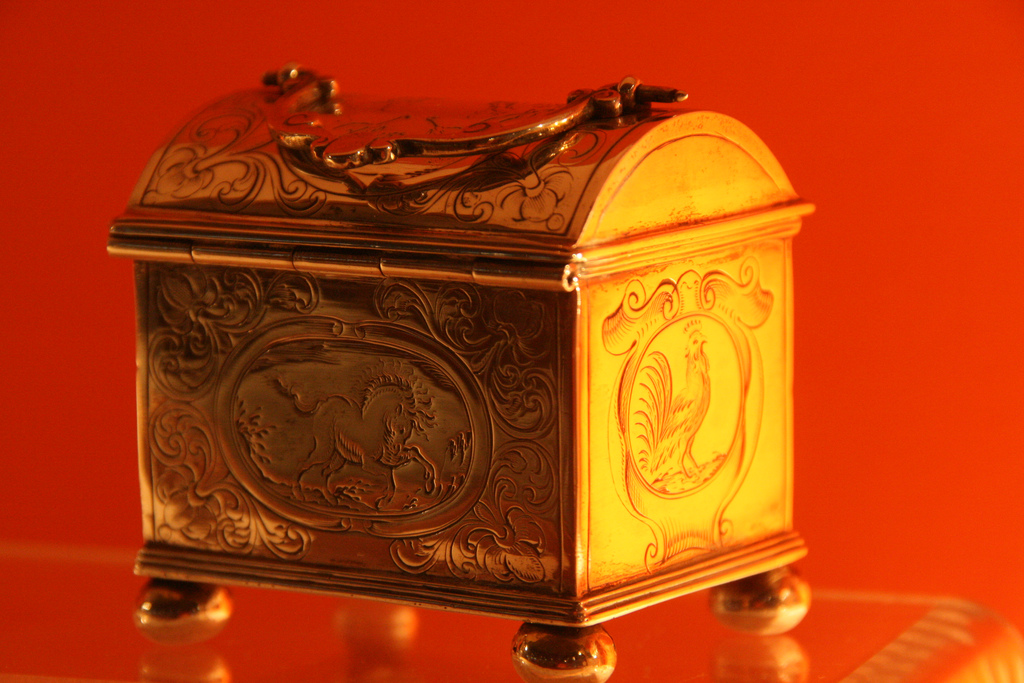 🇳🇱 NetherlandsKnottekistje
A silver Frisian box that replaced a knotted cloth as the token of engagement.Betrothal · Engagement and betrothal
🇳🇱 NetherlandsKnottekistje
A silver Frisian box that replaced a knotted cloth as the token of engagement.Betrothal · Engagement and betrothal
The same idea elsewhere
Interfaith, inter-community and same-sex weddings compared 🇰🇷 Seoul, South Korea and 3 moreBlessing ceremony
The large-scale marriage rite of the Unification Church where couples are matched and blessed by their leaders.Rite · The ceremony
🇺🇸 New York, United States and 5 moreInterracial marriage
A union between spouses of different races or racialized ethnicities, now legal in most nations.Modern
🇰🇷 Seoul, South Korea and 3 moreBlessing ceremony
The large-scale marriage rite of the Unification Church where couples are matched and blessed by their leaders.Rite · The ceremony
🇺🇸 New York, United States and 5 moreInterracial marriage
A union between spouses of different races or racialized ethnicities, now legal in most nations.Modern
 🇯🇵 Tokyo, JapanSame-sex marriage in Japan同性結婚 (dōsei kekkon)
The legal battle and local partnership systems for same-sex couples in JapanModern
🇯🇵 Tokyo, JapanSame-sex marriage in Japan同性結婚 (dōsei kekkon)
The legal battle and local partnership systems for same-sex couples in JapanModern
 🇦🇺 Sydney, AustraliaSame-sex marriage in Australia
The legal recognition of marriages between two people of the same gender in Australia.Modern · The ceremony
🇦🇺 Sydney, AustraliaSame-sex marriage in Australia
The legal recognition of marriages between two people of the same gender in Australia.Modern · The ceremony