Ceremony and sacred ritesSoutheast AsiaMuslim
Palang pintu
The martial arts and poetry test that allows the groom to enter the bride's home in Betawi weddings.
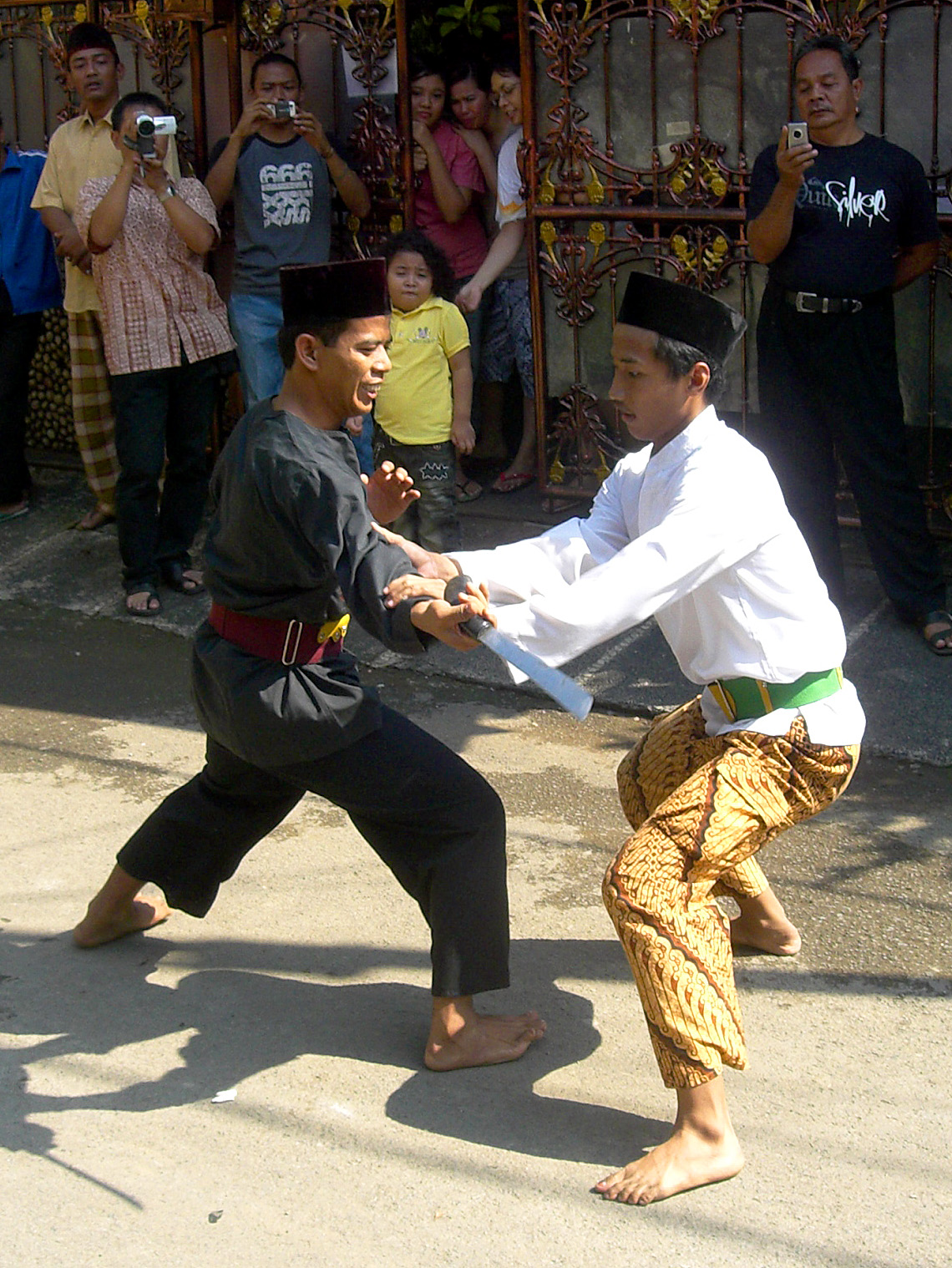
Palang pintu is a traditional wedding ceremony of the Betawi people in Indonesia. It serves as a symbolic gate barrier where local champions perform silat and recite pantun poetry to prove their worthiness before the groom can enter the bride's house.
When is Palang pintu kept?
Palang pintu is kept on before the main wedding ceremony.
This ceremony acts as a ceremonial gate barrier during traditional Betawi weddings in Indonesia. Local martial arts champions represent each family and engage in a display of silat skills and poetic exchange. The ritual tests the groom's ability to protect his future household and negotiate diplomatically with the bride's relatives before he may proceed.
Ceremony structure
Local martial arts experts known as Jawara stand in for the bride and groom. They face each other at the entrance to the bride's residence. The duel involves executing traditional silat moves while simultaneously reciting passages of pantun poetry. This dual performance requires physical agility and verbal skill. A reading from the Quran typically follows the duel. Once this spiritual element is complete, the groom and his group are permitted to cross the threshold into the home to continue the wedding proceedings.
Symbolic meaning
The event functions as a test for the groom to gain the approval of the bride's side. The silat combat symbolizes the groom's capacity to defend his family against external threats. The poetic dialogue demonstrates his diplomatic abilities and respect for tradition. The requirement for the groom's champion to defeat the bride's champion ensures the proper progression of the wedding. The ritual also helps reconcile relationships between different families or neighborhoods involved in the union.
Modern usage
While primarily a wedding custom, the practice appears in other official contexts. It serves to welcome distinguished visitors or mark formal inaugurations. In 2025, Jakarta officials received incoming Governor Pramono Anung and Deputy Governor Rano Karno with a palang pintu ceremony outside City Hall. This adaptation shows how the tradition maintains cultural relevance beyond matrimonial events, acting as a formal greeting protocol for important guests.
How Palang pintu is kept
Jawara representatives from both families meet at the entrance. They perform silat movements and recite pantun verses to one another. A Quranic reading usually concludes the confrontation. The groom then enters the bride's home with his entourage.
When and where
It occurs before the main ceremony begins, blocking the path to the bride's house until passed.
Practiced by the Betawi community in Indonesia, particularly in Jakarta.
What Palang pintu means
Silat represents protection capability. Poetry shows diplomatic skill. The test proves the groom's readiness for marriage responsibilities.
Who takes part
- Jawara (champions): Perform silat and recite pantun on behalf of their respective sides
- Groom: Waits outside until the test is passed and then enters the home
- Bride's entourage: Arranges the obstacle and provides the defending champion
Then and now
The custom adapts to secular official events, such as welcoming government leaders in Jakarta.
On the wedding table
Symbols: Swords and daggers Water and washing
Questions people ask about Palang pintu
When is Palang pintu kept?
Palang pintu is kept on before the main wedding ceremony.
What is Palang pintu?
It is a Betawi wedding ceremony featuring martial arts and poetry. Champions duel and recite verses to allow the groom entry.
Who performs the ritual?
Local martial arts experts called Jawara act as proxies for the bride and groom during the performance.
See also
 MandapaThe pillared pavilion that serves as the stage for Hindu wedding rituals and temple gatherings.
 PolonaiseA stately Polish partner dance in triple metre that opens weddings and formal celebrations.
 Minangkabau marriageA matrilineal wedding tradition from West Sumatra where the groom moves into the bride's family home.
Good reading and sources
The facts on this page come from the Wikipedia article "Palang pintu", written by its contributors and used under the CC BY-SA 4.0 licence, and from its Wikidata record (CC0). EveryShaadi rewrote the text in its own words, with AI assistance, and compares every page with the article to make sure no passage is copied. It may be reused under the same CC BY-SA 4.0 licence with a link back.
It may contain mistakes. Wedding customs differ from one family, village and community to the next, and the people who keep them know them best. If something is wrong, tell us. Last refreshed 2026-10-05.
More from Indonesia
All the traditions of Indonesia 🇺🇸 United States and 5 moreSaber Arch
An arch of swords or sabers held over a couple as they exit their wedding ceremony.Rite · The ceremony
🇮🇩 Lombok, IndonesiaMerariq
A Sasak ritual in Lombok where the groom takes the bride to his home with family consent.Rite · The weeks before
🇮🇳 India and 2 moreMandapaमण्डप (maṇḍapa)
The pillared pavilion that serves as the stage for Hindu wedding rituals and temple gatherings.Setting · The ceremony
🇵🇱 Poland and 1 morePolonaisePolonez
A stately Polish partner dance in triple metre that opens weddings and formal celebrations.Performance · Procession and arrival
🇺🇸 United States and 5 moreSaber Arch
An arch of swords or sabers held over a couple as they exit their wedding ceremony.Rite · The ceremony
🇮🇩 Lombok, IndonesiaMerariq
A Sasak ritual in Lombok where the groom takes the bride to his home with family consent.Rite · The weeks before
🇮🇳 India and 2 moreMandapaमण्डप (maṇḍapa)
The pillared pavilion that serves as the stage for Hindu wedding rituals and temple gatherings.Setting · The ceremony
🇵🇱 Poland and 1 morePolonaisePolonez
A stately Polish partner dance in triple metre that opens weddings and formal celebrations.Performance · Procession and arrival
The same idea elsewhere
The wedding procession and the arrival compared 🇲🇱 MaliWeddings in Mali
Multi-day Malian wedding traditions blending Islamic rites, civil law, and local customs with bazin attire.Rite · Engagement and betrothal
🇲🇱 MaliWeddings in Mali
Multi-day Malian wedding traditions blending Islamic rites, civil law, and local customs with bazin attire.Rite · Engagement and betrothal
 🇪🇬 Cairo, EgyptTahtibتحطيب (taḥṭīb)
A traditional Egyptian stick-fighting martial art that evolved into a folk dance performed at weddings and celebrations.Performance · The weeks before
🇪🇬 Cairo, EgyptTahtibتحطيب (taḥṭīb)
A traditional Egyptian stick-fighting martial art that evolved into a folk dance performed at weddings and celebrations.Performance · The weeks before