Music, dance and processionNorth Africa
Tahtib
In its own language: تحطيب (taḥṭīb)
A traditional Egyptian stick-fighting martial art that evolved into a folk dance performed at weddings and celebrations.

Tahtib is an ancient Egyptian practice that began as military training with sticks and transformed into a ceremonial folk dance. It is traditionally performed by men at weddings and community gatherings in Upper Egypt to celebrate unions and mark joyous occasions.
When is Tahtib kept?
Tahtib is kept at weddings and community celebrations.
Tahtib is a traditional Egyptian stick dance that originated as a martial art for soldiers. Over centuries, it became a festive performance at weddings and social gatherings in Upper Egypt. Men use wooden sticks to mimic combat in a rhythmic display of skill and honor.
Origins and history
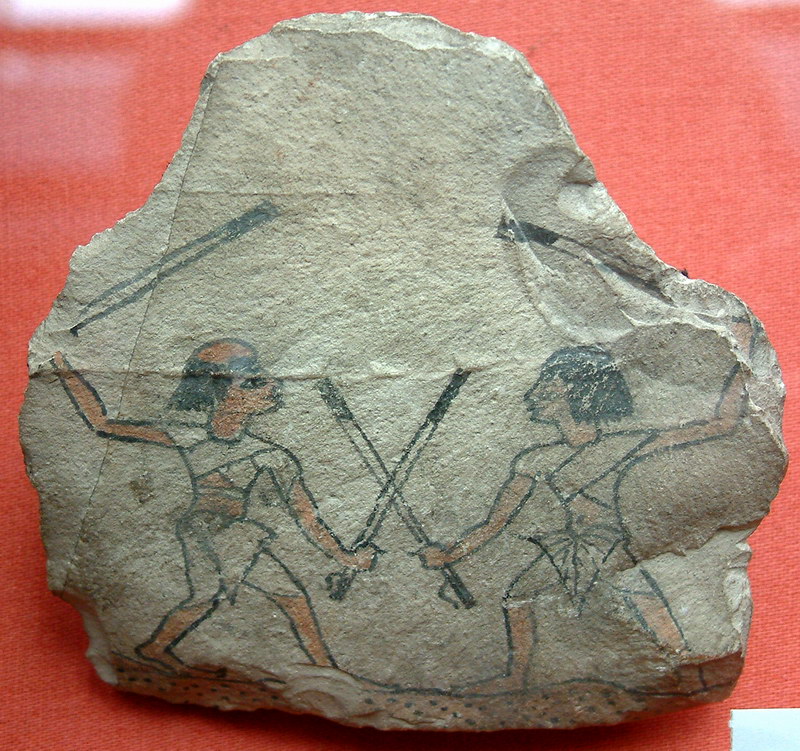
The practice dates back to the Old Kingdom period, with engravings found at Abusir showing military training using sticks. By the time of the Pyramid of Sahure around 2500 BC, it was taught alongside archery and wrestling. Later reliefs from Beni Hassan and Tell el Amarna depict both combat and civilian play. Early Christian writings confirm its role as a leisure activity performed by men during weddings and public celebrations.
Performance and music
Performers wield a four-foot wooden stick called an asa or nabboot. They move the stick in large figure-eight patterns with enough speed to create audible air displacement. The dance is accompanied by a tabl bass drum and a mizmar folk oboe. Drummers use a heavy hooked stick for deep beats and a light twig for rapid staccato rhythms, driving the tempo of the performance.
Modern adaptations
Today, tahtib exists as both a martial art and a performance. Modern codified versions focus on protecting the head while striking the opponent, allowing mixed-gender groups. Traditional performances remain male-dominated but have female variants where women imitate male movements or perform flirtatious cane dances in cabaret settings.
How Tahtib is kept
Male performers stand facing each other or a group, wielding wooden sticks. They move rhythmically to the sound of drums and oboes, swinging the sticks in wide arcs. The dance mimics combat without actual contact, showcasing agility and control. In modern contexts, women may also participate, either imitating the male style or performing a lighter, flirtatious version with decorated canes.
When and where
It occurs during wedding celebrations and community festivals. Historically, it marked joyous occasions and civic events. Today, it is often performed for tourists in Luxor and Aswan, but remains a living tradition in Upper Egyptian villages.
It is strongest in Upper Egypt, particularly around Minya, Luxor, and Aswan. Ancient traces appear near Cairo at Abusir and Saqqara, but the living custom is rooted in the southern regions.
What Tahtib means
The original name translates to 'the art of being straight and honest.' It symbolizes integrity, strength, and masculine virtue. At weddings, it serves as a public display of the groom's or community's vigor and honor, transforming ancient martial discipline into a celebratory ritual.
Who takes part
- The male performer: Wields a wooden stick and executes rhythmic combat-like movements
- The drummer: Plays the tabl with heavy and light sticks to set the rhythm
- The oboist: Plays the mizmar to provide the melodic line
- The bride's family: Hosts the celebration where the dance is performed
If you are a guest
Guests watch the performance during wedding feasts. They may clap along to the rhythm or offer encouragement. In tourist areas, visitors observe the dance as part of cultural entertainment, though it retains its sacred status in local communities.
Then and now
Modern tahtib seeks to preserve the martial roots through structured teaching. Female participation has increased in contemporary performances. While traditional village weddings still feature it, tourism has also commercialized aspects of the dance in major cities.
Questions people ask about Tahtib
When is Tahtib kept?
Tahtib is kept at weddings and community celebrations.
What is tahtib?
Tahtib is an Egyptian stick dance derived from an ancient martial art. Performers use wooden sticks to mimic combat in a rhythmic, non-contact display of skill and honor.
Who performs tahtib?
Traditionally, men perform tahtib. Modern variations include female dancers who may imitate male styles or perform lighter, flirtatious cane dances in cabaret settings.
What instruments are used?
The dance features a tabl bass drum and a mizmar folk oboe. Drummers use specific sticks to create deep beats and rapid staccato rhythms.
See also
 DabkeA Levantine line dance performed at weddings to celebrate union and community.
 KartuliA romantic Georgian wedding dance where the couple dances apart without touching.
Good reading and sources
- Tahtib on WikipediaEncyclopedia
- More photos on Wikimedia CommonsPhotos and video
- Wikidata recordOpen data
The facts on this page come from the Wikipedia article "Tahtib", written by its contributors and used under the CC BY-SA 4.0 licence, and from its Wikidata record (CC0). EveryShaadi rewrote the text in its own words, with AI assistance, and compares every page with the article to make sure no passage is copied. It may be reused under the same CC BY-SA 4.0 licence with a link back.
It may contain mistakes. Wedding customs differ from one family, village and community to the next, and the people who keep them know them best. If something is wrong, tell us. Last refreshed 2026-10-05.
More from Egypt
All the traditions of Egypt 🇪🇬 Egypt and 5 moreMizmarمزمار (mizmār)
A loud double reed instrument played at weddings and festivals across Egypt and the Levant.Performance · Procession and arrival
🇪🇬 Egypt and 3 moreZaffaزفّة
A lively musical procession that marks the start of wedding festivities in Arab culture.Performance · The weeks before
🇮🇷 Shiraz, Iran and 5 moreUlulation
A high-pitched trilling sound made by women to celebrate weddings and share good news across many cultures.Performance · Procession and arrival
🇪🇬 Egypt and 1 moreWedding music
The songs and instruments that mark the arrival of the couple and set the mood for the celebration.Performance · The weeks before
🇪🇬 Egypt and 5 moreMizmarمزمار (mizmār)
A loud double reed instrument played at weddings and festivals across Egypt and the Levant.Performance · Procession and arrival
🇪🇬 Egypt and 3 moreZaffaزفّة
A lively musical procession that marks the start of wedding festivities in Arab culture.Performance · The weeks before
🇮🇷 Shiraz, Iran and 5 moreUlulation
A high-pitched trilling sound made by women to celebrate weddings and share good news across many cultures.Performance · Procession and arrival
🇪🇬 Egypt and 1 moreWedding music
The songs and instruments that mark the arrival of the couple and set the mood for the celebration.Performance · The weeks before
The same idea elsewhere
Wedding music and the dance floor compared 🇨🇱 Santiago, Chile and 3 moreCueca
A courtship dance from Chile and the Andes where couples trace circles with handkerchiefs to reenact a rooster and hen.Performance · The eve
🇨🇱 Santiago, Chile and 3 moreCueca
A courtship dance from Chile and the Andes where couples trace circles with handkerchiefs to reenact a rooster and hen.Performance · The eve
 🇰🇭 Cambodia and 4 moreRomvongរាំវង់ (Khmer)
A circular folk dance across Southeast Asia where couples hold hands and step in time with drums.Performance · Reception, dance and gifts
🇰🇭 Cambodia and 4 moreRomvongរាំវង់ (Khmer)
A circular folk dance across Southeast Asia where couples hold hands and step in time with drums.Performance · Reception, dance and gifts
 🇲🇰 Galičnik, North MacedoniaGaličnik Wedding FestivalГаличка свадба (Galička svadba)
A recreated traditional wedding in a North Macedonian village that turns a local rite into an annual festival.Feast custom · The ceremony
🇲🇰 Galičnik, North MacedoniaGaličnik Wedding FestivalГаличка свадба (Galička svadba)
A recreated traditional wedding in a North Macedonian village that turns a local rite into an annual festival.Feast custom · The ceremony