Henna, jewellery and body art
Henna and turmeric, the mangalsutra and the ring, hair, crowns and the painted hand.
Henna, turmeric paste, gold chains, the mangalsutra, crowns and flowers in the hair all decorate the bride and sometimes the groom. Adornment is both beauty and meaning: it marks a person as a bride, protects against the evil eye, and brings family and friends together for hours of shared work.
Henna and turmeric
Henna is applied in North Africa, the Middle East and South Asia, from the Moroccan lilat el henna to the Indian mehndi, the Pakistani mehndi night and the Yemeni and Jewish henna ceremonies. Patterns differ: Moroccan designs are geometric, Indian ones floral and fine, and Gulf styles bold and lacy. In India a tale says the darker the colour, the more the mother-in-law will love the bride. Turmeric paste, haldi, is applied before Hindu weddings to cleanse and bless.
Jewellery that carries a promise
In south India the groom ties the mangalsutra or thali around the bride's neck, and she wears it as a sign of marriage. In many Indian communities toe rings, bangles and the bindi or sindoor also mark a married woman. In Ethiopia and Eritrea gold crosses and coin necklaces are worn, and Bedouin and Berber brides wear heavy silver that is also family savings. In Western weddings the ring is the central piece, and the something old, new, borrowed and blue rhyme gives a small ritual to a pin or a ribbon.
What is changing
Some couples now apply henna to both partners, or to guests, and the designs include names, initials or a hidden date. Men increasingly wear jewellery and rings. Ethical sourcing of gold and diamonds is a growing concern, and lab-grown stones and recycled gold have become common choices.
Written by the EveryShaadi desk with AI assistance. Background on Henna, jewellery and body art (kind of custom). Customs differ from place to place and family to family. If this is your tradition and we have it wrong, tell us.
 🇬🇧 United Kingdom and 1 moreGimmal ring
A betrothal ring with separate hoops that join to form the wedding band.Adornment · Engagement and betrothal
🇬🇧 United Kingdom and 1 moreGimmal ring
A betrothal ring with separate hoops that join to form the wedding band.Adornment · Engagement and betrothal
 🇩🇪 Hamburg, Germany and 3 moreWimpelווימפל
A linen sash made from a baby boy's circumcision cloth that binds the Torah scroll.Adornment · The weeks before
🇩🇪 Hamburg, Germany and 3 moreWimpelווימפל
A linen sash made from a baby boy's circumcision cloth that binds the Torah scroll.Adornment · The weeks before
 🇩🇰 Copenhagen, Denmark and 2 moreKransekakekransekage
A towering almond ring cake central to Scandinavian wedding and holiday traditions.Feast custom · Reception, dance and gifts
🇩🇰 Copenhagen, Denmark and 2 moreKransekakekransekage
A towering almond ring cake central to Scandinavian wedding and holiday traditions.Feast custom · Reception, dance and gifts
 🇺🇦 Ukraine and 2 moreRushnykрушник (Ukrainian), ручнік (Belarusian), ручник/рушник (Russian)
The embroidered linen cloth that marks life stages and guides the couple through the wedding ceremony in East Slavic culAdornment · The weeks before
🇺🇦 Ukraine and 2 moreRushnykрушник (Ukrainian), ручнік (Belarusian), ручник/рушник (Russian)
The embroidered linen cloth that marks life stages and guides the couple through the wedding ceremony in East Slavic culAdornment · The weeks before
 🇮🇹 ItalyFede ring
A clasped-hands ring that symbolizes betrothal and faithfulness in marriage traditions.Adornment · Engagement and betrothal
🇮🇹 ItalyFede ring
A clasped-hands ring that symbolizes betrothal and faithfulness in marriage traditions.Adornment · Engagement and betrothal
 🇬🇧 Edinburgh, United KingdomLuckenbooth brooch
A Scottish heart-shaped silver token of love and protection worn at weddings.Adornment · Engagement and betrothal
🇬🇧 Edinburgh, United KingdomLuckenbooth brooch
A Scottish heart-shaped silver token of love and protection worn at weddings.Adornment · Engagement and betrothal
 🇷🇺 RussiaLoving cup
A large shared drinking vessel with two handles used in Christian rites and weddingsFeast custom · The wedding feast
🇷🇺 RussiaLoving cup
A large shared drinking vessel with two handles used in Christian rites and weddingsFeast custom · The wedding feast
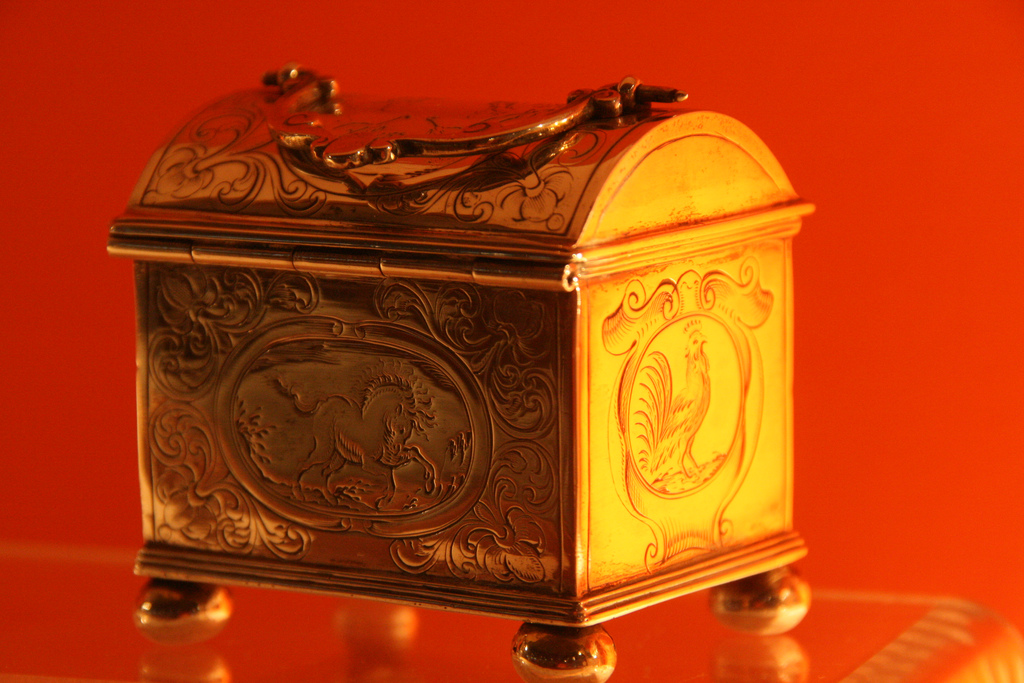 🇳🇱 NetherlandsKnottekistje
A silver Frisian box that replaced a knotted cloth as the token of engagement.Betrothal · Engagement and betrothal
🇳🇱 NetherlandsKnottekistje
A silver Frisian box that replaced a knotted cloth as the token of engagement.Betrothal · Engagement and betrothal
 🇬🇧 United Kingdom and 1 moreLovespoonLlwy garu
A carved wooden spoon given as a romantic gift to show skill and intent.Adornment · Engagement and betrothal
🇬🇧 United Kingdom and 1 moreLovespoonLlwy garu
A carved wooden spoon given as a romantic gift to show skill and intent.Adornment · Engagement and betrothal
 🇫🇷 France and 1 moreAcrostic ring
A jewelled band where gemstone initials spell a secret romantic wordAdornment · Engagement and betrothal
🇫🇷 France and 1 moreAcrostic ring
A jewelled band where gemstone initials spell a secret romantic wordAdornment · Engagement and betrothal
 🇩🇪 Hanover, Germany and 5 moreBridal crownBrautkrone
A headdress worn by brides in Central and Northern Europe to symbolize purity and status.Attire · The ceremony
🇩🇪 Hanover, Germany and 5 moreBridal crownBrautkrone
A headdress worn by brides in Central and Northern Europe to symbolize purity and status.Attire · The ceremony
 🇮🇪 Galway, Ireland and 2 moreCladdagh ringFáinne an Chladaigh
A traditional Irish ring featuring clasped hands, a heart, and a crown to symbolise friendship, love, and loyalty.Adornment · Engagement and betrothal
🇮🇪 Galway, Ireland and 2 moreCladdagh ringFáinne an Chladaigh
A traditional Irish ring featuring clasped hands, a heart, and a crown to symbolise friendship, love, and loyalty.Adornment · Engagement and betrothal
 🇫🇷 Paris, FranceGlobe de mariée
A glass bell jar used in France to hold the bride's bouquet and preserve family memories.Adornment · The weeks before
🇫🇷 Paris, FranceGlobe de mariée
A glass bell jar used in France to hold the bride's bouquet and preserve family memories.Adornment · The weeks before
 🇬🇧 United Kingdom and 3 moreBridal bouquet
The handheld flower arrangement carried by the bride during her wedding ceremony.Attire · The ceremony
🇬🇧 United Kingdom and 3 moreBridal bouquet
The handheld flower arrangement carried by the bride during her wedding ceremony.Attire · The ceremony
 🇫🇷 France and 2 moreBonbonniere
A small decorative container holding sweets given as a wedding favor in several countries.Feast custom · Reception, dance and gifts
🇫🇷 France and 1 moreAcrostic ring
A jewelled band where gemstone initials spell a secret romantic word.Adornment · Engagement and betrothal
🇫🇷 France and 2 moreBonbonniere
A small decorative container holding sweets given as a wedding favor in several countries.Feast custom · Reception, dance and gifts
🇫🇷 France and 1 moreAcrostic ring
A jewelled band where gemstone initials spell a secret romantic word.Adornment · Engagement and betrothal
 🇮🇪 Galway, Ireland and 1 moreMarriage stone
A carved stone bearing the initials and date of a newly married couple, placed on a building to mark their union.Adornment · After the wedding
🇮🇪 Galway, Ireland and 1 moreMarriage stone
A carved stone bearing the initials and date of a newly married couple, placed on a building to mark their union.Adornment · After the wedding
 🇧🇬 Bulgaria and 3 moreMartenitsaмартеница
White and red yarn charms worn in the Balkans to welcome spring and wish for good health.Adornment · The weeks before
🇷🇴 Romania and 3 moreMărțișor
The red and white string charm worn in early spring to welcome the new year.Adornment · The weeks before
🇧🇬 Bulgaria and 3 moreMartenitsaмартеница
White and red yarn charms worn in the Balkans to welcome spring and wish for good health.Adornment · The weeks before
🇷🇴 Romania and 3 moreMărțișor
The red and white string charm worn in early spring to welcome the new year.Adornment · The weeks before
Photo credits on this page
The small pictures above come from Wikimedia Commons under free licences. Some are cropped to fit.
- Gimmal ring: Geni, CC BY-SA 4.0, source
- Bridal crown: Daderot, CC0, source
- Claddagh ring: Royalcladdagh, CC BY-SA 3.0, source
- Globe de mariée: Alain Amet, CC BY 4.0, source
- Fede ring: Anonymous ( Europe ) Unknown author, Public domain, source
- Luckenbooth brooch: Walker14806, CC BY-SA 4.0, source
- Loving cup: Rhodian at English Wikipedia, CC BY-SA 3.0, source
- Kransekake: Kjetil Ree, CC BY-SA 3.0, source
- Knottekistje: mwibawa, CC BY-SA 2.0, source
- Marriage stone: Kim Traynor, CC BY-SA 3.0, source
- Lovespoon: Btinsley785, CC BY-SA 4.0, source
- Rushnyk: Pavlo Boyko, CC BY-SA 2.0, source
- Wimpel: Wikipedia Loves Art participant " The_Grotto ", CC BY-SA 2.5, source
- Bonbonniere: TitineH, CC BY-SA 4.0, source
- Acrostic ring: Jlblackmore, CC BY-SA 4.0, source
- Martenitsa: Unknown author, CC BY-SA 2.0, source
- Bridal bouquet: James Vick's Sons (Rochester, N.Y.); Henry G. Gilbert Nursery and Seed, No restrictions, source