Wedding dress and clothingEurope
Full plaid
A long tartan mantle worn over the shoulder in Scottish Highland dress and military uniforms.
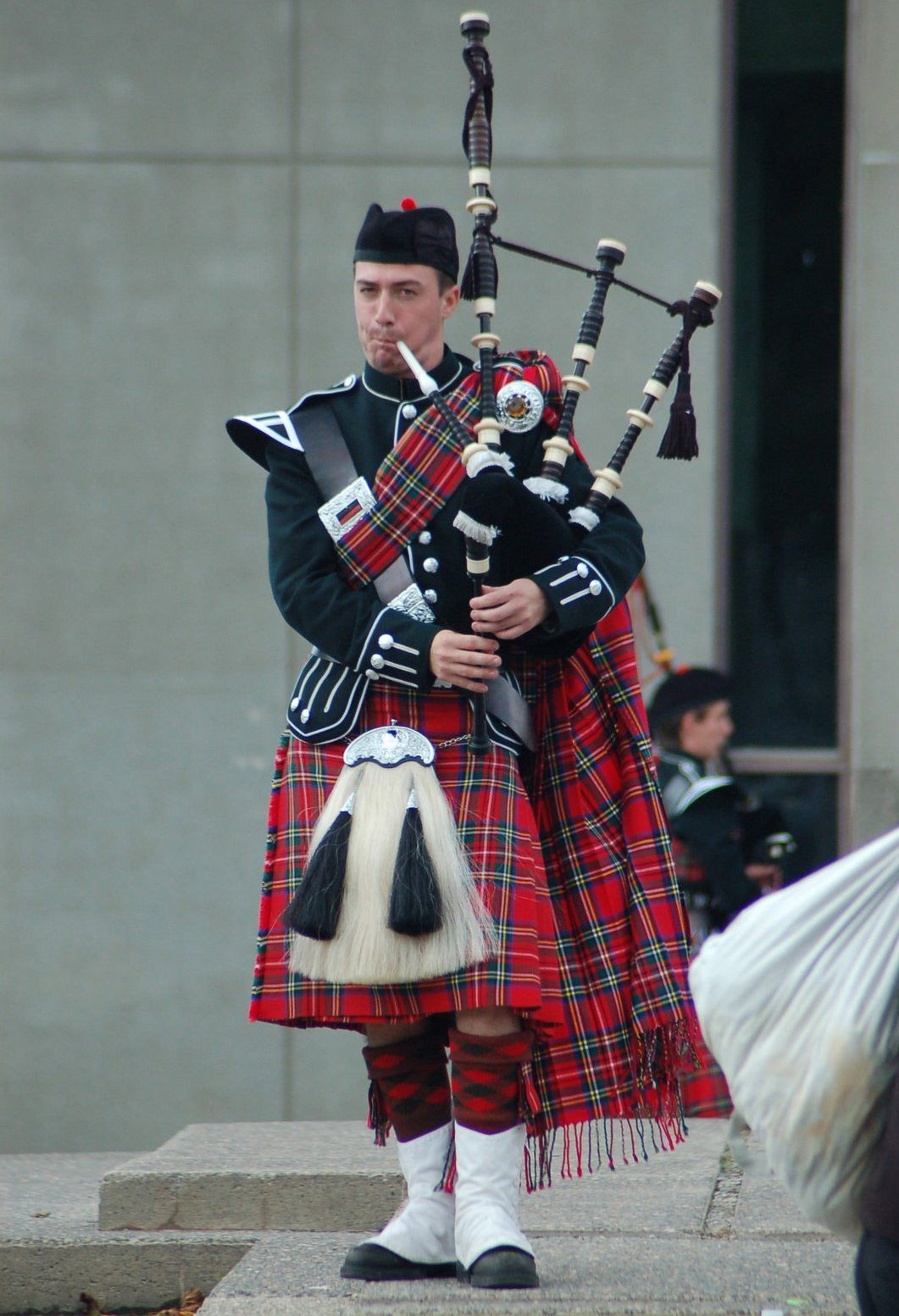
The full plaid is a substantial piece of tartan fabric used as an outer layer in traditional Scottish attire. It is most commonly associated with pipe bands and formal Highland dress, where it serves both decorative and historical functions.
When is Full plaid kept?
Full plaid is kept during formal Highland dress events or military ceremonies.
The full plaid is a large rectangular garment made from tartan cloth. It drapes over the shoulder and chest to complete a formal Highland outfit. This textile item has deep roots in Scottish military history and remains a key element of ceremonial dress for pipers today.
Construction and fit
Modern versions are pleated across their entire length. Half of the fabric is stitched down to keep these folds rigid. The total length reaches roughly twice the height from the floor to the wearer's shoulder. When worn, the material wraps around the torso under the right arm. One end tucks into the waist belt at the back. The other end crosses the chest and rests on the left shoulder. A brooch, often featuring a cairngorm stone, secures the front fold. The fringe hangs horizontally below the knee.
Military origins
This garment entered British Army uniforms in 1725 with independent Highland companies. These units later formed the Black Watch regiment. Soldiers used the twelve-yard double-width tartan as a practical blanket and rain cover for muskets. The fabric provided warmth and protection against the elements. By the nineteenth century, it remained part of regimental full dress. Usage narrowed by 1914 to officers, sergeants, and pipers only.
Visual appearance
To observers, the draped fabric resembles a shoulder cape. It matches the specific tartan pattern of the accompanying kilt. The arrangement creates a layered look that signifies formal status. The horizontal drape and secured folds distinguish it from earlier belted plaids. Today, you will mostly see this item on members of pipe bands choosing full dress uniforms.
How Full plaid is kept
The wearer wraps the tartan around the chest and under the right arm. They twist the fabric on the left shoulder. One loose end falls behind the back and tucks into the waist belt. The leading edge drapes forward over the left shoulder. A brooch pins the front face securely. The lower edge sits parallel to the ground, with fringe hanging just below the knee level.
When and where
It appears during formal Highland dress occasions or military parades. It is not part of daily wear but reserved for ceremonial contexts.
This custom belongs to Scotland. It is strongest within Scottish military regiments and pipe band traditions.
What Full plaid means
The plaid represents Highland heritage and military service. Its dual role as clothing and shelter reflects historical survival needs. The tartan pattern identifies clan or regiment affiliation. The formal draping signals respect for tradition and rank.
Who takes part
- The wearer: Wraps and secures the tartan using a brooch and waist belt
- The tailor: Pleats the fabric and stitches half its length to maintain shape
Then and now
Usage has declined outside of specific ceremonial groups. Most civilians do not wear full plaids. Pipe bands and military units preserve the practice for formal events.
Questions people ask about Full plaid
When is Full plaid kept?
Full plaid is kept during formal Highland dress events or military ceremonies.
What is a full plaid?
It is a long piece of tartan fabric worn over the shoulder in Scottish Highland dress. It matches the kilt and is secured with a brooch.
How does it differ from a belted plaid?
The belted plaid, or great kilt, was wrapped around the waist. The full plaid is a separate mantle worn over the shoulders and chest.
See also
 Bridal bouquetThe handheld flower arrangement carried by the bride during her wedding ceremony.
 Wedding superstitionsTraditional beliefs about luck and omens that shape wedding rituals across cultures
 Wedding dressThe ceremonial garment worn by the bride during her marriage rite.
 White weddingA formal Western ceremony marked by a white bridal gown and traditional Christian rituals.
Good reading and sources
- Full plaid on WikipediaEncyclopedia
- More photos on Wikimedia CommonsPhotos and video
- Wikidata recordOpen data
The facts on this page come from the Wikipedia article "Full plaid", written by its contributors and used under the CC BY-SA 4.0 licence, and from its Wikidata record (CC0). EveryShaadi rewrote the text in its own words, with AI assistance, and compares every page with the article to make sure no passage is copied. It may be reused under the same CC BY-SA 4.0 licence with a link back.
It may contain mistakes. Wedding customs differ from one family, village and community to the next, and the people who keep them know them best. If something is wrong, tell us. Last refreshed 2026-10-06.
More from the United Kingdom
All the traditions of the United Kingdom
🇬🇧 United Kingdom and 3 moreWedding dress
The ceremonial garment worn by the bride during her marriage rite.Attire · The ceremony
🇬🇧 United Kingdom and 2 moreWhite wedding
A formal Western ceremony marked by a white bridal gown and traditional Christian rituals.Attire · Engagement and betrothal
🇬🇧 United Kingdom and 3 moreBridal bouquet
The handheld flower arrangement carried by the bride during her wedding ceremony.Attire · The ceremony
🇬🇧 United Kingdom and 5 moreWedding superstitions
Traditional beliefs about luck and omens that shape wedding rituals across culturesAttire · The weeks before
The same idea elsewhere
The wedding dress and what the couple wear compared 🇪🇹 Addis Ababa, Ethiopia and 1 moreZuria
The ankle-length dress with woven hem bands worn by Tigrinya and Amhara women for weddings and holidays.Attire · The weeks before
🇪🇹 Addis Ababa, Ethiopia and 1 moreZuria
The ankle-length dress with woven hem bands worn by Tigrinya and Amhara women for weddings and holidays.Attire · The weeks before
 🇲🇱 MaliWeddings in Mali
Multi-day Malian wedding traditions blending Islamic rites, civil law, and local customs with bazin attire.Rite · Engagement and betrothal
🇲🇱 MaliWeddings in Mali
Multi-day Malian wedding traditions blending Islamic rites, civil law, and local customs with bazin attire.Rite · Engagement and betrothal
 🇳🇬 Lagos, Nigeria and 3 moreAso ebiAsọ-Ẹbí
Matching outfits worn by groups to show solidarity at Yoruba weddings and other ceremoniesAttire · The weeks before
🇳🇬 Lagos, Nigeria and 3 moreAso ebiAsọ-Ẹbí
Matching outfits worn by groups to show solidarity at Yoruba weddings and other ceremoniesAttire · The weeks before
 🇮🇳 IndiaShankha
White conch shell bangles worn by Bengali Hindu married women as a symbol of their husband's well-being.Adornment · Engagement and betrothal
🇮🇳 IndiaShankha
White conch shell bangles worn by Bengali Hindu married women as a symbol of their husband's well-being.Adornment · Engagement and betrothal