Music, dance and processionEurope
Nijemo kolo
A silent Croatian folk dance where couples move in a circle without music.

Nijemo kolo is a traditional folk dance from the Dalmatian hinterland of Croatia. It features couples moving in a closed circle without any accompanying music or sound.
When is Nijemo kolo kept?
Nijemo kolo is kept at weddings and local festivals.
Nijemo kolo is a unique Croatian folk dance performed entirely in silence. Couples form a tight circle and execute quick, vigorous steps without any musical accompaniment. This tradition highlights community bonding through shared movement rather than sound.
Dance structure
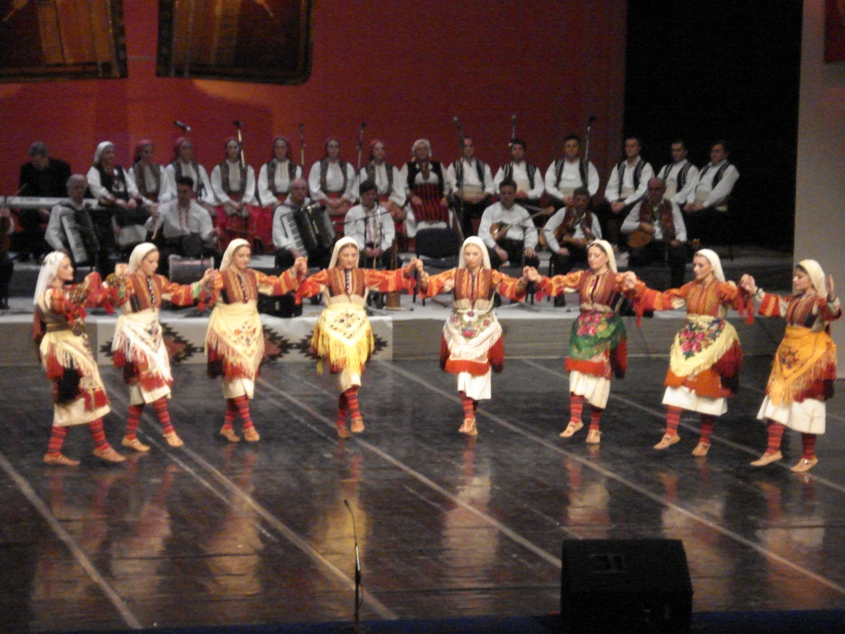
Participants arrange themselves into a closed ring. Men lead their female partners through rapid footwork that can appear intense to observers. The choreography relies on visual cues and rhythm rather than auditory signals. This formation creates a strong sense of unity among the dancers.
Historical context
The practice emerged within the rural communities of southern Croatia. UNESCO recognized its cultural value by adding it to the Representative List of the Intangible Cultural Heritage of Humanity in 2011. This recognition helped preserve the custom for future generations.
Modern performance
Local village groups keep the tradition alive today. You can witness performances at church celebrations, fairs, and cultural competitions. It remains a staple at weddings, offering a distinct alternative to typical musical entertainment during these events.
How Nijemo kolo is kept
Men guide their partners in a tight circle. They perform fast, energetic steps together. No instruments or singing accompany the movement. The silence forces dancers to focus on each other and the group rhythm. This creates a powerful visual spectacle of coordinated motion.
When and where
It occurs during wedding ceremonies and receptions. It also appears at local festivals and church events throughout the year.
The dance originates in the Dalmatian hinterland region of Croatia. It is most commonly seen in villages across this southern area.
What Nijemo kolo means
The silence emphasizes human connection over external noise. The circular formation represents equality and community strength. Moving without music tests the dancers' internal rhythm and mutual trust.
Who takes part
- Men: Lead their partners through the complex steps
- Women: Follow their partners in the circle
- Village groups: Perform together at community events
If you are a guest
Guests watch the silent performance with attention. They appreciate the skill required to maintain rhythm without sound. At weddings, this dance often serves as a memorable centerpiece of the celebration.
Then and now
The dance survives through active village groups. Festivals and competitions provide stages for younger generations to learn it. Its UNESCO status ensures continued support and visibility.

Questions people ask about Nijemo kolo
When is Nijemo kolo kept?
Nijemo kolo is kept at weddings and local festivals.
What makes Nijemo kolo unique?
It is performed completely without music. Dancers rely on visual cues and internal rhythm to stay synchronized while moving quickly in a circle.
Where does this dance come from?
It originates from the Dalmatian hinterland in southern Croatia. It is a traditional folk dance specific to this region.
Is it still practiced today?
Yes, local village groups continue to perform it. It was added to the UNESCO Intangible Cultural Heritage list in 2011 to help preserve it.
See also
 CsárdásA Hungarian folk dance that begins slowly and ends with a fast spin.
 KoloA South Slavic circle dance performed at weddings and social gatherings across the Balkans.BećaracA humorous folk song sung at weddings and village parties in Eastern Croatia
 HoraA circle dance held at weddings across Southeast Europe and among Jewish communities worldwide.
Good reading and sources
The facts on this page come from the Wikipedia article "Nijemo kolo", written by its contributors and used under the CC BY-SA 4.0 licence, and from its Wikidata record (CC0). EveryShaadi rewrote the text in its own words, with AI assistance, and compares every page with the article to make sure no passage is copied. It may be reused under the same CC BY-SA 4.0 licence with a link back.
It may contain mistakes. Wedding customs differ from one family, village and community to the next, and the people who keep them know them best. If something is wrong, tell us. Last refreshed 2026-10-06.
More from Croatia
All the traditions of Croatia
🇭🇺 Hungary and 5 moreCsárdás
A Hungarian folk dance that begins slowly and ends with a fast spin.Performance · Reception, dance and gifts
🇷🇸 Serbia and 2 moreKoloКоло
A South Slavic circle dance performed at weddings and social gatherings across the Balkans.Performance · Reception, dance and gifts
🇷🇴 Romania and 7 moreHorahora (Romanian), horo (Bulgarian), oro (Macedonian), horah (Hebrew)
A circle dance held at weddings across Southeast Europe and among Jewish communities worldwide.Performance · Reception, dance and gifts
🇭🇷 Croatia and 2 moreBećarac
A humorous folk song sung at weddings and village parties in Eastern CroatiaPerformance · The wedding feast
The same idea elsewhere
Wedding music and the dance floor compared 🇳🇪 In-Gall, Niger and 2 moreGuérewol
A week-long courtship dance where Wodaabe men display their beauty to win the attention of marriageable women.Rite · The weeks before
🇳🇪 In-Gall, Niger and 2 moreGuérewol
A week-long courtship dance where Wodaabe men display their beauty to win the attention of marriageable women.Rite · The weeks before
 🇵🇸 Ramallah, Palestine and 4 moreDabkeدبكة
A Levantine line dance performed at weddings to celebrate union and community.Performance · Reception, dance and gifts
🇵🇸 Ramallah, Palestine and 4 moreDabkeدبكة
A Levantine line dance performed at weddings to celebrate union and community.Performance · Reception, dance and gifts
 🇪🇬 Egypt and 5 moreMizmarمزمار (mizmār)
A loud double reed instrument played at weddings and festivals across Egypt and the Levant.Performance · Procession and arrival
🇪🇬 Egypt and 5 moreMizmarمزمار (mizmār)
A loud double reed instrument played at weddings and festivals across Egypt and the Levant.Performance · Procession and arrival
 🇮🇳 Chandigarh, IndiaBhangra
A vigorous Punjabi folk dance performed to the beat of a dhol drum during harvest celebrations.Performance · Reception, dance and gifts
🇮🇳 Chandigarh, IndiaBhangra
A vigorous Punjabi folk dance performed to the beat of a dhol drum during harvest celebrations.Performance · Reception, dance and gifts