Music, dance and processionEuropeJewishSecular and civil
Hora
In its own language: hora (Romanian), horo (Bulgarian), oro (Macedonian), horah (Hebrew)
A circle dance held at weddings across Southeast Europe and among Jewish communities worldwide.
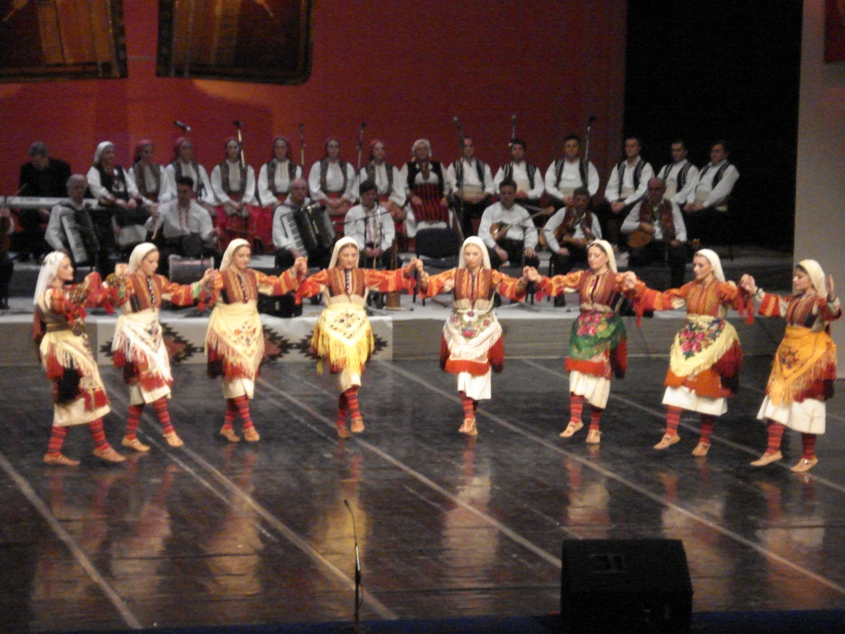
The hora is a circle dance performed in Romania, Bulgaria, North Macedonia, and by Ashkenazi and Sephardic Jews. Dancers hold hands or link arms to move in a ring, often spinning counterclockwise. It serves as a central social activity at wedding receptions and festivals.
When is Hora kept?
Hora is kept at wedding receptions and community festivals.
The hora is a circle dance that brings people together at weddings and festivals. Dancers join hands to form a ring that moves in unison. This custom appears across Southeast Europe and within Jewish diaspora communities. It transforms the reception into a shared celebration of unity and joy.
How the dance works
Participants stand in a circle, holding hands or linking arms behind their backs. The group moves forward toward the left, stepping with the right foot first. They follow with the left foot, then step back with the right and left. The motion is cheerful and fast. In large groups, dancers may form concentric circles or a spiral. Romanian versions often spin counterclockwise. Bulgarian types vary widely, with some regions using simple steps learned quickly and others requiring complex sequences. Macedoro dancers hold hands in a circle for weddings and christenings.
Origins and history
The name derives from the Greek word for dance, cognate with ancient terms for circular movement. Slavic languages use similar words meaning round dance. The practice spread through Southeast Europe, adapting to local rhythms. In the early twentieth century, Jewish immigrants brought the dance to North America. Baruch Agadati choreographed a specific version in 1924 based on a Moldavian tune. This became known as Hora Agadati and served as a symbol for Zionist agricultural movements. It gained popularity in Israeli kibbutzim before spreading globally.
Jewish wedding customs
At Jewish weddings, the horah is a highlight of the reception. Dancers lift the bride and groom onto chairs while holding a handkerchief between them. This tradition honors the couple during the dance. The same chair-lifting custom appears at b'nai mitzvah celebrations. Music often shifts from a slow triple meter to a faster duple beat. Songs like Hava Nagila accompany the dancing. The practice connects modern Jewish communities to their Eastern European roots and fosters collective participation.
Regional variations
Romania features the Horă Unirii, a patriotic dance linked to national union. Moldova shares similar traditions. Bulgaria offers over one hundred distinct types, each with unique regional rhythms. North Macedonia uses the Cyrillic spelling oro for its circle dances. Turkey hosts the Horon in the Black Sea region, which differs from the Balkan style. Roma communities perform the horo with skill, appreciating neighboring ethnic music. These variations reflect local histories while maintaining the core circle formation.
How Hora is kept
Dancers join hands to form a circle. They step forward to the left, then back, moving in a continuous ring. The pace varies from slow and limping to fast and energetic. At Jewish weddings, the couple is lifted onto chairs held aloft by the dancers. A handkerchief is placed between them. The music drives the rhythm, shifting between meters. Participants smile and engage fully in the communal movement.
When and where
It occurs during wedding receptions and festivals. The dance follows the main ceremony. It continues throughout the evening as a social activity. Dates are not fixed to specific calendar days but depend on the event schedule.
The custom is strongest in Romania, Bulgaria, and North Macedonia. It is also central to Jewish communities in Israel, the United States, and Canada. Urban and rural areas both practice it. The dance adapts to local venues and crowd sizes.
What Hora means
The circle represents unity and equality among participants. No one stands apart. The movement symbolizes shared joy and community strength. For Jewish communities, it connects generations and preserves cultural heritage. The chair lifting honors the couple's new status. The dance reinforces social bonds and collective identity.
Who takes part
- The couple: They are lifted onto chairs during the Jewish horah.
- The dancers: They hold hands and move in a circle.
- The musicians: They play traditional folk tunes or klezmer music.
- The choreographer: They design specific steps for regional or community groups.
If you are a guest
Guests join the circle by holding hands with neighbors. They follow the leader's steps without needing prior training. Men and women dance together in most variants. Guests may clap or sing along. They participate actively rather than watching passively.
Then and now
The dance remains popular at weddings and festivals. Modern adaptations include faster tempos and mixed-gender circles. Some traditional forms face decline as younger generations prefer other styles. However, community groups keep older versions alive. The Jewish horah continues to be a staple at celebrations worldwide.
On the wedding table
Symbols: The ring

Questions people ask about Hora
When is Hora kept?
Hora is kept at wedding receptions and community festivals.
What is the hora?
It is a circle dance performed at weddings and festivals. Dancers hold hands and move in a ring. It appears in Southeast Europe and among Jewish communities.
How do you dance it?
Join hands with others to form a circle. Step forward to the left, then back. Move in unison with the group. The pace can be slow or fast depending on the region.
Why are the couple lifted?
In Jewish weddings, dancers lift the bride and groom onto chairs. This honors them during the horah. A handkerchief is held between them. It symbolizes their elevated status.
See also
 CsárdásA Hungarian folk dance that begins slowly and ends with a fast spin.
 HalayA traditional line and circle dance performed across Turkey and surrounding regions at weddings.
 HoronThe fast shoulder-shimmying line dance of the Eastern Black Sea Region performed at weddings and festivals
 Bulgarian wedding musicFast-paced instrumental music played at Bulgarian weddings that blends folk, Romani, and Turkish styles.
Good reading and sources
- Encyclopaedia BritannicaArticle
- Library of Congress CatalogLibrary of Congress, Article
- Library of Congress CatalogLibrary of Congress, Article
- Hora (dance) on WikipediaEncyclopedia
- More photos on Wikimedia CommonsPhotos and video
- Wikidata recordOpen data
The facts on this page come from the Wikipedia article "Hora (dance)", written by its contributors and used under the CC BY-SA 4.0 licence, and from its Wikidata record (CC0). EveryShaadi rewrote the text in its own words, with AI assistance, and compares every page with the article to make sure no passage is copied. It may be reused under the same CC BY-SA 4.0 licence with a link back.
It may contain mistakes. Wedding customs differ from one family, village and community to the next, and the people who keep them know them best. If something is wrong, tell us. Last refreshed 2026-10-05.
More from Romania
All the traditions of Romania 🇷🇴 Romania and 4 moreCălușariCălușarii
A traditional Romanian spring dance and male society known for acrobatic leaps and ritual healing.Performance · The weeks before
🇷🇴 Romania and 4 moreCălușariCălușarii
A traditional Romanian spring dance and male society known for acrobatic leaps and ritual healing.Performance · The weeks before
 🇷🇸 Serbia and 5 moreČočekčočек (Serbian/Macedonian), кючек (Bulgarian), çyçek/qyqek (Albanian), sistemul (Romanian), Tsifteteli (Greek)
A Balkan wedding dance with a distinctive nine-beat rhythm, kept alive by Romani musicians and village celebrations.Performance · The wedding feast
🇷🇸 Serbia and 5 moreČočekčočек (Serbian/Macedonian), кючек (Bulgarian), çyçek/qyqek (Albanian), sistemul (Romanian), Tsifteteli (Greek)
A Balkan wedding dance with a distinctive nine-beat rhythm, kept alive by Romani musicians and village celebrations.Performance · The wedding feast
 🇷🇴 Romania and 5 moreKlezmerקלעזמער
The instrumental wedding music of Ashkenazi Jews, blending Eastern European and Jewish ritual melodies.Performance · Engagement and betrothal
🇷🇴 Romania and 1 morePerinița
A Romanian circle dance where a pillow marks the last partner dance for unmarried youth before a wedding.Performance · The eve
🇷🇴 Romania and 5 moreKlezmerקלעזמער
The instrumental wedding music of Ashkenazi Jews, blending Eastern European and Jewish ritual melodies.Performance · Engagement and betrothal
🇷🇴 Romania and 1 morePerinița
A Romanian circle dance where a pillow marks the last partner dance for unmarried youth before a wedding.Performance · The eve
The same idea elsewhere
Wedding music and the dance floor compared
🇹🇷 Kayseri, Turkey and 4 moreHalay
A traditional line and circle dance performed across Turkey and surrounding regions at weddings.Performance · The ceremony
 🇮🇳 IndiaOdia Hindu weddingBahaghara (ଓଡ଼ିଆ ବାହାଘର)
The traditional Hindu marriage ceremony of the Odia people in Odisha, India.Rite · Engagement and betrothal
🇮🇳 IndiaOdia Hindu weddingBahaghara (ଓଡ଼ିଆ ବାହାଘର)
The traditional Hindu marriage ceremony of the Odia people in Odisha, India.Rite · Engagement and betrothal
 🇦🇿 AzerbaijanAzerbaijani wedding traditionsAzərbaycanın toy adətləri
The multi-step family rituals of Azerbaijani weddings, from matchmaking to the henna night.Rite · Finding a match
🇦🇿 AzerbaijanAzerbaijani wedding traditionsAzərbaycanın toy adətləri
The multi-step family rituals of Azerbaijani weddings, from matchmaking to the henna night.Rite · Finding a match
 🇮🇷 Tehran, Iran and 1 moreIranian weddingمراسم عروسی در ایران
A multi-stage ceremony rooted in Zoroastrianism and Islam that binds families through courtship, feasts, and sacred vowsRite · Finding a match
🇮🇷 Tehran, Iran and 1 moreIranian weddingمراسم عروسی در ایران
A multi-stage ceremony rooted in Zoroastrianism and Islam that binds families through courtship, feasts, and sacred vowsRite · Finding a match