Music, dance and processionEurope
Kolo
In its own language: Коло
A South Slavic circle dance performed at weddings and social gatherings across the Balkans.

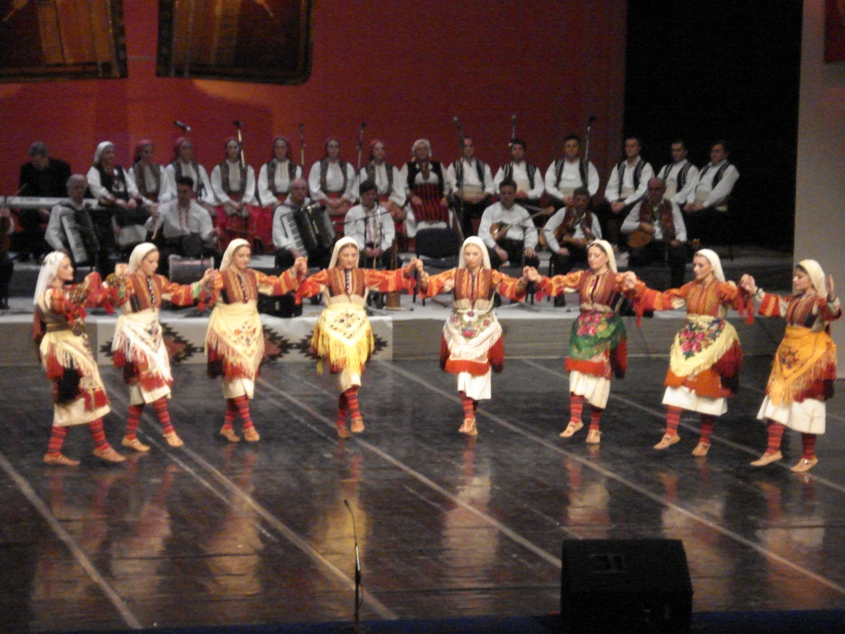
The kolo is a circle dance found in Bosnia and Herzegovina, Croatia, and Serbia. Dancers hold hands or waists to form circles or lines while moving their feet in simple steps. It is a key part of wedding celebrations and other community events in these regions.
When is Kolo kept?
Kolo is kept at weddings and social ceremonies.
The kolo is a traditional circle dance that brings communities together in the Balkans. People join hands to move in rhythm during weddings and festivals. This shared movement strengthens bonds between neighbors and families. The dance requires little upper body motion but demands skillful footwork. It remains a living tradition in Serbia, Croatia, and Bosnia and Herzegovina.
How the dance works
Dancers link hands or hold waists to create a circle or line. Groups range from three people to dozens. The steps stay low, focusing on foot placement rather than arm movements. Beginners learn basic patterns quickly. Skilled dancers add complex rhythms like syncopation. Each area has its own version of the steps. Mastering every local style takes years even for experts.
Music and costumes
Fast accordion music usually guides the tempo. Traditional clothing changes depending on the region. Border areas often share similar styles. The most common type uses standard steps with accordion accompaniment. Some versions require mixed gender groups while others separate men and women. The visual appeal comes from regional dress variations rather than choreography complexity.
Where it is kept
The dance appears across Bosnia, Croatia, and Serbia. UNESCO recognized it as intangible heritage for Serbia in 2017. Similar circle dances exist elsewhere in the Balkans. Bulgaria calls theirs horo while North Macedonia uses oro. Hungarian communities near Mohács also preserve a version called Kalala. These connections show how the tradition spread through neighboring populations over time.
How Kolo is kept
Groups of three or more dancers link hands or hold waists. They form circles or parallel lines. Feet move in simple steps while the upper body stays still. Accordion music sets a fast pace. Experienced participants add rhythmic details. Regional variations dictate specific step patterns. Both mixed and single-gender groups perform the dance at weddings and social events.
When and where
It happens during weddings and social ceremonies. The timing depends on the event schedule rather than a fixed calendar date. Families organize these gatherings throughout the year based on personal milestones.
The custom thrives in Serbia, Croatia, and Bosnia and Herzegovina. It also appears in parts of Hungary near Mohács. Urban centers keep the tradition alive alongside rural villages. Community halls and outdoor spaces host these gatherings.
What Kolo means
The linked hands represent unity and mutual support among participants. Moving together in rhythm reinforces community bonds. Sharing the same space and pace creates a sense of belonging. The dance celebrates collective joy rather than individual performance skills.
Who takes part
- Dancers: Hold hands and follow foot steps in a circle
- Musicians: Play fast accordion music to guide the tempo
- Elders: Demonstrate advanced steps and regional variations
If you are a guest
Guests may join the circle by linking hands with others. They follow the basic steps led by experienced dancers. Wearing traditional regional clothing is common but not required. Observers watch from the sides until invited to participate.
Then and now
The dance remains active in daily life and special occasions. Younger generations learn the steps through community events. UNESCO recognition helps preserve the Serbian variant specifically. Other regions maintain their own distinct versions without formal protection.


Questions people ask about Kolo
When is Kolo kept?
Kolo is kept at weddings and social ceremonies.
What is the kolo?
It is a South Slavic circle dance where participants hold hands or waists. They move in circles or lines during weddings and social gatherings. The steps focus on footwork while keeping the upper body still.
Is it legal?
Yes, the kolo is a cultural practice freely performed in Serbia, Croatia, and Bosnia and Herzegovina. It faces no legal restrictions. UNESCO listed it as intangible heritage for Serbia in 2017.
See also
 CsárdásA Hungarian folk dance that begins slowly and ends with a fast spin.UlulationA high-pitched trilling sound made by women to celebrate weddings and share good news across many cultures.
 DabkeA Levantine line dance performed at weddings to celebrate union and community.
 KartuliA romantic Georgian wedding dance where the couple dances apart without touching.
Good reading and sources
- Encyclopaedia BritannicaArticle
- Kolo, traditional folk danceUNESCO, Heritage listing
- Kolo, traditional folk danceUNESCO, Article
- Kolo (dance) on WikipediaEncyclopedia
- More photos on Wikimedia CommonsPhotos and video
- Wikidata recordOpen data
The facts on this page come from the Wikipedia article "Kolo (dance)", written by its contributors and used under the CC BY-SA 4.0 licence, and from its Wikidata record (CC0). EveryShaadi rewrote the text in its own words, with AI assistance, and compares every page with the article to make sure no passage is copied. It may be reused under the same CC BY-SA 4.0 licence with a link back.
It may contain mistakes. Wedding customs differ from one family, village and community to the next, and the people who keep them know them best. If something is wrong, tell us. Last refreshed 2026-10-05.
More from Serbia
All the traditions of Serbia 🇧🇬 Bulgaria and 5 moreBulgarian wedding musicсватбарска музика
Fast-paced instrumental music played at Bulgarian weddings that blends folk, Romani, and Turkish styles.Performance · The ceremony
🇧🇬 Bulgaria and 5 moreBulgarian wedding musicсватбарска музика
Fast-paced instrumental music played at Bulgarian weddings that blends folk, Romani, and Turkish styles.Performance · The ceremony
 🇷🇴 Romania and 7 moreHorahora (Romanian), horo (Bulgarian), oro (Macedonian), horah (Hebrew)
A circle dance held at weddings across Southeast Europe and among Jewish communities worldwide.Performance · Reception, dance and gifts
🇷🇴 Romania and 7 moreHorahora (Romanian), horo (Bulgarian), oro (Macedonian), horah (Hebrew)
A circle dance held at weddings across Southeast Europe and among Jewish communities worldwide.Performance · Reception, dance and gifts
 🇵🇱 Poland and 6 moreKolachколач (kolach), калач (kalach), kołacz, colac, kalács
A braided or ring-shaped bread that marks weddings and major holidays across Eastern Europe.Feast custom · Engagement and betrothal
🇵🇱 Poland and 6 moreKolachколач (kolach), калач (kalach), kołacz, colac, kalács
A braided or ring-shaped bread that marks weddings and major holidays across Eastern Europe.Feast custom · Engagement and betrothal
 🇩🇪 Hanover, Germany and 5 moreBridal crownBrautkrone
A headdress worn by brides in Central and Northern Europe to symbolize purity and status.Attire · The ceremony
🇩🇪 Hanover, Germany and 5 moreBridal crownBrautkrone
A headdress worn by brides in Central and Northern Europe to symbolize purity and status.Attire · The ceremony
The same idea elsewhere
Wedding music and the dance floor compared 🇹🇷 Kayseri, Turkey and 4 moreHalay
A traditional line and circle dance performed across Turkey and surrounding regions at weddings.Performance · The ceremony
🇹🇷 Kayseri, Turkey and 4 moreHalay
A traditional line and circle dance performed across Turkey and surrounding regions at weddings.Performance · The ceremony
 🇲🇱 MaliWeddings in Mali
Multi-day Malian wedding traditions blending Islamic rites, civil law, and local customs with bazin attire.Rite · Engagement and betrothal
🇲🇱 MaliWeddings in Mali
Multi-day Malian wedding traditions blending Islamic rites, civil law, and local customs with bazin attire.Rite · Engagement and betrothal
 🇮🇷 Tehran, Iran and 1 moreIranian weddingمراسم عروسی در ایران
A multi-stage ceremony rooted in Zoroastrianism and Islam that binds families through courtship, feasts, and sacred vowsRite · Finding a match
🇮🇷 Tehran, Iran and 1 moreIranian weddingمراسم عروسی در ایران
A multi-stage ceremony rooted in Zoroastrianism and Islam that binds families through courtship, feasts, and sacred vowsRite · Finding a match