Matchmaking, courtship and engagementEuropeOrthodox and Eastern ChristianCatholic
Adelphopoiesis
A historical Eastern Christian ceremony uniting two people of the same sex in a recognized spiritual bond.
Adelphopoiesis is a ritual from the Byzantine tradition that formally united two individuals, usually men, as spiritual brothers. Practiced in Eastern Orthodox and Catholic churches between the ninth and twentieth centuries, it created a sacred kinship distinct from marriage. The rite involved prayers and the exchange of baptismal crosses to seal the lifelong commitment.
When is Adelphopoiesis kept?
Adelphopoiesis is kept on historically within the church calendar.
Adelphopoiesis was a historic Christian rite that bound two people together as spiritual siblings. Originating in the Byzantine Empire, this ceremony offered a formal way for same-sex friends to share a deep, sacramental bond. It stands as a unique example of pre-modern religious recognition for close same-sex relationships.
What the rite involves
The ceremony established participants as spiritual brothers through specific prayers found in Byzantine manuscripts. A key physical act was the exchange of baptismal crosses, which the partners wore for life. This private exchange symbolized their shared faith and mutual support. Unlike marriage rites, the adelphopoiesis did not include crowning. The ritual drew on saintly examples like Sergius and Bacchus to frame the union as holy and enduring.
Scholarly debates
Modern attention to this practice began with historian John Boswell, who argued it functioned as a same-sex marriage. His view sparked intense debate among academics and religious leaders. Critics like Claudia Rapp suggested the rite was merely for monastic companionship or political pacts. The Greek Orthodox Church rejects the marriage interpretation, translating the term as fraternization. Some scholars point to Serbian records showing romantic elements in similar local traditions.
Theological meaning
Priest Pavel Florensky described the bond as a community molecule that transcends individualism. He saw it as combining different forms of love into a single philic devotion. The relationship relied on shared Eucharist and co-martyrdom rather than sexual intimacy. Florensky compared the ideal friendship to that of David and Jonathan, emphasizing loyalty and spiritual insight over utilitarian gain.
How Adelphopoiesis is kept
Two participants stood before a priest who recited prayers invoking saints known for close bonds. They exchanged baptismal crosses, wearing them as permanent tokens of their spiritual brotherhood. The ritual focused on shared faith and mutual support without the crowning found in marriage ceremonies.
When and where
The practice existed from the ninth to the fifteenth centuries in manuscripts and continued in some regions until the early twentieth century.
It originated in the Byzantine tradition and spread through Eastern Orthodox communities in Greece, Russia, and Serbia.
What Adelphopoiesis means
The exchange of crosses represented a shared life in Christ. The rite aimed to create a sacred kinship that provided emotional and spiritual stability. It framed same-sex friendship as a holy vocation capable of sustaining believers through hardship.
Who takes part
- The participants: Exchange baptismal crosses and accept spiritual brotherhood
- The priest: Recites the binding prayers and oversees the ritual
Then and now
The practice is no longer performed as a standard church rite. It remains a subject of academic study and theological discussion regarding the history of same-sex relationships in Christianity.
On the wedding table
Symbols: Water and washing
Questions people ask about Adelphopoiesis
When is Adelphopoiesis kept?
Adelphopoiesis is kept on historically within the church calendar.
Is adelphopoiesis a form of marriage?
Scholars disagree. John Boswell argued it functioned like a marriage, while others say it was for platonic friendship or monastic living. The Greek Orthodox Church views it as chaste fraternization.
What objects are used in the ritual?
The main object is the baptismal cross. Participants exchanged these crosses to wear for life as a sign of their spiritual bond and shared faith.
See also
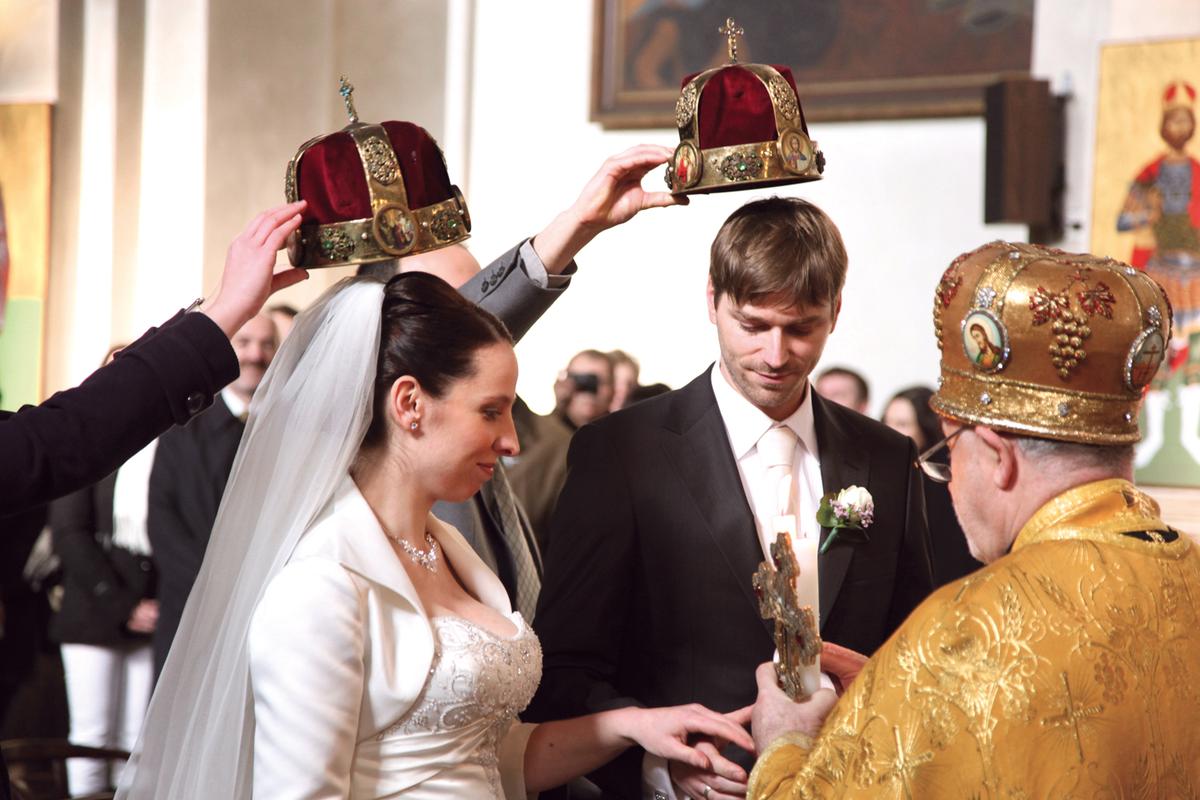 Eastern Orthodox marriageThe Byzantine Rite ceremony where a priest crowns the couple to seal their union in Christ.
 Kazakh wedding ceremonyThe multi-stage Kazakh marriage process featuring the face-revealing feast and the Islamic religious contract.
 MantillaA lace or silk veil worn over the head and shoulders by women in Spain and Latin America
 Same-sex marriage in GreeceThe legal recognition of marriage between two people of the same sex, effective since February 2024.
Good reading and sources
The facts on this page come from the Wikipedia article "Adelphopoiesis", written by its contributors and used under the CC BY-SA 4.0 licence, and from its Wikidata record (CC0). EveryShaadi rewrote the text in its own words, with AI assistance, and compares every page with the article to make sure no passage is copied. It may be reused under the same CC BY-SA 4.0 licence with a link back.
It may contain mistakes. Wedding customs differ from one family, village and community to the next, and the people who keep them know them best. If something is wrong, tell us. Last refreshed 2026-10-05.
More from Greece
All the traditions of Greece 🇬🇷 Greece and 2 moreEngagement party
A gathering to announce a new engagement and introduce the two families before the wedding.Betrothal · Engagement and betrothal
🇬🇷 Greece and 2 moreEngagement party
A gathering to announce a new engagement and introduce the two families before the wedding.Betrothal · Engagement and betrothal
 🇬🇷 Greece and 1 moreEpithalamium
A poem or song written to celebrate a bride as she goes to her wedding chamber.Performance · The eve
🇬🇷 Greece and 1 moreEpithalamium
A poem or song written to celebrate a bride as she goes to her wedding chamber.Performance · The eve
 🇬🇷 Greece and 5 moreWedding ring
A metal circle worn on the finger to show that a person is married.Attire · Engagement and betrothal
🇬🇷 Greece and 5 moreWedding ring
A metal circle worn on the finger to show that a person is married.Attire · Engagement and betrothal
 🇬🇧 United Kingdom and 5 moreWedding superstitions
Traditional beliefs about luck and omens that shape wedding rituals across culturesAttire · The weeks before
🇬🇧 United Kingdom and 5 moreWedding superstitions
Traditional beliefs about luck and omens that shape wedding rituals across culturesAttire · The weeks before
The same idea elsewhere
Rings, knots and tokens of promise compared 🇮🇷 Iran and 1 moreNikahnikāḥ (Arabic: نِكَاح)
The Islamic marriage contract that establishes a binding union between two people.Vow · Engagement and betrothal
🇮🇷 Iran and 1 moreNikahnikāḥ (Arabic: نِكَاح)
The Islamic marriage contract that establishes a binding union between two people.Vow · Engagement and betrothal
 🇰🇷 South Korea and 5 moreBlessing ceremony of the Unification ChurchHoly Marriage Blessing Ceremony (축복결혼식)
A large-scale marriage rededication or new union ceremony that engrafts couples into a sinless lineage.Rite · Engagement and betrothal
🇰🇷 South Korea and 5 moreBlessing ceremony of the Unification ChurchHoly Marriage Blessing Ceremony (축복결혼식)
A large-scale marriage rededication or new union ceremony that engrafts couples into a sinless lineage.Rite · Engagement and betrothal
 🇪🇬 Egypt and 4 moreWaist beads
Strands of glass or seed worn around the hips to mark womanhood and track body changes in West and North Africa.Adornment · Engagement and betrothal
🇪🇬 Egypt and 4 moreWaist beads
Strands of glass or seed worn around the hips to mark womanhood and track body changes in West and North Africa.Adornment · Engagement and betrothal
 🇰🇷 Seoul, South Korea and 3 moreBlessing ceremony
The large-scale marriage rite of the Unification Church where couples are matched and blessed by their leaders.Rite · The ceremony
🇰🇷 Seoul, South Korea and 3 moreBlessing ceremony
The large-scale marriage rite of the Unification Church where couples are matched and blessed by their leaders.Rite · The ceremony