Music, dance and processionEurope
Bulgarian wedding music
In its own language: сватбарска музика
Fast-paced instrumental music played at Bulgarian weddings that blends folk, Romani, and Turkish styles.

Bulgarian wedding music is a lively genre performed at celebrations in Bulgaria and among diaspora communities. It combines traditional rhythms with instruments like the clarinet and saxophone to drive hours of dancing.
When is Bulgarian wedding music kept?
Bulgarian wedding music is kept during wedding receptions and banquets.
Bulgarian wedding music serves as the energetic heartbeat of modern nuptial celebrations in Bulgaria. This instrumental style fuses local folk traditions with Romani and Turkish influences. Musicians play complex rhythms on brass and woodwind instruments to encourage continuous dancing throughout the event.
Origins and history
The genre emerged in the late 1960s as musicians began blending various regional sounds. Ivan Paparov established early orchestral ensembles in Stara Zagora around 1974. He created a loose structure that allowed for improvisation and audience participation. The style faced suppression under the communist regime because it incorporated non-Bulgarian elements. After 1989, the music gained widespread popularity and spread to Europe and North America.
Musical characteristics
Performers use instruments such as the clarinet, saxophone, accordion, and synthesizer. The sound is loud and designed to sustain high energy levels for several hours. Composers favor additive meters like rachenitsa alongside standard time signatures. The arrangement often features solos that highlight individual skill while maintaining a dynamic flow. American jazz also influences the harmonic structure of these pieces.
Key performers
Ivo Papazov is a leading figure who introduced the clarinet into the ensemble format. His work sparked controversy due to its strong Turkish and Romani roots. Yuri Yunakov, another prominent artist, helped popularize the style internationally. His band performs dances at rapid speeds, showcasing technical precision. These artists define the modern sound of the genre through their innovative arrangements.
How Bulgarian wedding music is kept
Wedding bands consisting of both Bulgarian and Romani musicians perform this music. They play for hours during the banquet and subsequent dancing. The repertoire includes traditional dance forms like pravo horo and rachenitsa. Guests participate actively by dancing along to the fast-paced rhythms. The performance creates a festive atmosphere that lasts through the entire reception.
When and where
It is played during the wedding ceremony and extends through the long banquet and dancing sessions. The music continues for several hours after the formal rituals conclude.
The custom is strongest in Bulgaria, particularly in the southern Balkan region. It is also performed by diaspora communities in the United States, Turkey, Greece, North Macedonia, and Serbia.
What Bulgarian wedding music means
The music represents a fusion of cultural identities within Bulgarian society. It honors local folk traditions while acknowledging the contributions of Romani and Turkish neighbors. The lively tempo symbolizes joy and communal celebration. The improvisational nature reflects spontaneity and shared happiness among the wedding party.
Who takes part
- The wedding band: Plays instrumental pieces featuring clarinet, saxophone, and accordion
- The guests: Dances continuously to the fast-paced rhythms throughout the reception
- The musicians: Improvises solos and adapts the tempo to keep the energy high
If you are a guest
Guests stand up to dance as soon as the band begins playing. They follow the lead of the wedding party in performing traditional steps. The loud volume encourages active participation rather than passive listening. People stay on the dance floor for hours to celebrate the couple.
Then and now
The genre has expanded beyond Bulgaria to international audiences. Western musicians have cited its unusual time signatures as an influence. Diaspora communities maintain the tradition in countries like the United States. The style continues to evolve while preserving its core rhythmic identity.

Questions people ask about Bulgarian wedding music
When is Bulgarian wedding music kept?
Bulgarian wedding music is kept during wedding receptions and banquets.
What instruments are used?
Ensembles typically feature the clarinet, saxophone, accordion, electric bass, and synthesizer. These tools create the loud, driving sound characteristic of the genre.
Is it legal?
Yes. The music is a celebrated cultural art form with no legal restrictions. It was previously suppressed but is now fully embraced.
See also
 Chicken DanceA novelty polka song and accompanying hand movements performed at weddings and festivals.PentozaliThe vigorous Cretan war dance of high jumps and improvisation that marks the wedding procession.
 HoronThe fast shoulder-shimmying line dance of the Eastern Black Sea Region performed at weddings and festivals
 Conga lineA long processing line dance that links dancers in single file to a rhythmic drum beat.
Good reading and sources
The facts on this page come from the Wikipedia article "Bulgarian wedding music", written by its contributors and used under the CC BY-SA 4.0 licence, and from its Wikidata record (CC0). EveryShaadi rewrote the text in its own words, with AI assistance, and compares every page with the article to make sure no passage is copied. It may be reused under the same CC BY-SA 4.0 licence with a link back.
It may contain mistakes. Wedding customs differ from one family, village and community to the next, and the people who keep them know them best. If something is wrong, tell us. Last refreshed 2026-10-05.
More from Bulgaria
All the traditions of Bulgaria 🇭🇺 Hungary and 5 moreCsárdás
A Hungarian folk dance that begins slowly and ends with a fast spin.Performance · Reception, dance and gifts
🇭🇺 Hungary and 5 moreCsárdás
A Hungarian folk dance that begins slowly and ends with a fast spin.Performance · Reception, dance and gifts
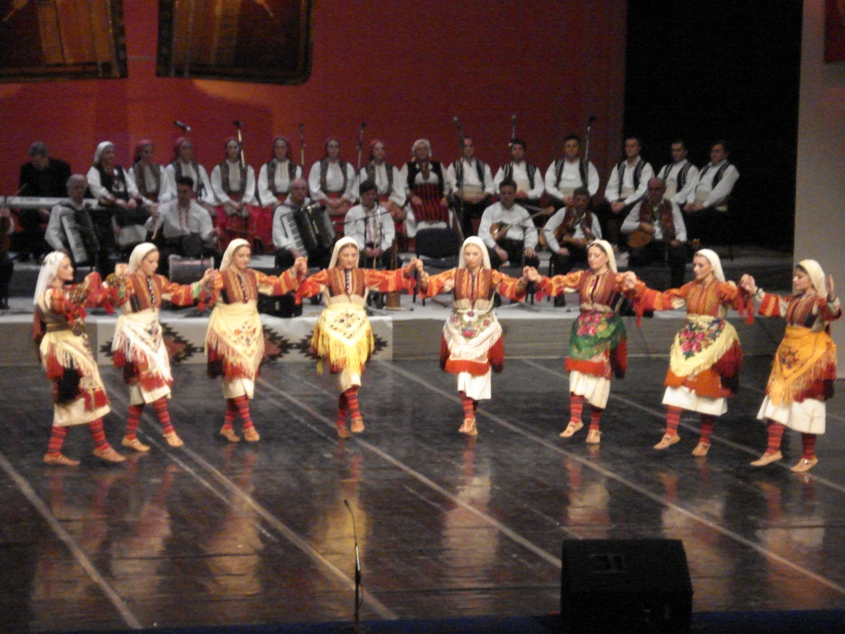 🇷🇴 Romania and 7 moreHorahora (Romanian), horo (Bulgarian), oro (Macedonian), horah (Hebrew)
A circle dance held at weddings across Southeast Europe and among Jewish communities worldwide.Performance · Reception, dance and gifts
🇷🇴 Romania and 7 moreHorahora (Romanian), horo (Bulgarian), oro (Macedonian), horah (Hebrew)
A circle dance held at weddings across Southeast Europe and among Jewish communities worldwide.Performance · Reception, dance and gifts
 🇷🇺 Russia and 5 moreBread and salt
A traditional welcome offering of bread and salt to guests or newlyweds in Slavic, Baltic, and Balkan cultures.Feast custom · The weeks before
🇺🇦 Ukraine and 4 moreKorovaiкоровай (Ukrainian), каравай (Russian), кравай (Bulgarian)
A large round braided bread shared at weddings to bless the couple and unite the community.Feast custom · The ceremony
🇷🇺 Russia and 5 moreBread and salt
A traditional welcome offering of bread and salt to guests or newlyweds in Slavic, Baltic, and Balkan cultures.Feast custom · The weeks before
🇺🇦 Ukraine and 4 moreKorovaiкоровай (Ukrainian), каравай (Russian), кравай (Bulgarian)
A large round braided bread shared at weddings to bless the couple and unite the community.Feast custom · The ceremony
The same idea elsewhere
Wedding music and the dance floor compared 🇲🇱 MaliWeddings in Mali
Multi-day Malian wedding traditions blending Islamic rites, civil law, and local customs with bazin attire.Rite · Engagement and betrothal
🇲🇱 MaliWeddings in Mali
Multi-day Malian wedding traditions blending Islamic rites, civil law, and local customs with bazin attire.Rite · Engagement and betrothal
 🇦🇴 Luanda, Angola and 4 moreKizomba
A slow, sensual partner dance from Angola that turns wedding parties into intimate social gatherings.Performance · The wedding feast
🇦🇴 Luanda, Angola and 4 moreKizomba
A slow, sensual partner dance from Angola that turns wedding parties into intimate social gatherings.Performance · The wedding feast
 🇵🇸 Ramallah, Palestine and 4 moreDabkeدبكة
A Levantine line dance performed at weddings to celebrate union and community.Performance · Reception, dance and gifts
🇪🇬 Egypt and 3 moreZaffaزفّة
A lively musical procession that marks the start of wedding festivities in Arab culture.Performance · The weeks before
🇵🇸 Ramallah, Palestine and 4 moreDabkeدبكة
A Levantine line dance performed at weddings to celebrate union and community.Performance · Reception, dance and gifts
🇪🇬 Egypt and 3 moreZaffaزفّة
A lively musical procession that marks the start of wedding festivities in Arab culture.Performance · The weeks before