Feasts, food and drinkEuropeCatholicOrthodox and Eastern Christian
Kolach
In its own language: колач (kolach), калач (kalach), kołacz, colac, kalács
A braided or ring-shaped bread that marks weddings and major holidays across Eastern Europe.

This baked good appears in Central and Eastern European cultures as a centerpiece for nuptials, Christmas, Easter, and harvest festivals. Its circular form signals unity and eternity to the communities that prepare it. The practice stretches back to early Slavic traditions and remains active in rural villages today.
When is Kolach kept?
Kolach is kept during weddings, Christmas, Easter, and harvest festivals.
The kolach is a ceremonial bread central to life events in Eastern Europe. Families bake these intricate loaves to welcome guests, bless new unions, and honor ancestors. The shape represents the cycle of life and community bonds. It serves as both food and symbol during key moments like engagements and holiday suppers.
What the bread looks like
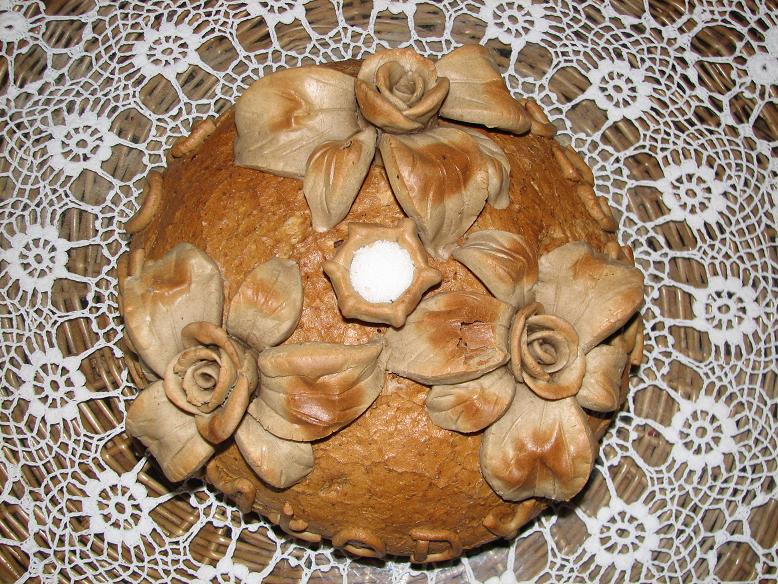
Bakers shape this loaf into rings, circles, or braids using wheat or rye flour. Some versions are sweet with fillings like cheese or poppy seeds, while others remain savory. Decorations often include dough birds, grain ears, or floral patterns. In Russia, the kalach features a distinct thick end and a thin handle. Hungarian bakers create a sweet, brioche-like version called kalács. Romanian colaci are typically braided loops.
Wedding and engagement roles
At Polish weddings, the kołacz welcomes guests and signifies hospitality. Ukrainian families present kolaches during betrothal rituals to bless the couple's future. Midwives in Kyiv regions historically gifted these loaves to new parents for fertility blessings. Serbian Orthodox families use the Slavski kolač exclusively for their patron saint day, though it shares visual similarities with wedding breads. The bread acts as a tangible wish for prosperity and unity.
Holiday and seasonal ties
Christmas Eve involves stacking three loaves in Ukraine to represent the Trinity. These remain untouched until midnight due to fasting rules. Polish communities serve kołacze during Dożynki harvest festivals and winter holidays. Hungarian kalács accompanies Easter meals and is sometimes consecrated in churches. Romanian groups sing carols door-to-door on Christmas Eve, receiving small colacs as gifts from host families.
Funeral and remembrance customs
In Ukraine, funeral kolaches are blessed at church and sliced with fresh fruit to honor the deceased's life. Bakers decorate them with apples or grapes. Serbian traditions also incorporate bread into memorial rites. Hungarian communities give unfilled kalács to beggars near graveyards on All Saints' Day. This act blends Christian charity with older pagan beliefs about caring for the dead.
How Kolach is kept
Families gather to mix flour, yeast, and eggs, then braid or twist the dough into symbolic shapes. Bakers add decorative elements like dough crosses, birds, or grain motifs. The loaves are baked in ovens or brick fires. During weddings, the bread is placed on tables for guests. At funerals, priests bless the loaves before they are shared. Children may present smaller versions to godparents as part of ritual exchanges.
When and where
It appears at weddings, Christmas Eve, Easter, and harvest festivals. Dates depend on religious calendars and agricultural cycles. Ukrainian families wait until Christmas Day to eat the holy supper bread after fasting.
Strongest in Poland, Ukraine, Belarus, Romania, Serbia, and Russia. Rural villages maintain the most detailed traditions. Urban areas keep simplified versions. Regional styles vary significantly between neighboring towns.
What Kolach means
The circle stands for eternity and endless community bonds. The handle on Russian kalach allowed workers to eat without washing hands, later becoming a metaphor for hitting rock bottom. Braiding represents interconnected lives. Shared slices signify unity and mutual support among family and neighbors.
Who takes part
- The baker: Shapes and decorates the dough with symbolic motifs
- The priest: Consecrates the bread during religious ceremonies
- The midwife: Gifts kolaches to new parents for blessings
- Children: Present bread to godparents during ritual visits
- Guests: Receive slices as a sign of welcome and blessing
- Beggar recipients: Receive bread at graveyards as part of remembrance rites
If you are a guest
Guests receive slices of the bread as a welcome gesture. They may share it with family members to strengthen bonds. In some regions, visitors bring small gifts like nuts or dried fruits when receiving kolacs during holiday visits. The bread is eaten as part of the meal or kept as a lucky charm.
Then and now
Modern bakers register regional varieties with agricultural ministries. Some urban families simplify traditional recipes. Rural communities preserve complex decoration techniques. The custom survives despite industrialization, adapting to contemporary kitchen tools while keeping ancient shapes.
On the wedding table
- Kołacz: Polish wedding bread often filled with cheese or poppy seeds
- Kalács: Hungarian sweet braided bread served at Easter
- Colac: Romanian braided bread given during Christmas caroling
- Slavski kolač: Serbian Orthodox bread decorated with crosses and Cyrillic letters
- Kalach: Russian twisted white bread with a distinctive handle
- Korovai: Decorative Ukrainian wedding bread often topped with figurines
Symbols: Bread The ring Candles and lamps


Questions people ask about Kolach
When is Kolach kept?
Kolach is kept during weddings, Christmas, Easter, and harvest festivals.
What is a kolach?
It is a ceremonial bread shaped into rings or braids, used in weddings and holidays across Eastern Europe. The name comes from the word for circle, symbolizing unity and eternity.
Is it legal?
Yes, baking and sharing kolach is a protected cultural tradition in countries like Poland and Ukraine. No laws restrict its preparation or consumption.
What does it symbolize?
The circular shape represents eternal bonds and community. Shared slices signify mutual support and prosperity for the family or village.
See also
 Wedding breakfastThe post-ceremony feast served to the couple and their guests in British English usage.
 Loving cupA large shared drinking vessel with two handles used in Christian rites and weddings
 KorovaiA large round braided bread shared at weddings to bless the couple and unite the community.Bread and saltA traditional welcome offering of bread and salt to guests or newlyweds in Slavic, Baltic, and Balkan cultures.
Good reading and sources
- Consulter les Listes du patrimoine culturel immatériel et le Registre de bonnes pratiques de sauvegardeUNESCO, Heritage listing
- Consulter les Listes du patrimoine culturel immatériel et le Registre de bonnes pratiques de sauvegardeUNESCO, Article
- Kolach (bread) on WikipediaEncyclopedia
- More photos on Wikimedia CommonsPhotos and video
- Wikidata recordOpen data
The facts on this page come from the Wikipedia article "Kolach (bread)", written by its contributors and used under the CC BY-SA 4.0 licence, and from its Wikidata record (CC0). EveryShaadi rewrote the text in its own words, with AI assistance, and compares every page with the article to make sure no passage is copied. It may be reused under the same CC BY-SA 4.0 licence with a link back.
It may contain mistakes. Wedding customs differ from one family, village and community to the next, and the people who keep them know them best. If something is wrong, tell us. Last refreshed 2026-10-05.
More from Poland
All the traditions of Poland
🇺🇦 Ukraine and 4 moreKorovaiкоровай (Ukrainian), каравай (Russian), кравай (Bulgarian)
A large round braided bread shared at weddings to bless the couple and unite the community.Feast custom · The ceremony
🇬🇧 United Kingdom and 1 moreWedding breakfast
The post-ceremony feast served to the couple and their guests in British English usage.Feast custom · The ceremony
🇵🇱 Kraków, PolandWedding of the Weddings
A Polish annual gathering for couples who chose alcohol-free wedding receptions.Feast custom · The ceremony
 🇷🇺 Russia and 5 moreRadonitsaРа́доница (Russian), Прóводи (Ukrainian), Ра́даўніца (Belarusian)
The Orthodox memorial day that lifts fasting restrictions and officially opens the wedding season.Feast custom · The weeks before
🇷🇺 Russia and 5 moreRadonitsaРа́доница (Russian), Прóводи (Ukrainian), Ра́даўніца (Belarusian)
The Orthodox memorial day that lifts fasting restrictions and officially opens the wedding season.Feast custom · The weeks before
The same idea elsewhere
The wedding feast, the cake and the toast compared 🇮🇩 Indonesia and 2 moreKenduri
A communal feast and prayer gathering held by Javanese and Malay communities to mark life events.Feast custom · The weeks before
🇮🇩 Indonesia and 2 moreKenduri
A communal feast and prayer gathering held by Javanese and Malay communities to mark life events.Feast custom · The weeks before
 🇮🇳 IndiaOdia Hindu weddingBahaghara (ଓଡ଼ିଆ ବାହାଘର)
The traditional Hindu marriage ceremony of the Odia people in Odisha, India.Rite · Engagement and betrothal
🇮🇳 IndiaOdia Hindu weddingBahaghara (ଓଡ଼ିଆ ବାହାଘର)
The traditional Hindu marriage ceremony of the Odia people in Odisha, India.Rite · Engagement and betrothal
 🇨🇳 China and 2 moreChinese pre-wedding customs三書六禮 (sàam syù luhk láih)
The traditional betrothal rituals of the Book of Rites that prepare a Chinese marriage.Betrothal · Finding a match
🇨🇳 China and 2 moreChinese pre-wedding customs三書六禮 (sàam syù luhk láih)
The traditional betrothal rituals of the Book of Rites that prepare a Chinese marriage.Betrothal · Finding a match
 🇳🇪 In-Gall, Niger and 2 moreGuérewol
A week-long courtship dance where Wodaabe men display their beauty to win the attention of marriageable women.Rite · The weeks before
🇳🇪 In-Gall, Niger and 2 moreGuérewol
A week-long courtship dance where Wodaabe men display their beauty to win the attention of marriageable women.Rite · The weeks before