Matchmaking, courtship and engagementCentral Asia and the Caucasus
Kyz kuu
In its own language: qız-qov (Azerbaijani), qyz quu (Kazakh), kyz kuumai (Kyrgyz)
A horse race where a young man chases a young woman for a kiss, or feels her whip.

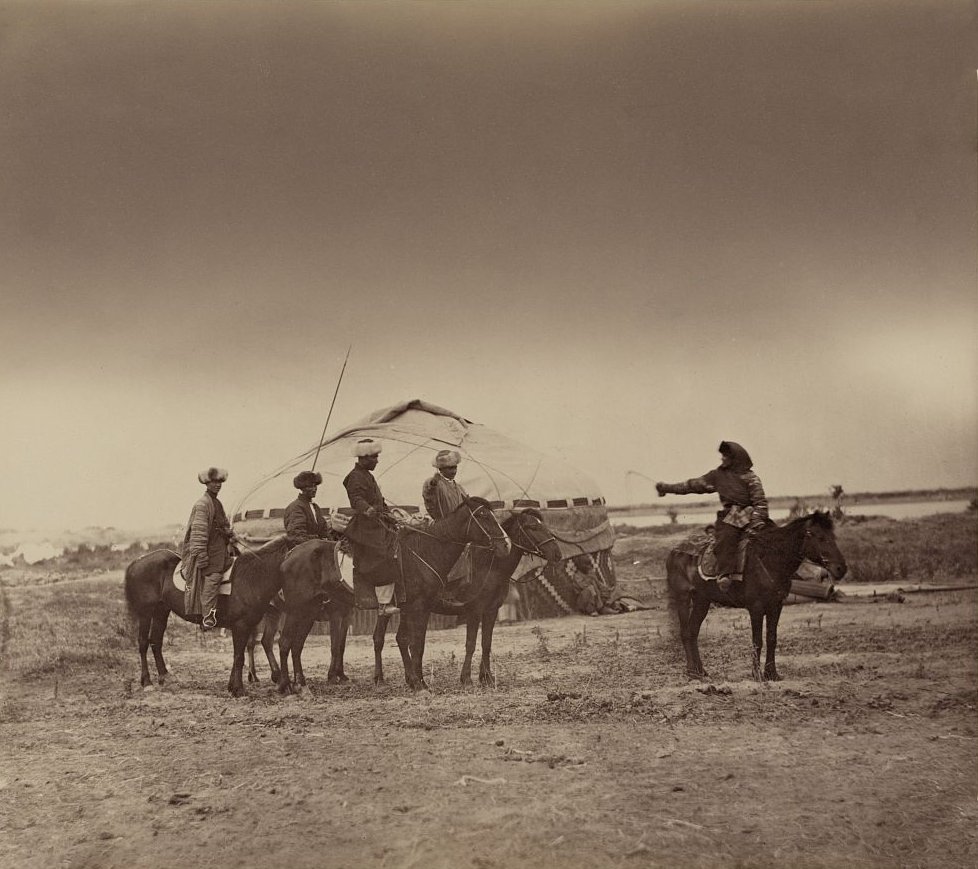
Kyz kuu, from Turkic words meaning girl-chasing, is a traditional equestrian sport kept by Azerbaijanis, Kazakhs and Kyrgyz and often called a kissing game. A young man chases a young woman on horseback: if he catches her he may steal a kiss, and if he fails she chases him back and may strike him with her whip.
Kyz kuu, a name that means girl-chasing, is a riding game of the Turkic world, kept by Azerbaijanis, Kazakhs and Kyrgyz. A young man and a young woman race on horseback: if he catches her before the finish line, he may steal a kiss; if he cannot, she turns and chases him back, whip in hand. It is often called a kissing game.
A kissing game
Kyz kuu is a traditional equestrian sport with the shape of a horse race, but the nickname it carries is the kissing game. Both descriptions fit. Two riders, a young man and a young woman, race their horses over a set course, yet nothing is scored in times or points: the outcome is a kiss for one rider or a blow from a whip for the other. The chase is the whole of the sport, and it runs in both directions, which sets it apart from a simple race.
How a race runs
A young man on horseback waits at the starting line. A young woman, riding her own horse, gallops off from a set distance behind him. When she passes him, he may begin his own gallop, and the two race toward a finish line ahead. If he manages to catch her before that line, he may reach out and steal a kiss, and the victory is his. If not, the race is not over, for the second half belongs to her.
What winning means
The head start is built into the rules: the woman rides off first and the man may only give chase once she has passed him, so his kiss must be earned against the ground she has already covered. If he fails to reach her by the finish line, the roles reverse. She becomes the pursuer, he the pursued, and a blow of her whip within range counts as her victory, just as his kiss would have counted as his.
How Kyz kuu is kept
Two young riders take part, a man and a woman, each on horseback. The man waits at the start; the woman gallops first from a set distance behind him. Once she has passed him, he may give chase, and both race for the finish line. Catching her before it wins him a stolen kiss. Failing that, she turns, pursues him back toward the start, and a whip blow within range makes her the winner.
When and where
The game belongs to the Turkic world. The peoples named as its keepers are Azerbaijanis, Kazakhs and Kyrgyz, and the name takes a local form in each language: qız-qov, qyz quu, kyz kuumai. The countries tied to it are Azerbaijan and Kyrgyzstan, and a 2006 book about Kyrgyzstan stands among the sources cited for it.
What Kyz kuu means
The flirtation sits in the rules themselves. A kiss is the prize the young man may take only by out-riding the woman, and the whip is the answer she keeps for him if he cannot. Each rider courts and tests at the same time: he chases, she sets the pace, and the better rider on the day decides how the game ends. The name girl-chasing tells only the first half of the story.
Who takes part
- the young man: waits on horseback at the starting line, then chases; if he catches her, he steals a kiss
- the young woman: gallops off first from behind; if he fails, she turns and chases him, whip in hand
Then and now
The article notes no change to the game or its rules. Its one modern link is the World Nomad Games, an international event for sports of nomadic peoples, which it lists as a related subject.
On the wedding table
Symbols: Horse and carriage
Questions people ask about Kyz kuu
What is kyz kuu?
It is a traditional riding sport of the Turkic world, kept by Azerbaijanis, Kazakhs and Kyrgyz, and its name means girl-chasing. Two young riders, a man and a woman, race on horseback, and because the prize can be a kiss, the game is often called a kissing game.
At what point in a wedding does it happen?
It is not tied to any point in a wedding ceremony. The sources describe kyz kuu as a sport and a kissing game between young people, which places it in courtship, before betrothal and marriage.
How does each rider win?
The young man wins if he catches up with the woman before the finish line, and his victory is the stolen kiss. If she reaches the line first, she turns and chases him back, and a blow of her whip within range means the victory is hers.
Who plays it, and where?
It is kept by Turkic peoples: the source names Azerbaijanis, Kazakhs and Kyrgyz. The article connects it with Azerbaijan and Kyrgyzstan, and points readers to the World Nomad Games as a related international event.
Why does the woman start first?
She begins her gallop from a set distance behind the waiting man, and only when she has passed him may he start. She therefore reaches the course ahead of him, and to win his kiss he must make up that ground before the line.
See also
 Ala kachuuA Kyrgyz custom of taking a woman for marriage, ranging from consensual elopement to forced abduction.
 Bride kidnappingThe abduction of a woman or girl by a man who wishes to marry her, ranging from consensual elopement to violent coercion
 Azerbaijani wedding traditionsA multi-stage family ceremony in Azerbaijan featuring matchmaking, dowry exchange, and henna rituals.SambandamA traditional marriage alliance among specific communities in Kerala, India.
Good reading and sources
- Kyz kuu on WikipediaEncyclopedia
- More photos on Wikimedia CommonsPhotos and video
- Wikidata recordOpen data
The facts on this page come from the Wikipedia article "Kyz kuu", written by its contributors and used under the CC BY-SA 4.0 licence, and from its Wikidata record (CC0). EveryShaadi rewrote the text in its own words, with AI assistance, and compares every page with the article to make sure no passage is copied. It may be reused under the same CC BY-SA 4.0 licence with a link back.
It may contain mistakes. Wedding customs differ from one family, village and community to the next, and the people who keep them know them best. If something is wrong, tell us. Last refreshed 2026-11-02.
More from Azerbaijan
All the traditions of Azerbaijan
🇦🇿 Nakhchivan, AzerbaijanAzerbaijani wedding traditionsAzərbaycanın toy adətləri
A multi-stage family ceremony in Azerbaijan featuring matchmaking, dowry exchange, and henna rituals.Rite · Finding a match
 🇬🇪 Georgia and 1 moreTamadaთამადა
The Georgian toastmaster who leads the supra and guides every wedding feast.Feast custom · The wedding feast
 🇹🇷 Sivas, Turkey and 3 moreHalay
A traditional line and circle dance performed at weddings across Turkey and the Caucasus.Performance · Reception, dance and gifts
 🇦🇲 Armenia and 1 moreKochariՔոչարի
A circle dance from the Armenian Highlands that marks weddings and community gatherings.Performance · Reception, dance and gifts
The same idea elsewhere
Arranged marriage, matchmaking and choosing a partner compared 🇰🇷 Seoul, South Korea and 1 moreMarriage in KoreaKorean marriage (결혼)
A look at how Korean weddings blend ancient Confucian rites with modern legal practices.Rite · Finding a match