Matchmaking, courtship and engagementMiddle EastZoroastrian and Parsi
Xwedodah
In its own language: xwidōdāh
A Zoroastrian rite of close-kin marriage rooted in ancient cosmology and royal tradition.
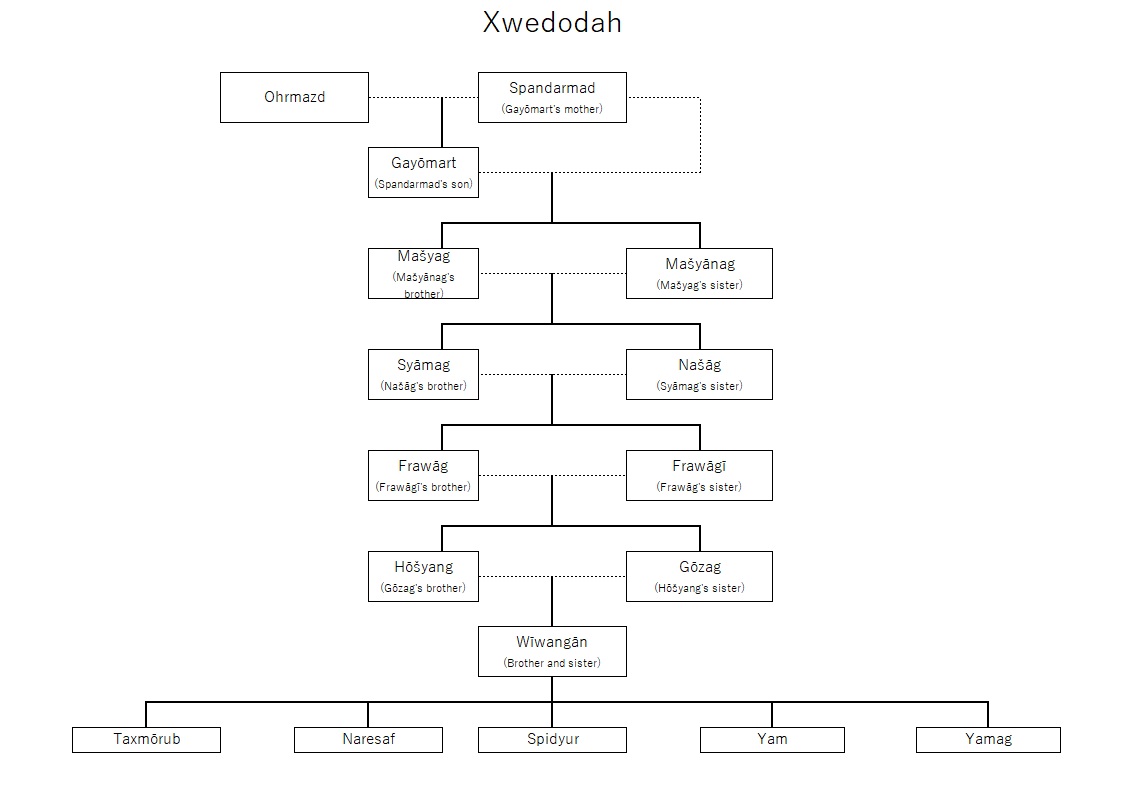
Xwedodah refers to marriages between close relatives within the Zoroastrian faith. Historically practiced by Persian royalty and nobility before the seventh century, it was viewed as a pious act that mirrored divine creation. The custom faded from common life by the eleventh century and is virtually absent in modern communities.
When is Xwedodah kept?
Xwedodah is kept on historically in antiquity and the early Middle Ages.
Xwedodah describes a historical practice of marrying close relatives within the Zoroastrian tradition. Ancient texts link this union to the creation of the world and view it as a sacred duty. While once upheld by kings and priests, the ritual disappeared from daily life over a thousand years ago and holds no place in contemporary ceremonies.
Origins and meaning
The term derives from Middle Persian roots relating to self and marriage. Early Zoroastrian cosmology taught that Ahura Mazda created all spiritual beings. Some traditions describe the first humans emerging from unions between divine entities or parents and children. These myths provided a template for human behavior. Believers saw such unions as maintaining purity and strength within their lineage. The practice was not merely social but deeply theological, reflecting the unity of the divine family.
Historical practice
Records show that Persian kings often married their sisters or daughters. Darius III wed Stateira, while Cambyses II united with Atossa. Nobles and possibly clergy also followed these rules. Greek and Roman writers noted these customs among the Magi priesthood. Jewish and Islamic scholars later discussed the legality and morality of such unions. By the medieval period, clerical letters confirmed the practice had largely vanished, though some texts still encouraged it theoretically.
Religious sources
Pahlavi literature solidified the doctrine. Texts like the Denkard and Dadestan-i Denig claim humanity originated from such marriages. They argue that keeping bloodlines pure prevents corruption. Some passages distinguish between sibling unions and parent-child relations, viewing the former as more acceptable. Later clerical communications from the fourteenth century continued to debate the merits of these matches. They acknowledged the practice was no longer common but retained its status as an ideal in religious law.
Modern status
Today, xwedodah is nearly extinct among Zoroastrians worldwide. Modern communities do not observe this form of marriage. Historical accounts from various cultures provide most of our knowledge about the custom. Scholars study these texts to understand ancient Persian society and theology. The practice remains a subject of academic interest rather than living tradition. Contemporary Zoroastrians follow different marital norms aligned with current legal and social standards.
How Xwedodah is kept
Historically, eligible individuals from royal or noble families entered into these unions. Clergy guided the process based on religious texts. The marriages were arranged to preserve lineage purity. Participants included siblings, parents, and children. The rituals likely involved standard wedding vows adapted to reflect the unique familial bond. No specific ceremonial objects are recorded for this distinct type of union beyond general wedding practices.
When and where
This custom belonged to the pre-Islamic era and persisted into the early Middle Ages. It was not tied to a specific season or calendar day. The timing depended entirely on the availability of suitable relatives within the family line. The practice declined significantly after the seventh century and ceased to be common by the eleventh century.
The custom originated in ancient Persia, now modern Iran. It was strongest among the Achaemenid, Parthian, and Sassanian royal courts. Zoroastrian communities in India and Armenia also encountered references to it. Non-Iranian sources from Greece, Rome, and China documented the practice among Persian elites.
What Xwedodah means
Believers viewed xwedodah as a reflection of divine creation. Just as gods were united in myth, so too should humans mirror that unity. The practice was believed to protect the family from external corruption. It reinforced social hierarchy by keeping power and wealth within closed circles. Purity of blood was considered essential for spiritual and physical well-being.
Who takes part
- The couple: Enter into a marriage with a close relative
- The clergy: Guide the union according to religious doctrine
- Royal families: Provide examples of high-status adherence
Then and now
The practice has disappeared from active Zoroastrian life. Modern adherents do not perform close-kin marriages. Historical texts remain the primary source for understanding the custom. Contemporary communities focus on other aspects of their faith and legal marital requirements.
Questions people ask about Xwedodah
When is Xwedodah kept?
Xwedodah is kept on historically in antiquity and the early Middle Ages.
What is xwedodah?
It is a historical Zoroastrian practice involving marriage between close relatives. Ancient texts linked it to divine creation and lineage purity. It was primarily observed by royalty and nobility in pre-Islamic Persia.
Is xwedodah still practiced today?
No. The custom vanished from common life by the eleventh century. Modern Zoroastrian communities do not engage in close-kin marriages. Current practices follow contemporary legal and social norms.
Why was it considered pious?
Religious myths described gods and first humans uniting in similar ways. Believers thought such marriages preserved spiritual purity. They believed it strengthened the family against corruption and maintained divine order.
Who practiced this custom?
Persian kings, queens, and nobles were the main practitioners. Some clergy may have followed the doctrine. Greek and Roman sources confirm its use among the elite classes of the Achaemenid and Sassanian empires.
See also
 Maithil VivahThe arranged Hindu marriage of Maithils in the Mithila region, guided by Vedic texts and local customs.
 MatchmakingThe practice of pairing two people for marriage through an intermediary or system.
 SvayamvaraThe ancient Hindu ceremony where a princess picks her husband from assembled suitors
Good reading and sources
The facts on this page come from the Wikipedia article "Xwedodah", written by its contributors and used under the CC BY-SA 4.0 licence, and from its Wikidata record (CC0). EveryShaadi rewrote the text in its own words, with AI assistance, and compares every page with the article to make sure no passage is copied. It may be reused under the same CC BY-SA 4.0 licence with a link back.
It may contain mistakes. Wedding customs differ from one family, village and community to the next, and the people who keep them know them best. If something is wrong, tell us. Last refreshed 2026-10-05.
More from Iran
All the traditions of Iran
🇸🇬 Singapore and 3 moreMatchmaking
The practice of pairing two people for marriage through an intermediary or system.Betrothal · Finding a match
 🇮🇷 Iran and 1 moreNikahnikāḥ (Arabic: نِكَاح)
The Islamic marriage contract that establishes a binding union between two people.Vow · Engagement and betrothal
🇮🇷 Shiraz, Iran and 5 moreUlulation
A high-pitched trilling sound made by women to celebrate weddings and share good news across many cultures.Performance · Procession and arrival
🇮🇳 India and 3 moreNikah halalaنکاح حلالہ
A second marriage required for a woman to remarry her first husband after triple talaq.Vow · After the wedding
🇮🇷 Iran and 1 moreNikahnikāḥ (Arabic: نِكَاح)
The Islamic marriage contract that establishes a binding union between two people.Vow · Engagement and betrothal
🇮🇷 Shiraz, Iran and 5 moreUlulation
A high-pitched trilling sound made by women to celebrate weddings and share good news across many cultures.Performance · Procession and arrival
🇮🇳 India and 3 moreNikah halalaنکاح حلالہ
A second marriage required for a woman to remarry her first husband after triple talaq.Vow · After the wedding
The same idea elsewhere
Arranged marriage, matchmaking and choosing a partner compared 🇺🇸 United States and 5 moreInterfaith marriage
A union between spouses of different faiths, navigating legal and religious boundaries across the world.Vow · Engagement and betrothal
🇨🇳 China and 5 morePosthumous marriageminghun
A union performed when one or both partners have died, kept in parts of Asia and permitted by law in a few nations.Betrothal · After the wedding
🇺🇸 United States and 5 moreInterfaith marriage
A union between spouses of different faiths, navigating legal and religious boundaries across the world.Vow · Engagement and betrothal
🇨🇳 China and 5 morePosthumous marriageminghun
A union performed when one or both partners have died, kept in parts of Asia and permitted by law in a few nations.Betrothal · After the wedding