Wedding traditions with the colour red
Red is the colour of weddings in much of Asia.
Red is the colour of weddings in much of Asia. It stands for luck, joy, fertility, life and protection, and in China, India, Vietnam and Korea it is the colour of the bride. In the West it is often avoided, which shows how much meaning a colour can carry.
Red in Asia
Chinese brides wear red qipao or qungua, the wedding hall is hung with red double-happiness characters, and guests give hongbao, red envelopes. Indian brides wear red lehengas or silk saris, and the sindoor in the parting of the hair is red. Vietnamese brides wear a red ao dai, and Korean brides wear red dots, yeonji gonji, on the cheeks. In Japan the uchikake may be red, and the bridal umbrella is also red.
Red elsewhere
Red also appears in Armenia, Georgia and Turkey, where the bride may be wrapped in a red veil or have a red ribbon tied at her waist, called the kirmizi kusak in Turkish custom. In the Balkans red and white cloth were used in traditional dress, and in Central Asia red wedding robes and headdresses were common. In Europe white took over in the nineteenth century.
Written by the EveryShaadi desk with AI assistance. Background on The colour red (symbol). Customs differ from place to place and family to family. If this is your tradition and we have it wrong, tell us.
 🇮🇹 Rome, ItalyWeddings in ancient Rome
The religious ceremonies and attire that marked a union in the city of Rome before the rise of Christianity.Rite · The weeks before
🇺🇦 UkraineSong about the RushnykПісня про рушник (Pisnia pro rushnyk)
A Ukrainian song that celebrates the embroidered cloth used in weddings and family life.Performance · The ceremony
🇮🇹 Rome, ItalyWeddings in ancient Rome
The religious ceremonies and attire that marked a union in the city of Rome before the rise of Christianity.Rite · The weeks before
🇺🇦 UkraineSong about the RushnykПісня про рушник (Pisnia pro rushnyk)
A Ukrainian song that celebrates the embroidered cloth used in weddings and family life.Performance · The ceremony
 🇺🇦 Ukraine and 2 moreRushnykрушник (Ukrainian), ручнік (Belarusian), ручник/рушник (Russian)
The embroidered linen cloth that marks life stages and guides the couple through the wedding ceremony in East Slavic culAdornment · The weeks before
🇺🇦 Ukraine and 2 moreRushnykрушник (Ukrainian), ручнік (Belarusian), ручник/рушник (Russian)
The embroidered linen cloth that marks life stages and guides the couple through the wedding ceremony in East Slavic culAdornment · The weeks before
 🇬🇧 United Kingdom and 3 moreCare cloth
A linen or silk cloth held over the heads of a bride and groom during a Christian wedding blessing.Attire · The ceremony
🇬🇧 United Kingdom and 3 moreCare cloth
A linen or silk cloth held over the heads of a bride and groom during a Christian wedding blessing.Attire · The ceremony
 🇷🇴 Romania and 4 moreCălușariCălușarii
A traditional Romanian spring dance and male society known for acrobatic leaps and ritual healing.Performance · The weeks before
🇷🇴 Romania and 4 moreCălușariCălușarii
A traditional Romanian spring dance and male society known for acrobatic leaps and ritual healing.Performance · The weeks before
 🇬🇷 Greece and 1 moreAnastenariaΑναστενάρια (Greek), Нестинарство (Bulgarian)
A barefoot firewalking ritual performed by Orthodox Christian communities in Greece and Bulgaria.Rite · The weeks before
🇬🇷 Greece and 1 moreAnastenariaΑναστενάρια (Greek), Нестинарство (Bulgarian)
A barefoot firewalking ritual performed by Orthodox Christian communities in Greece and Bulgaria.Rite · The weeks before
 🇵🇱 Poland and 5 moreTuroń
A horned effigy that visits homes during Carnival to wish for fertility and collect gifts.Blessing · The weeks before
🇵🇱 Poland and 5 moreTuroń
A horned effigy that visits homes during Carnival to wish for fertility and collect gifts.Blessing · The weeks before
 🇵🇱 Poland and 3 moreEaster palmPolish: palma wielkanocna; Lithuanian: verba
A decorated willow or juniper bundle blessed on Palm Sunday to protect homes and crops.Blessing · The weeks before
🇵🇱 Poland and 3 moreEaster palmPolish: palma wielkanocna; Lithuanian: verba
A decorated willow or juniper bundle blessed on Palm Sunday to protect homes and crops.Blessing · The weeks before
 🇬🇷 Corfu, GreeceBotidesμπότηδες
The throwing of clay pots filled with water from balconies in Corfu on Holy Saturday to mark the Resurrection.Blessing · The ceremony
🇬🇷 Corfu, GreeceBotidesμπότηδες
The throwing of clay pots filled with water from balconies in Corfu on Holy Saturday to mark the Resurrection.Blessing · The ceremony
 🇮🇹 Viterbo, ItalyMacchina di Santa Rosa
The annual procession in Viterbo where men carry a towering structure to honor their patron saint.Blessing · Procession and arrival
🇮🇹 Viterbo, ItalyMacchina di Santa Rosa
The annual procession in Viterbo where men carry a towering structure to honor their patron saint.Blessing · Procession and arrival
 🇧🇬 Bulgaria and 3 moreMartenitsaмартеница
White and red yarn charms worn in the Balkans to welcome spring and wish for good health.Adornment · The weeks before
🇧🇬 Bulgaria and 3 moreMartenitsaмартеница
White and red yarn charms worn in the Balkans to welcome spring and wish for good health.Adornment · The weeks before
 🇩🇪 Germany and 5 moreLenten veilFastentuch
A large painted or embroidered canvas that covers the altar during Lent to create a period of visual penance.Rite · The weeks before
🇩🇪 Germany and 5 moreLenten veilFastentuch
A large painted or embroidered canvas that covers the altar during Lent to create a period of visual penance.Rite · The weeks before
 🇩🇪 GermanyBollenhut
A straw hat with woolen pompoms worn by women in specific Black Forest villages as part of their traditional dress.Attire · The weeks before
🇷🇴 Romania and 3 moreMărțișor
The red and white string charm worn in early spring to welcome the new year.Adornment · The weeks before
🇩🇪 GermanyBollenhut
A straw hat with woolen pompoms worn by women in specific Black Forest villages as part of their traditional dress.Attire · The weeks before
🇷🇴 Romania and 3 moreMărțișor
The red and white string charm worn in early spring to welcome the new year.Adornment · The weeks before
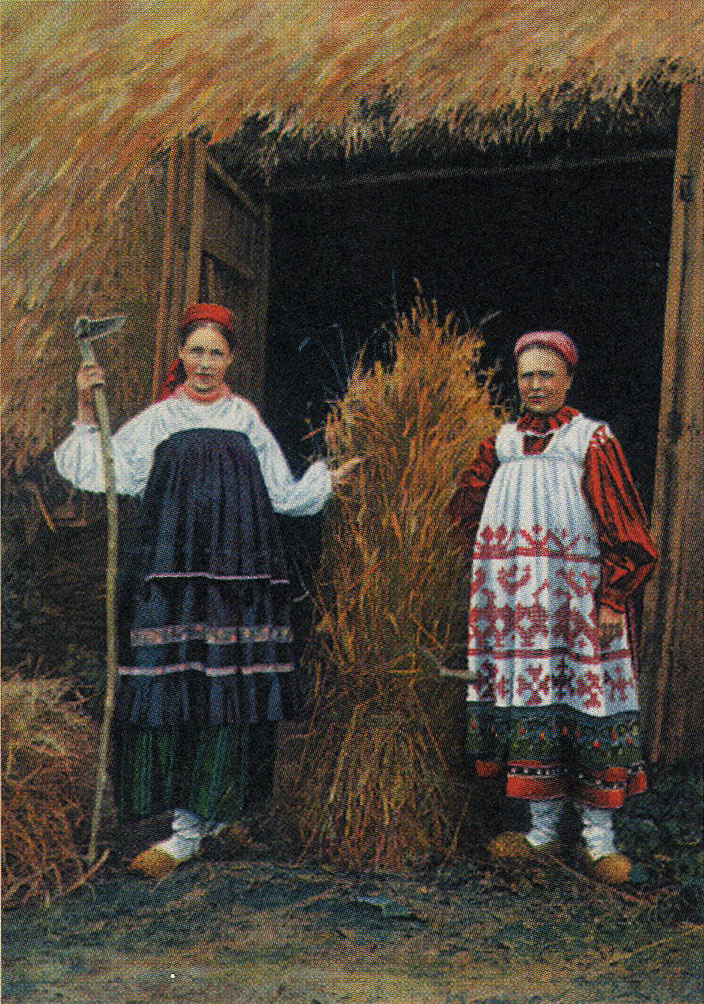 🇵🇱 Poland and 5 moreDożynki
A Slavic harvest festival where farmers bring the last sheaf of grain to the village in a ceremonial wreath.Feast custom · After the wedding
🇵🇱 Poland and 5 moreDożynki
A Slavic harvest festival where farmers bring the last sheaf of grain to the village in a ceremonial wreath.Feast custom · After the wedding
Photo credits on this page
The small pictures above come from Wikimedia Commons under free licences. Some are cropped to fit.
- Turoń: Museum: The Seweryn Udziela Ethnographic Museum in Kraków, CC0, source
- Macchina di Santa Rosa: Amras Carnesîr, CC BY-SA 3.0, source
- Botides: Gkaridis0, CC BY 4.0, source
- Easter palm: Evaldas Liutkus, CC BY 2.0, source
- Bollenhut: Unknown author, Public domain, source
- Dożynki: Unknown author, Public domain, source
- Weddings in ancient Rome: Meister der Aldobrandinischen Hochzeit, Public domain, source
- Rushnyk: Pavlo Boyko, CC BY-SA 2.0, source
- Care cloth: Unknown author, Public domain, source
- Martenitsa: Unknown author, CC BY-SA 2.0, source
- Lenten veil: Plutowiki, CC0, source
- Anastenaria: Artkostov, CC BY-SA 4.0, source
- Călușari: El bes, CC BY 3.0, source