Krokan
A multi-tiered almond pastry tower joined by caramel and decorated with marzipan roses, served at Swedish weddings.
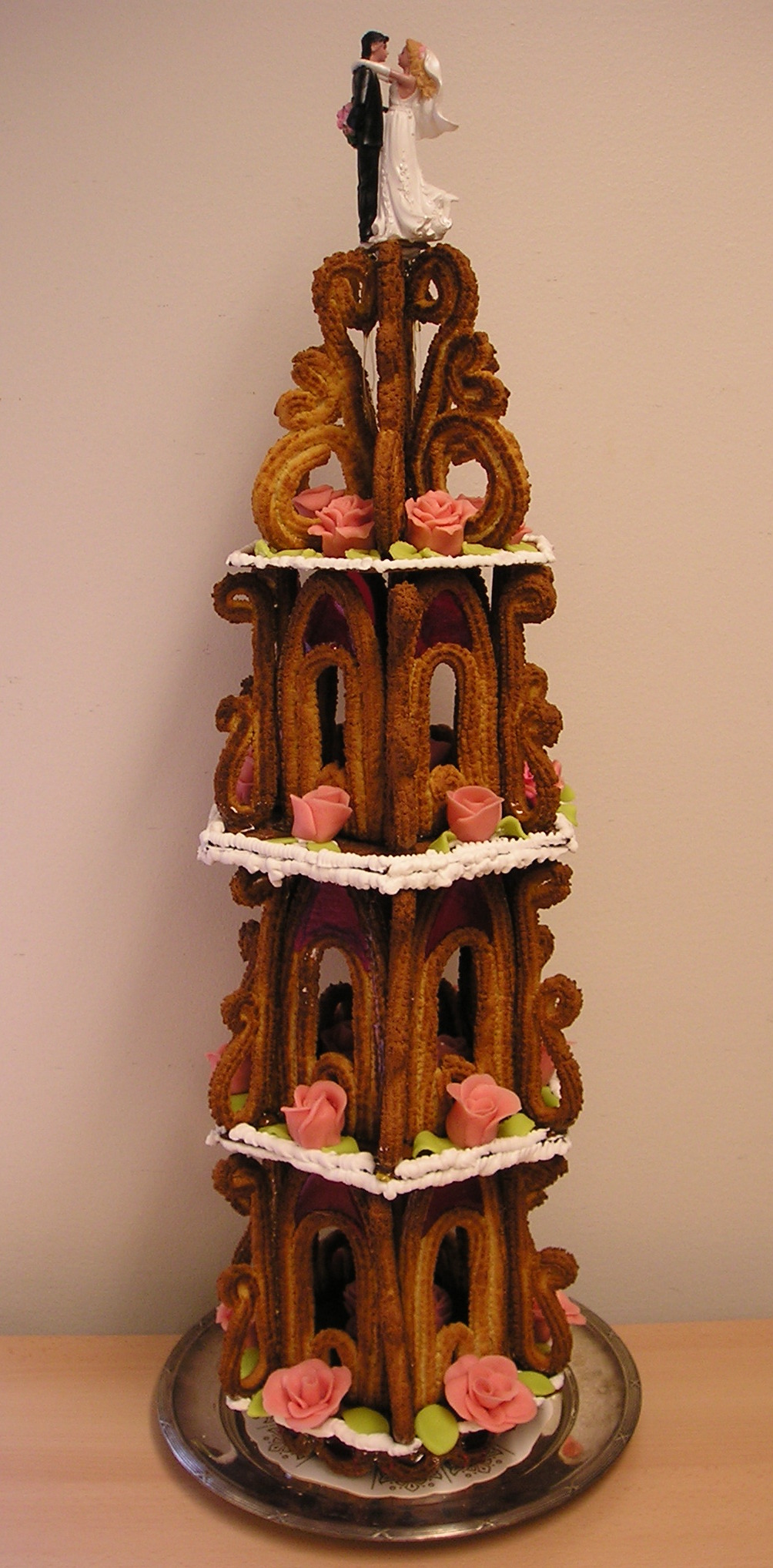
Krokan is a traditional Swedish wedding dessert consisting of a multi-tiered tower of thin almond pastries joined by caramelized sugar and decorated with marzipan roses. It has been considered an essential part of the celebration for over a century.
When is Krokan kept?
Krokan is kept at Swedish weddings.
Krokan is a towering Swedish wedding dessert built from thin sheets of almond pastry bound together with caramel. Decorated with marzipan roses and geometric patterns, this sweet structure serves as a centerpiece for the celebration, marking the occasion with shared sweetness.
Structure and ingredients
Krokan consists of thin layers of almond-based pastry baked into decorative shapes. These pieces are stacked and glued together using melted caramelized sugar to form a tall tower. The exterior is often adorned with crisscross designs and marzipan roses.
Wedding tradition
This dessert holds a long-standing place in Swedish nuptials. A letter from the early twentieth century noted that the krokan was as essential to a wedding as the bride. It appeared at high-profile events, such as the royal wedding of King Carl XVI Gustaf in 1976.
Regional variations
Similar almond towers exist in neighboring cultures. The Danish kransekage shares the same core ingredients and construction method, reflecting a shared Scandinavian baking heritage.
How Krokan is kept
Thin sheets of almond pastry are baked and then assembled into a vertical tower using caramelized sugar as a binding agent. The finished structure is decorated with geometric patterns and marzipan flowers before being served as a dessert at the reception.
When and where
It is served during the wedding feast or reception in Sweden. The dessert has been a standard feature of these celebrations for decades, appearing at both local and royal ceremonies.
This custom belongs to Sweden, where the pastry is a recognized national treat. It is also found in Denmark through the closely related kransekage.
What Krokan means
The sources describe the krokan as a 'gorgeous' and necessary element of the celebration. Its presence signals the completeness of the wedding festivities, serving as a shared sweet treat for guests.
On the wedding table
- Krokan: A multi-tiered almond pastry tower joined by caramel and decorated with marzipan roses, served as a wedding dessert.
Symbols: The wedding cake Sweets, sugar and honey
Questions people ask about Krokan
When is Krokan kept?
Krokan is kept at Swedish weddings.
What is a krokan?
It is a Swedish wedding dessert made of thin almond pastry slices stacked into a tower and held together with caramelized sugar. It is decorated with marzipan roses and geometric patterns.
Is it unique to Sweden?
While traditional in Sweden, a similar pastry called kransekage exists in Denmark. Both use almond flour and caramel to create tiered cakes.
See also
 KenduriA communal feast and prayer gathering held by Javanese and Malay communities to mark life events.
 TamadaThe toastmaster who leads the Georgian supra and sets the rhythm of a wedding feast.
 Pièce montéeA sculptural French dessert centerpiece made of nougat, sugar, and pastry for wedding banquets.Seudat nissuinThe Jewish wedding meal blessed with wine and bread, followed by seven days of celebration.
Good reading and sources
The facts on this page come from the Wikipedia article "Krokan", written by its contributors and used under the CC BY-SA 4.0 licence, and from its Wikidata record (CC0). EveryShaadi rewrote the text in its own words, with AI assistance, and compares every page with the article to make sure no passage is copied. It may be reused under the same CC BY-SA 4.0 licence with a link back.
It may contain mistakes. Wedding customs differ from one family, village and community to the next, and the people who keep them know them best. If something is wrong, tell us. Last refreshed 2026-10-05.
More from Sweden
All the traditions of Sweden 🇩🇪 Germany and 4 moreDower
A share of the husband's property set aside to secure a woman's life if he dies first.Gift custom · Engagement and betrothal
🇩🇪 Germany and 4 moreDower
A share of the husband's property set aside to secure a woman's life if he dies first.Gift custom · Engagement and betrothal
 🇩🇪 Germany and 5 morePolterabend
The evening before the wedding when guests break porcelain to bring luck and test the couple's teamwork.Blessing · The eve
🇸🇪 Stockholm, SwedenSame-sex marriage in SwedenSambolydning i Sverige
The legal recognition of same-sex unions in Sweden since 2009.Modern · Engagement and betrothal
🇩🇪 Germany and 5 morePolterabend
The evening before the wedding when guests break porcelain to bring luck and test the couple's teamwork.Blessing · The eve
🇸🇪 Stockholm, SwedenSame-sex marriage in SwedenSambolydning i Sverige
The legal recognition of same-sex unions in Sweden since 2009.Modern · Engagement and betrothal
 🇩🇪 Hanover, Germany and 5 moreBridal crownBrautkrone
A headdress worn by brides in Central and Northern Europe to symbolize purity and status.Attire · The ceremony
🇩🇪 Hanover, Germany and 5 moreBridal crownBrautkrone
A headdress worn by brides in Central and Northern Europe to symbolize purity and status.Attire · The ceremony
The same idea elsewhere
The wedding feast, the cake and the toast compared 🇰🇷 Seoul, South Korea and 1 moreMarriage in KoreaKorean marriage (결혼)
A look at how Korean weddings blend ancient Confucian rites with modern legal practices.Rite · Finding a match
🇰🇷 Seoul, South Korea and 1 moreMarriage in KoreaKorean marriage (결혼)
A look at how Korean weddings blend ancient Confucian rites with modern legal practices.Rite · Finding a match
 🇲🇱 MaliWeddings in Mali
Multi-day Malian wedding traditions blending Islamic rites, civil law, and local customs with bazin attire.Rite · Engagement and betrothal
🇲🇱 MaliWeddings in Mali
Multi-day Malian wedding traditions blending Islamic rites, civil law, and local customs with bazin attire.Rite · Engagement and betrothal
 🇵🇸 Ramallah, Palestine and 4 moreDabkeدبكة
A Levantine line dance performed at weddings to celebrate union and community.Performance · Reception, dance and gifts
🇵🇸 Ramallah, Palestine and 4 moreDabkeدبكة
A Levantine line dance performed at weddings to celebrate union and community.Performance · Reception, dance and gifts
 🇦🇴 Luanda, Angola and 4 moreKizomba
A slow, sensual partner dance from Angola that turns wedding parties into intimate social gatherings.Performance · The wedding feast
🇦🇴 Luanda, Angola and 4 moreKizomba
A slow, sensual partner dance from Angola that turns wedding parties into intimate social gatherings.Performance · The wedding feast