Henna, jewellery and body artSouth AsiaHindu
Mangalsutra
In its own language: मङ्गलसूत्रम् (maṅgalasūtram)
The sacred necklace tied around the bride's neck to mark her marriage.
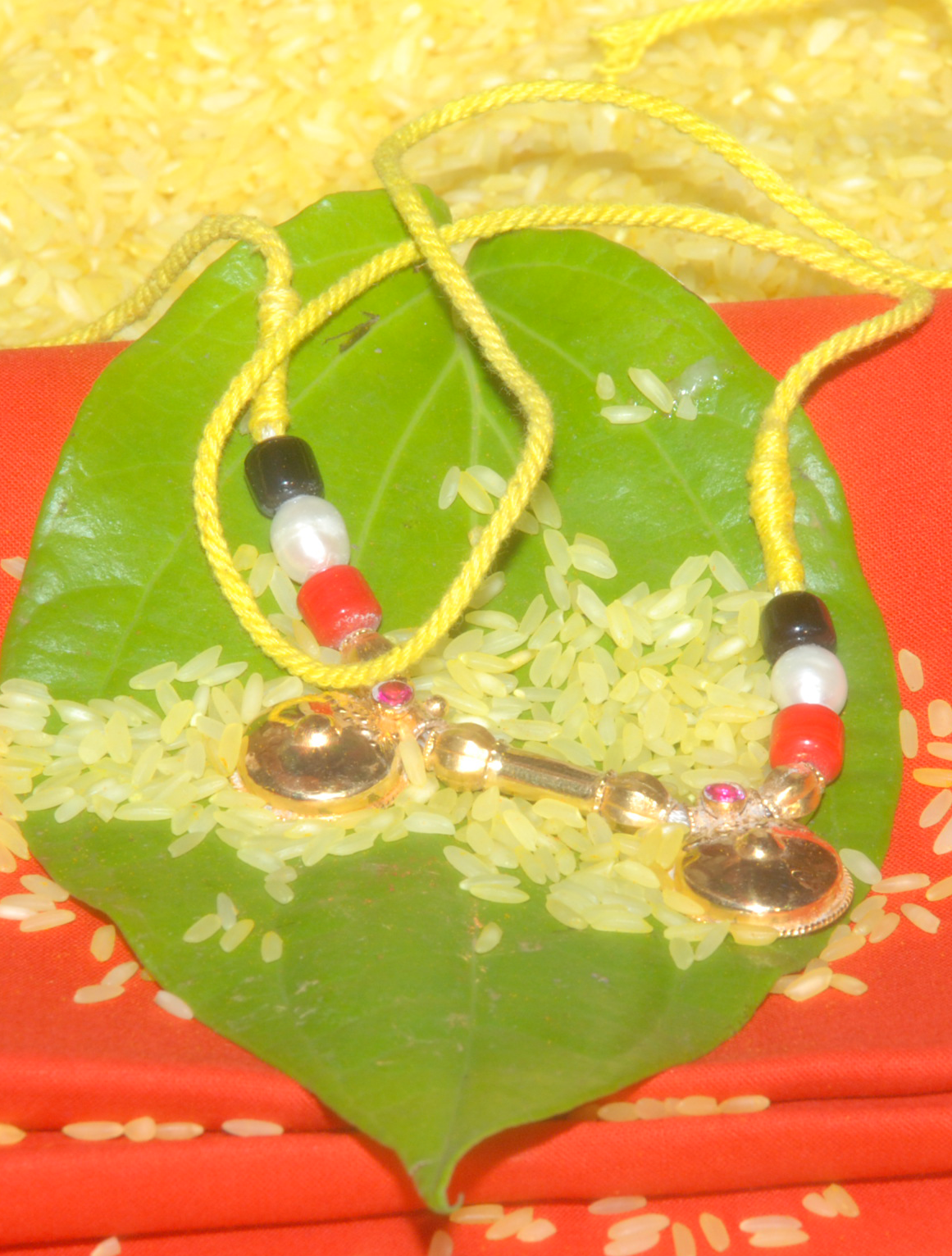
A mangalsutra is a necklace worn by married women in India and parts of South Asia. It serves as a visible sign that a woman is wed. The groom ties it during the wedding ceremony, often alongside other rituals like applying vermilion.
When is Mangalsutra kept?
Mangalsutra is kept during the wedding ceremony and for the rest of the marriage.
The mangalsutra is a sacred necklace worn by married women across the Indian subcontinent. It acts as a public marker of marital status. The groom ties this thread around the bride's neck during the wedding ceremony. This act signifies her new role and commitment within the family.
What the necklace means
The word mangalsutra translates to an auspicious thread. It is typically made of black beads strung on a yellow or black thread. The yellow color often comes from turmeric. Some versions include gold, white, or red beads. The design varies by region and community. In some areas, it is a simple chain. In others, it features a pendant. The pendant might show images of deities or geometric shapes. Regardless of the style, the black beads are central. They are believed to protect the marriage from evil spirits and negative energy.
History and origins
References to sacred threads date back to the fourth century CE. Early texts mention a mangalya sutra used in religious contexts. By the sixth century, the thread was specifically tied for protection. Historians note that it began as a literal thread rather than jewelry. Over time, it evolved into an ornamental piece. Ancient bridal jewelry also served as financial security for women. This practice helped ensure support in old age or widowhood. The custom spread through various communities in India and neighboring countries.
Regional variations
Different groups use distinct names and styles. In Tamil Nadu, it is called mangalyam or tali. In Kerala, Malayalees wear the minnu. Telugu communities in Andhra Pradesh and Telangana prefer the Lakshmi tali. Marathi families often use a pendant with two small bowls called vati. Gujaratis may choose a diamond pendant on a gold chain. Syrian Christians and Muslims in certain regions also wear similar nuptial chains. These variations reflect local traditions while maintaining the core purpose of marking marriage.
Who wears it and why
Married women wear the mangalsutra throughout their lives. It is a daily reminder of their vows. Hindu tradition holds that wearing it ensures the long life of the husband. Social expectations reinforce this practice. Women who do not wear it may face questions about their marital status. In some communities, the necklace is passed down from mother-in-law to daughter-in-law. This transmission strengthens family bonds. The ornament remains a key part of a woman's identity after marriage.
How Mangalsutra is kept
The groom ties the mangalsutra around the bride's neck during the wedding ceremony. This moment is known as Mangalya Dharanam. He places the thread over her head while reciting mantras. The bride stands still as he secures the knot. This act makes the marriage binding in many traditions. After the ceremony, the bride wears the necklace every day. She removes it only for specific reasons, such as medical procedures. The necklace becomes a permanent part of her attire.
When and where
It is tied during the main wedding ceremony. The exact timing depends on regional customs. Some tie it before applying vermilion. Others do it after exchanging garlands. The necklace is worn daily for the rest of the marriage.
It is most common in India, Sri Lanka, and Nepal. Variations exist across different states and communities. Urban areas see modern designs. Rural areas often keep traditional styles. The practice is widespread among Hindus but also found among other groups.
What Mangalsutra means
The black beads ward off evil eyes and bad luck. The gold represents prosperity and wealth. The thread symbolizes the bond between husband and wife. Wearing it is seen as a duty that brings well-being to the husband. It marks the woman as protected and committed. The ornament is both a spiritual shield and a social signal.
Who takes part
- The groom: Ties the necklace around the bride's neck
- The bride: Receives the necklace and wears it daily
- The officiant: Guides the couple through the tying ritual
- The mother-in-law: May pass down the necklace in some families
If you are a guest
Guests witness the tying of the necklace. They offer blessings to the couple. In some traditions, guests give gifts of gold or money. They respect the bride's new status by acknowledging the ornament. Guests do not touch the necklace once it is tied.
Then and now
Modern designs are lighter and more fashionable. Many women choose simpler chains. Some urban brides wear them less frequently. Legal debates continue regarding dowry practices linked to jewelry. Despite changes, the mangalsutra remains a strong cultural symbol.
On the wedding table
Symbols: Gold and jewellery The colour red The colour white Turmeric Garlands and flowers


Questions people ask about Mangalsutra
When is Mangalsutra kept?
Mangalsutra is kept during the wedding ceremony and for the rest of the marriage.
What is a mangalsutra?
It is a sacred necklace worn by married women in India. It marks the woman as wed and is tied by the groom during the ceremony.
Why are there black beads?
Black beads are believed to protect the marriage from evil spirits and the evil eye. They are a key part of the design.
Do non-Hindus wear it?
Yes. Some Christian, Muslim, and Jewish communities in India wear similar nuptial chains. The rituals may differ slightly.
See also
 AlpanaRice flour floor paintings that bless homes and mark wedding celebrations in Bengal.
 Toe ringA silver band worn on the second toe to mark a woman as married in India.
 ShankhaWhite conch shell bangles worn by Bengali Hindu married women as a symbol of their husband's well-being.
 GanaA sacred red thread tied to wrists for protection during wedding rituals in parts of India.
Good reading and sources
- How the concept of Mangal Sutra has evolved over the centuriesThe Indian Express, Article
- How the concept of Mangal Sutra has evolved over the centuriesThe Indian Express, Article
- Mangalasutra on WikipediaEncyclopedia
- More photos on Wikimedia CommonsPhotos and video
- Wikidata recordOpen data
The facts on this page come from the Wikipedia article "Mangalasutra", written by its contributors and used under the CC BY-SA 4.0 licence, and from its Wikidata record (CC0). EveryShaadi rewrote the text in its own words, with AI assistance, and compares every page with the article to make sure no passage is copied. It may be reused under the same CC BY-SA 4.0 licence with a link back.
It may contain mistakes. Wedding customs differ from one family, village and community to the next, and the people who keep them know them best. If something is wrong, tell us. Last refreshed 2026-10-05.
More from India
All the traditions of India
🇮🇳 India and 1 moreAlpanaআলপনা (Bengali)
Rice flour floor paintings that bless homes and mark wedding celebrations in Bengal.Adornment · The weeks before
🇮🇳 India and 1 moreToe ring
A silver band worn on the second toe to mark a woman as married in India.Adornment · The ceremony
🇮🇳 IndiaShankha
White conch shell bangles worn by Bengali Hindu married women as a symbol of their husband's well-being.Adornment · Engagement and betrothal
🇮🇳 IndiaGana
A sacred red thread tied to wrists for protection during wedding rituals in parts of India.Adornment · The weeks before
The same idea elsewhere
Rings, knots and tokens of promise compared 🇪🇬 Egypt and 4 moreWaist beads
Strands of glass or seed worn around the hips to mark womanhood and track body changes in West and North Africa.Adornment · Engagement and betrothal
🇪🇬 Egypt and 4 moreWaist beads
Strands of glass or seed worn around the hips to mark womanhood and track body changes in West and North Africa.Adornment · Engagement and betrothal
 🇫🇷 Paris, FranceGlobe de mariée
A glass bell jar used in France to hold the bride's bouquet and preserve family memories.Adornment · The weeks before
🇫🇷 Paris, FranceGlobe de mariée
A glass bell jar used in France to hold the bride's bouquet and preserve family memories.Adornment · The weeks before
 🇷🇺 RussiaRussian wedding traditionsРусская свадьба
A multi-day celebration blending Orthodox crowning, ransom games, and lively toasting in Russia.Rite · Engagement and betrothal
🇷🇺 RussiaRussian wedding traditionsРусская свадьба
A multi-day celebration blending Orthodox crowning, ransom games, and lively toasting in Russia.Rite · Engagement and betrothal
 🇯🇵 Tokyo, JapanShinto wedding神前結婚 (Shinzen kekkon)
A Shinto purification ritual featuring sake sharing and kimono attire held at a shrine or venue.Rite · The ceremony
🇯🇵 Tokyo, JapanShinto wedding神前結婚 (Shinzen kekkon)
A Shinto purification ritual featuring sake sharing and kimono attire held at a shrine or venue.Rite · The ceremony