Henna, jewellery and body artSouth AsiaHinduMuslim
Mehndi
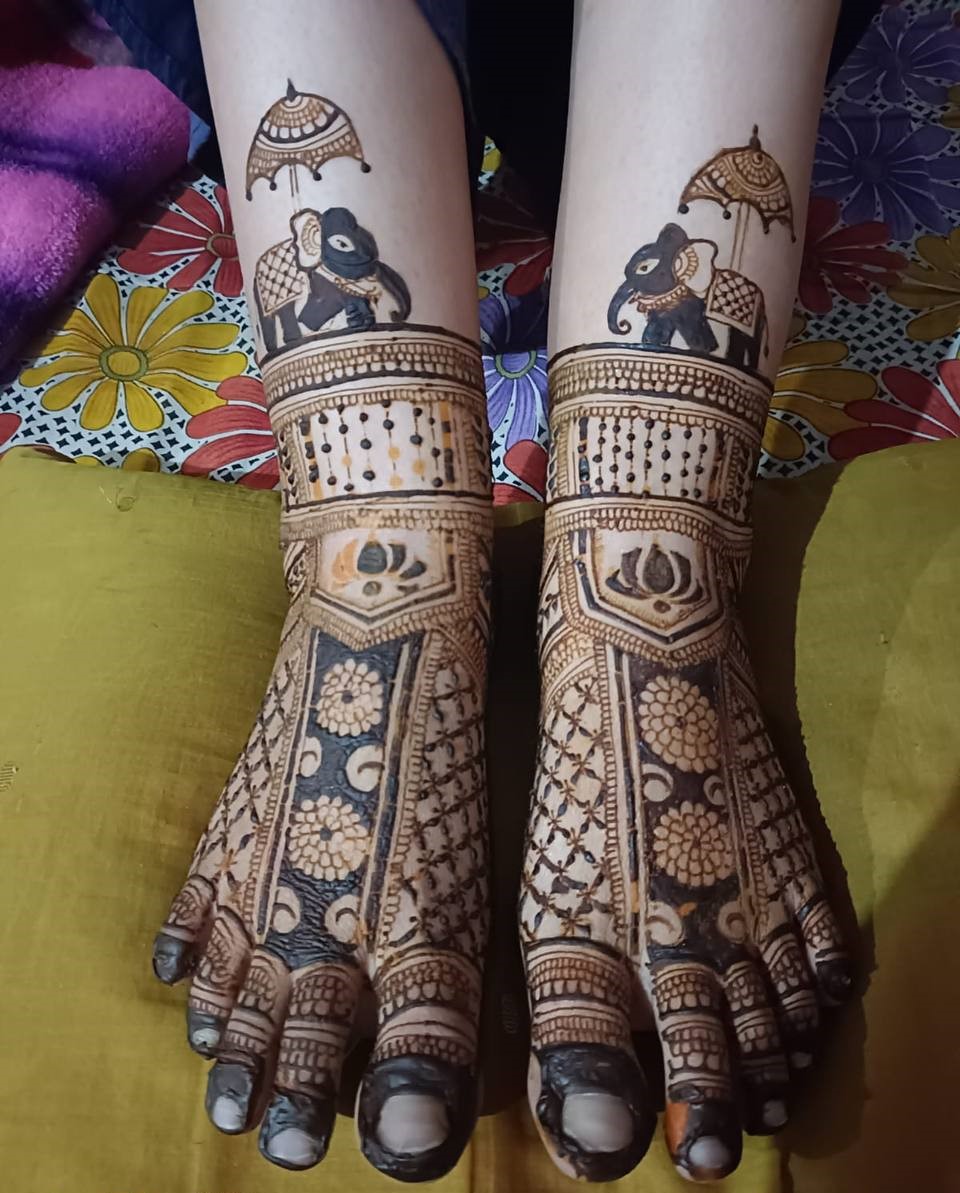
The henna body art applied to brides and guests before a South Asian wedding ceremony.

Mehndi is the temporary skin decoration created with henna paste. It is a central part of Indian weddings, where it adorns the bride and her female relatives during pre-ceremony gatherings.
When is Mehndi kept?
Mehndi is kept on the evening or day before the wedding ceremony.
Mehndi refers to the intricate temporary designs painted on the skin using a natural dye from the henna plant. This practice marks a joyous phase in South Asian weddings, bringing families together for celebration and adornment before the main ritual takes place.
What is mehndi
Mehndi is a form of temporary body art that uses a paste made from the dried leaves of the Lawsonia inermis plant. The resulting stain appears reddish-brown on the skin and can last for one to three weeks. While the term originates from Sanskrit, the custom shares roots with similar traditions across North Africa and the Middle East. In India, the designs are known for their small, intricate lines and floral motifs, distinguishing them from the bolder patterns found elsewhere.
History and origins
The use of henna dates back to ancient Babylon and Egypt, with evidence of its presence in India by the fourth century CE. The tradition likely became widespread in the subcontinent around the twelfth century, coinciding with the rise of Islam. It gained further prominence during the Mughal Empire, which ruled from the early sixteenth to the mid-nineteenth century. The Mughal dynasty heavily influenced local culture, architecture, and artistic patterns, embedding henna deeply into regional customs.
How the ceremony works
Families often host a dedicated gathering called the Mehndi night. During this event, professional artists or skilled relatives apply the paste to the bride's hands, forearms, feet, and lower legs. Guests also receive designs on their hands and arms. The atmosphere includes traditional music and dancing. Families serve special foods to attendees as part of the celebration. The darker the final stain on the bride, the more love her partner is believed to hold for her.
Designs and application
Artisans use plastic cones, sticks, or brushes to apply the thick paste. After fifteen to twenty minutes, the mixture dries and cracks. To deepen the color, the area is wrapped in tissue or tape to retain body heat. Lemon juice, sugar, and essential oils may be added to enhance the stain. Common motifs include vines, paisleys, peacocks, and mandalas. Names or initials of the couple are often hidden within the intricate artwork.
How Mehndi is kept
A designated person applies the henna paste to the bride's hands, feet, and arms using a cone or brush. Family members and friends sit together while receiving simpler designs on their own limbs. The group shares food and dances to traditional music. The paste remains on the skin for several hours before being removed, leaving a reddish-brown stain that darkens over the next two days.
When and where
It occurs during the days leading up to the wedding, typically at a separate gathering held the night before the ceremony. The date is set by the family to allow time for the stain to develop fully before the main wedding rituals begin.
This custom is most prominent in India and across the Indian Subcontinent. It is practiced by Hindu and Muslim communities alike, particularly in regions influenced by Mughal history. The designs vary by region, with South Asian styles favoring intricate details over the geometric patterns common in other areas.
What Mehndi means
The practice symbolizes prosperity, good fortune, and spiritual awakening. A deep red-brown color is considered auspicious and indicates strong affection between the couple. The intricate patterns represent the bond between the bride and her new family. The act of applying the dye is seen as a blessing that protects the couple and invites happiness into their marriage.
Who takes part
- The bride: Receives the most elaborate designs on her hands and feet
- Family and friends: Attend the ceremony and receive simpler designs on their limbs
- Henna artist: Applies the paste using a cone or brush to create the patterns
- Guests: Share in the feast and participate in the celebratory dancing
If you are a guest
Guests attend the gathering wearing comfortable clothing that exposes their arms and legs. They bring gifts for the bride and enjoy traditional foods served during the event. Many receive henna designs on their hands as a token of participation. They dance and celebrate alongside the bride's family, sharing in the joyous atmosphere before the wedding.
Then and now
Modern adaptations include the use of white, gold, or black colors alongside the traditional brown. Some people add synthetic dyes like PPD to achieve a black stain, though this carries health risks. The practice remains popular, with professionals offering services for both weddings and festivals like Eid and Diwali.
On the wedding table
Symbols: Henna The colour red Gold and jewellery The colour white



Questions people ask about Mehndi
When is Mehndi kept?
Mehndi is kept on the evening or day before the wedding ceremony.
What is mehndi?
Mehndi is temporary body art created using a paste from the henna plant. It produces a reddish-brown stain on the skin that lasts for weeks. The designs are intricate and often feature floral or geometric patterns.
Why is it important?
It symbolizes good luck, prosperity, and love. A darker stain is believed to indicate stronger affection between the couple. The gathering brings families together for celebration and bonding before the marriage.
Is it legal?
Yes, mehndi is a cultural and religious tradition with no legal restrictions. It is widely practiced across South Asia and among diaspora communities worldwide as a standard part of wedding preparations.
See also
 SvayamvaraThe ancient Hindu ceremony where a princess picks her husband from assembled suitors
 MayianThe turmeric paste ceremony held the day before Punjabi weddings in India and Pakistan.
 Odia Hindu weddingThe traditional Hindu marriage ceremony of the Odia people in Odisha, India.
 Bengali Muslim weddingA multi-day Bengali Muslim marriage blending Islamic rites with local folk traditions.
Good reading and sources
- Mehndi on WikipediaEncyclopedia
- More photos on Wikimedia CommonsPhotos and video
- Wikidata recordOpen data
The facts on this page come from the Wikipedia article "Mehndi", written by its contributors and used under the CC BY-SA 4.0 licence, and from its Wikidata record (CC0). EveryShaadi rewrote the text in its own words, with AI assistance, and compares every page with the article to make sure no passage is copied. It may be reused under the same CC BY-SA 4.0 licence with a link back.
It may contain mistakes. Wedding customs differ from one family, village and community to the next, and the people who keep them know them best. If something is wrong, tell us. Last refreshed 2026-10-05.
More from India
All the traditions of India 🇮🇳 India and 1 moreAlpanaআলপনা (Bengali)
Rice flour floor paintings that bless homes and mark wedding celebrations in Bengal.Adornment · The weeks before
🇮🇳 India and 1 moreAlpanaআলপনা (Bengali)
Rice flour floor paintings that bless homes and mark wedding celebrations in Bengal.Adornment · The weeks before
 🇮🇳 India and 1 moreToe ring
A silver band worn on the second toe to mark a woman as married in India.Adornment · The ceremony
🇮🇳 India and 1 moreToe ring
A silver band worn on the second toe to mark a woman as married in India.Adornment · The ceremony
 🇮🇳 IndiaShankha
White conch shell bangles worn by Bengali Hindu married women as a symbol of their husband's well-being.Adornment · Engagement and betrothal
🇮🇳 IndiaShankha
White conch shell bangles worn by Bengali Hindu married women as a symbol of their husband's well-being.Adornment · Engagement and betrothal
 🇮🇳 IndiaGana
A sacred red thread tied to wrists for protection during wedding rituals in parts of India.Adornment · The weeks before
🇮🇳 IndiaGana
A sacred red thread tied to wrists for protection during wedding rituals in parts of India.Adornment · The weeks before
The same idea elsewhere
Henna, turmeric and the decorated bride compared 🇪🇬 Egypt and 4 moreWaist beads
Strands of glass or seed worn around the hips to mark womanhood and track body changes in West and North Africa.Adornment · Engagement and betrothal
🇪🇬 Egypt and 4 moreWaist beads
Strands of glass or seed worn around the hips to mark womanhood and track body changes in West and North Africa.Adornment · Engagement and betrothal
 🇪🇬 Egypt and 2 moreHenna ceremonyليلة الحناء (Laylat al-Henna)
The pre-wedding gathering where the bride and guests receive intricate henna body art for luck and protection.Adornment · The weeks before
🇪🇬 Egypt and 2 moreHenna ceremonyليلة الحناء (Laylat al-Henna)
The pre-wedding gathering where the bride and guests receive intricate henna body art for luck and protection.Adornment · The weeks before
 🇸🇿 Ludzidzini Royal Village, Eswatini and 1 moreUmhlanga
The annual Swazi and Zulu gathering where young women cut reeds to preserve chastity and offer tribute labour.Rite · The eve
🇸🇿 Ludzidzini Royal Village, Eswatini and 1 moreUmhlanga
The annual Swazi and Zulu gathering where young women cut reeds to preserve chastity and offer tribute labour.Rite · The eve
 🇲🇲 MyanmarMarriage in Myanmar
A blend of Buddhist rites, astrological timing, and family negotiations that defines union across Myanmar's diverse ethnRite · Finding a match
🇲🇲 MyanmarMarriage in Myanmar
A blend of Buddhist rites, astrological timing, and family negotiations that defines union across Myanmar's diverse ethnRite · Finding a match