Ceremony and sacred ritesSouth AsiaBuddhistHindu
Poruwa ceremony
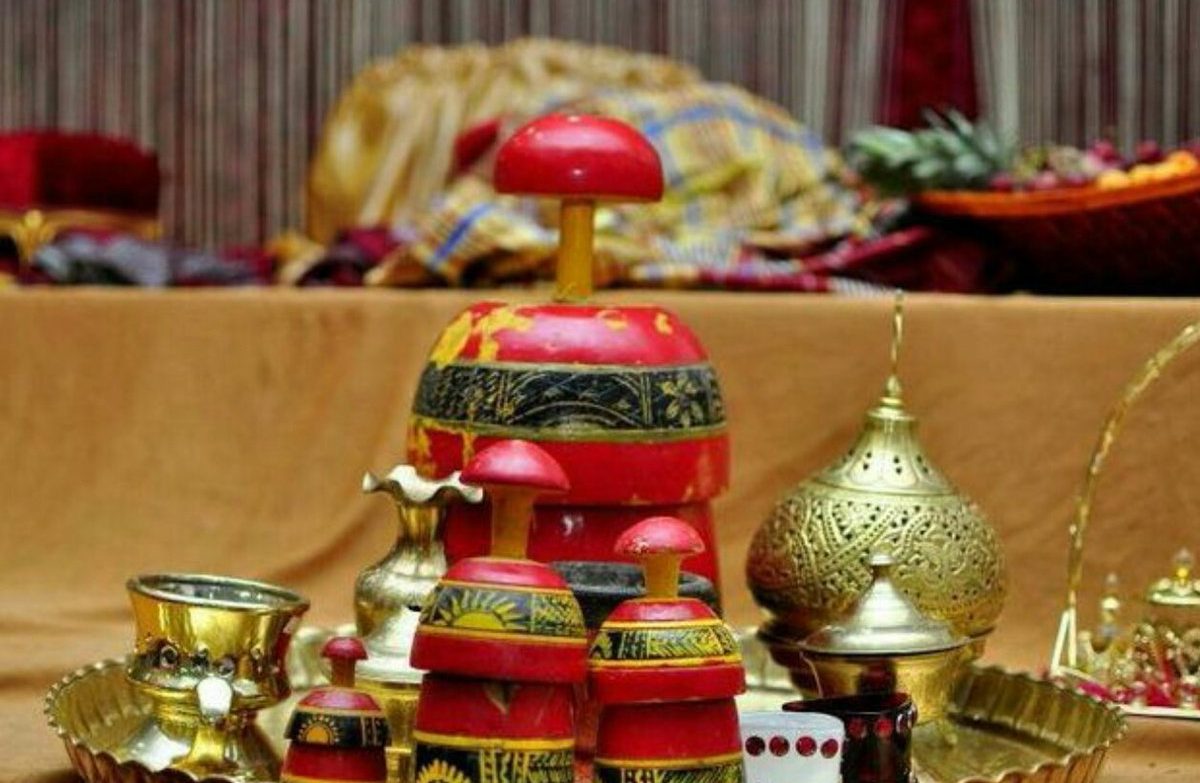
The Sinhalese wedding ritual performed on a carved wooden platform with betel leaves and milk rice.

The Poruwa ceremony is the traditional wedding rite of the Sinhalese people in Sri Lanka. It takes place on a decorated wooden stage called a poruwa, where the couple performs specific rituals involving betel leaves, gold threads, and shared food to mark their union.
When is Poruwa ceremony kept?
Poruwa ceremony is kept during the main wedding ceremony.
The Poruwa ceremony serves as the central wedding event for the Sinhalese community in Sri Lanka. It centers on a raised wooden platform where families exchange gifts and blessings. The ritual blends ancient local traditions with Buddhist influences, creating a structured path for the couple to join their lives through symbolic acts like sharing betel leaves and milk rice.
What the ceremony involves
The event unfolds on a carved wooden stage known as a poruwa. The groom’s side stands on the right while the bride’s family gathers on the left. Both partners enter leading with their right foot and greet each other with palms pressed together. An officiant offers betel leaves that the couple accepts before returning them to be placed on the platform. The bride’s father then places her hand into the groom’s hand, symbolizing the transfer of care. A brother of the groom presents a tray holding seven sheaves of betel leaves with coins inside. Each partner takes a leaf and drops it onto the wood. The groom’s brother gives a gold necklace to the groom, who puts it around the bride’s neck. A maternal uncle ties the couple’s small fingers with a gold thread and pours water over them. Six girls chant the Jayamangala Gatha to bless the union. The groom gives a white cloth to his bride, who passes it to her mother as thanks. Finally, the bride feeds the groom milk rice, which he returns. As they leave the stage, a family member breaks a coconut.
Origins and history
This tradition likely predates the arrival of Buddhism in Sri Lanka during the third century BC. For centuries, it functioned as a legally recognized form of marriage within the community. The British colonial administration changed this status in 1870 when they introduced formal marriage registration laws. Modern versions of the ceremony now reflect a mix of customs from both the upcountry and lowcountry regions of Sri Lanka. While the legal landscape has shifted, the cultural practice remains a vital expression of Sinhalese heritage.
Symbolism and meaning
Each action carries deep significance for the participants. The joint entry onto the platform marks the start of their shared journey. The exchange of betel leaves represents mutual respect and agreement. Tying the small fingers with gold thread signifies an unbreakable bond between the two individuals. Pouring water over the joined fingers suggests purity and the flow of life together. The feeding of milk rice demonstrates care and nourishment within the new household. Breaking the coconut at the end symbolizes the removal of obstacles and the breaking of ego, allowing the couple to begin their life together without hindrance.
How Poruwa ceremony is kept
The couple enters the wooden platform separately and greets each other formally. They receive betel leaves from an officiant and drop them on the stage. The bride’s father joins their hands, and they exchange betel sheaves with coins. A gold necklace is given, and a relative ties their fingers with gold thread while pouring water. Chants are sung by six women. The groom gives a cloth to the bride’s mother. They feed each other milk rice. A coconut is broken as they exit.
When and where
It occurs during the main wedding ceremony. The date is set according to traditional auspicious timing, often influenced by Buddhist calendars and family preferences.
It is practiced primarily in Sri Lanka among the Sinhalese community. It may also occur in diaspora communities, such as in Australia, where Sinhalese families maintain their traditions.
What Poruwa ceremony means
The rituals emphasize unity, respect, and the removal of barriers. The gold thread binding the fingers represents an eternal connection. The milk rice sharing shows mutual care. The broken coconut signifies clearing away negativity. The entire sequence moves the couple from individual families into a single unit bound by tradition.
Who takes part
- The bride and groom: Enter the platform, exchange betel leaves, receive gifts, and feed each other.
- The bride's father: Places the bride's hand in the groom's hand.
- The groom's brother: Presents the betel tray and gives the gold necklace.
- The maternal uncle: Ties the fingers with gold thread and pours water.
- Six girls: Chant the Jayamangala Gatha to bless the marriage.
- A family member: Breaks a coconut as the couple steps down.
If you are a guest
Guests observe the rituals from the sides of the platform. They witness the exchanges and chants. Their presence validates the union and supports the families involved in the proceedings.
Then and now
The ceremony adapts to modern legal requirements while keeping its core rituals. Families in Sri Lanka and abroad continue to perform it to honor their heritage. Some elements may be shortened for time or space constraints, but the essential symbols remain intact.
On the wedding table
- Milk rice: Specially cooked rice fed between the bride and groom to show care.
- Betel leaves: Accepted from the officiant and dropped on the platform as part of the ritual.
- Coconut: Broken by a family member as the couple exits the platform.
Symbols: Rice and grain The ring Gold and jewellery Water and washing Coconut and betel
Questions people ask about Poruwa ceremony
When is Poruwa ceremony kept?
Poruwa ceremony is kept during the main wedding ceremony.
What is the Poruwa ceremony?
It is a traditional Sinhalese wedding ritual performed on a carved wooden platform. It involves specific exchanges of gifts, chants, and symbolic acts to unite the couple.
Who performs the rituals?
The bride and groom lead the ceremony. Family members like fathers, brothers, and uncles play key roles in the exchanges and blessings.
See also
 MayianThe turmeric paste ceremony held the day before Punjabi weddings in India and Pakistan.
 JirtigA Sudanese inauguration ritual where the groom is symbolically crowned as a king.
 IhiThe Newar rite in which a girl is married to Vishnu, shown by a golden figure
 SvayamvaraThe ancient Hindu ceremony where a princess picks her husband from assembled suitors
Good reading and sources
The facts on this page come from the Wikipedia article "Poruwa ceremony", written by its contributors and used under the CC BY-SA 4.0 licence, and from its Wikidata record (CC0). EveryShaadi rewrote the text in its own words, with AI assistance, and compares every page with the article to make sure no passage is copied. It may be reused under the same CC BY-SA 4.0 licence with a link back.
It may contain mistakes. Wedding customs differ from one family, village and community to the next, and the people who keep them know them best. If something is wrong, tell us. Last refreshed 2026-10-05.
More from Sri Lanka
All the traditions of Sri Lanka 🇬🇧 United Kingdom and 3 moreCare cloth
A linen or silk cloth held over the heads of a bride and groom during a Christian wedding blessing.Attire · The ceremony
🇬🇧 United Kingdom and 3 moreCare cloth
A linen or silk cloth held over the heads of a bride and groom during a Christian wedding blessing.Attire · The ceremony
 🇱🇰 Kandy, Sri LankaOsariyaඔසරිය
The traditional sari style worn by Sinhalese women in Sri Lanka for weddings and formal events.Attire · The ceremony
🇱🇰 Kandy, Sri LankaOsariyaඔසරිය
The traditional sari style worn by Sinhalese women in Sri Lanka for weddings and formal events.Attire · The ceremony
The same idea elsewhere
The wedding procession and the arrival compared 🇯🇵 Tokyo, JapanShinto wedding神前結婚 (Shinzen kekkon)
A Shinto purification ritual featuring sake sharing and kimono attire held at a shrine or venue.Rite · The ceremony
🇯🇵 Tokyo, JapanShinto wedding神前結婚 (Shinzen kekkon)
A Shinto purification ritual featuring sake sharing and kimono attire held at a shrine or venue.Rite · The ceremony
 🇱🇹 Lithuania and 1 moreLithuanian wedding songsvestuvinės dainos
The polyphonic songs and weeping rituals that mark a Lithuanian bride's transition to her new family.Performance · Engagement and betrothal
🇱🇹 Lithuania and 1 moreLithuanian wedding songsvestuvinės dainos
The polyphonic songs and weeping rituals that mark a Lithuanian bride's transition to her new family.Performance · Engagement and betrothal
 🇸🇿 EswatiniUmtsimbauntsimba
A multi-day Swazi wedding procession where the bride joins her husband's family through ritualised stages.Rite · Finding a match
🇸🇿 EswatiniUmtsimbauntsimba
A multi-day Swazi wedding procession where the bride joins her husband's family through ritualised stages.Rite · Finding a match
 🇩🇪 Hamburg, Germany and 3 moreWimpelווימפל
A linen sash made from a baby boy's circumcision cloth that binds the Torah scroll.Adornment · The weeks before
🇩🇪 Hamburg, Germany and 3 moreWimpelווימפל
A linen sash made from a baby boy's circumcision cloth that binds the Torah scroll.Adornment · The weeks before