Henna, jewellery and body artSouth AsiaHindu
Dejhoor
A hexagonal ear ornament worn by Kashmiri Pandit women to mark their marriage.

The dejhoor is a dangling ear ornament worn by Kashmiri Pandit women starting from the eve of their wedding. It serves as a visible symbol of union between two families and represents Shiva and Shakti through its hexagonal shape.
When is Dejhoor kept?
Dejhoor is kept from the evening before the wedding onwards.
The dejhoor is a distinctive ear ornament kept by Kashmiri Pandit women to signify their marital status. Worn from the wedding eve onward, it acts as a sacred marker of union between families. Its unique design carries deep spiritual meaning for the community.
Design and materials
The ornament features a hexagonal bottom part called the athur. This section may be made of gold, silver threads, or pearls. A red thread or a gold chain known as an ath connects the piece to the ear. The chain measures approximately eight to twelve inches in length. In-laws often purchase this gold chain at their home. The jewelry sits in a cartilage piercing on the ear.
Spiritual meaning
The hexagonal shape functions as a yantra representing the divine pair of Shiva and Shakti. Some interpret the term Dij as dvija, marking the female counterpart to the Brahmin yajnopavita. It holds a role similar to the mangal-sutra or sindoor found in other Indian regions. The piece remains a permanent symbol of family connection.
Community practice
Only Kashmiri Pandit women wear this specific ornament. Members of other Hindu communities and Kashmiri Muslims do not use it. The bride's family provides the initial item. Women continue wearing the dejhoor even after the death of their husband. It stands as a lifelong badge of identity within the group.
How Dejhoor is kept
Women pierce the ear cartilage to receive the ornament. They begin wearing it on the wedding eve using a red thread. Later, in-laws may provide a gold chain to replace the thread. The hexagonal athur hangs from this attachment. The wearer keeps the piece for life, including periods after her husband passes away.
When and where
It is first put on during the wedding eve and worn continuously thereafter. There is no specific seasonal date for the custom itself.
The practice belongs to the Kashmiri Pandit community within India. It is not found among other religious groups in the region.
What Dejhoor means
The hexagonal form acts as a yantra for Shiva and Shakti. It signals the bond between two families. The name may link to dvija, mirroring male Brahmin traditions. It serves as a lasting sign of marriage and community belonging.
Who takes part
- The bride: Wears the ornament from the wedding eve onward
- The in-laws: Buy the gold chain that replaces the initial thread
- The bride's family: Provides the initial ornament
On the wedding table
Symbols: Gold and jewellery The colour red
Questions people ask about Dejhoor
When is Dejhoor kept?
Dejhoor is kept from the evening before the wedding onwards.
What is the dejhoor?
It is a hexagonal dangling ear ornament worn by Kashmiri Pandit women. It marks their marriage and symbolizes union between families.
Who buys the gold chain?
The in-laws typically purchase the gold chain, known as an ath, which replaces the initial red thread used to hold the ornament.
Is it worn by all Hindus?
No. Only Kashmiri Pandit women wear this specific ornament. Other Hindu communities and Kashmiri Muslims do not use it.
See also
 Toe ringA silver band worn on the second toe to mark a woman as married in India.
 ShankhaWhite conch shell bangles worn by Bengali Hindu married women as a symbol of their husband's well-being.
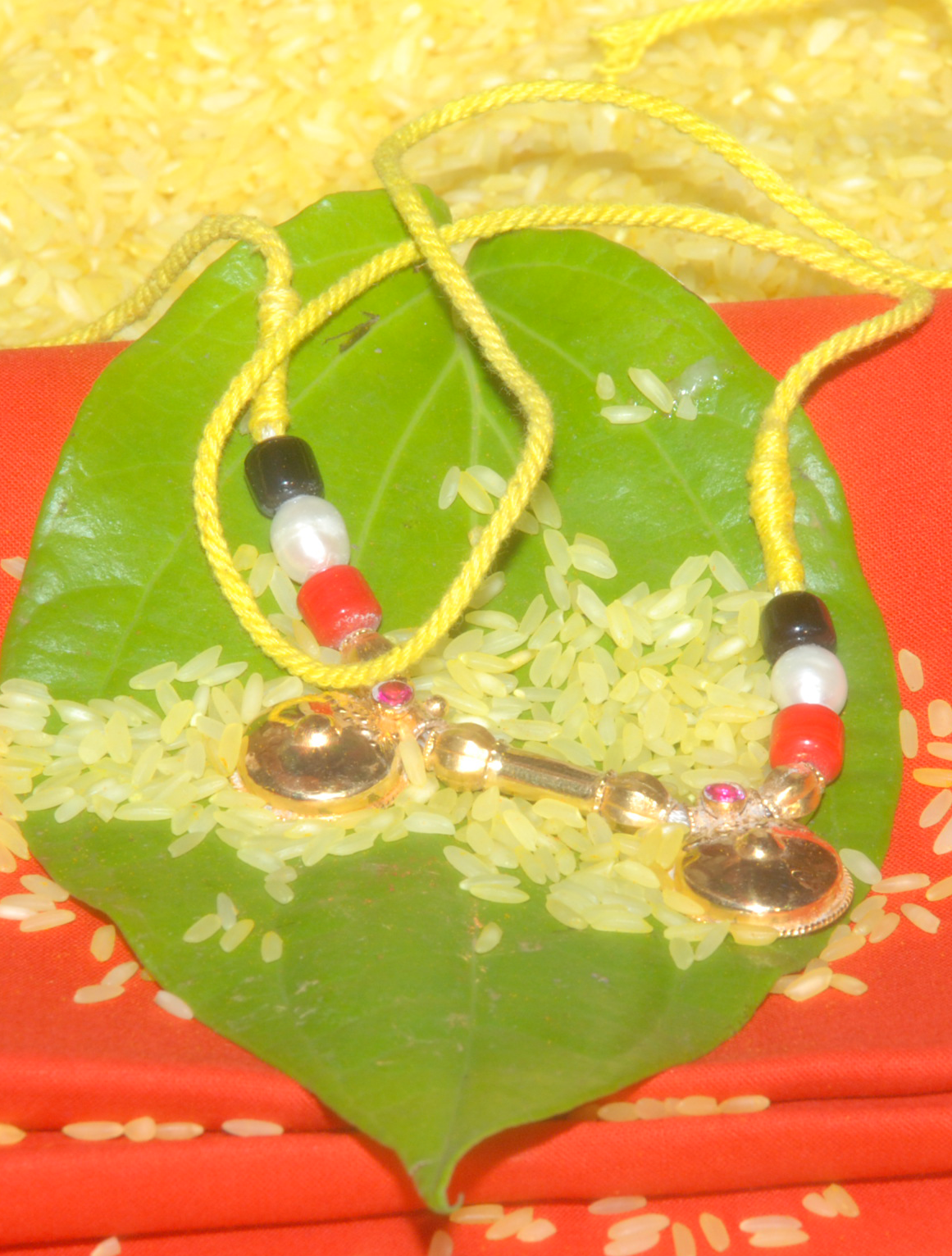 MangalsutraThe sacred necklace tied around the bride's neck to mark her marriage.
 SindoorThe vermilion powder a Hindu husband applies to his wife's hair parting to mark her marriage.
Good reading and sources
The facts on this page come from the Wikipedia article "Dejhoor", written by its contributors and used under the CC BY-SA 4.0 licence, and from its Wikidata record (CC0). EveryShaadi rewrote the text in its own words, with AI assistance, and compares every page with the article to make sure no passage is copied. It may be reused under the same CC BY-SA 4.0 licence with a link back.
It may contain mistakes. Wedding customs differ from one family, village and community to the next, and the people who keep them know them best. If something is wrong, tell us. Last refreshed 2026-10-05.
More from India
All the traditions of India
🇮🇳 IndiaShankha
White conch shell bangles worn by Bengali Hindu married women as a symbol of their husband's well-being.Adornment · Engagement and betrothal
🇮🇳 India and 1 moreToe ring
A silver band worn on the second toe to mark a woman as married in India.Adornment · The ceremony
🇮🇳 India and 2 moreMangalsutraमङ्गलसूत्रम् (maṅgalasūtram)
The sacred necklace tied around the bride's neck to mark her marriage.Adornment · The ceremony
🇮🇳 Delhi, India and 4 moreSindoorसिंदूर (Hindi)
The vermilion powder a Hindu husband applies to his wife's hair parting to mark her marriage.Adornment · Engagement and betrothal
The same idea elsewhere
Rings, knots and tokens of promise compared 🇪🇬 Egypt and 4 moreWaist beads
Strands of glass or seed worn around the hips to mark womanhood and track body changes in West and North Africa.Adornment · Engagement and betrothal
🇪🇬 Egypt and 4 moreWaist beads
Strands of glass or seed worn around the hips to mark womanhood and track body changes in West and North Africa.Adornment · Engagement and betrothal
 🇪🇸 Spain and 4 moreMantilla
A lace or silk veil worn over the head and shoulders by women in Spain and Latin AmericaAttire · The weeks before
🇪🇸 Spain and 4 moreMantilla
A lace or silk veil worn over the head and shoulders by women in Spain and Latin AmericaAttire · The weeks before
 🇮🇱 Jerusalem, Israel and 3 moreJewish wedding
The ceremony and laws that bind a couple in Jewish marriage, from the canopy to the glass.Rite · Engagement and betrothal
🇮🇱 Jerusalem, Israel and 3 moreJewish wedding
The ceremony and laws that bind a couple in Jewish marriage, from the canopy to the glass.Rite · Engagement and betrothal
 🇮🇷 Tehran, Iran and 1 moreIranian weddingمراسم عروسی در ایران
A multi-stage ceremony rooted in Zoroastrianism and Islam that binds families through courtship, feasts, and sacred vowsRite · Finding a match
🇮🇷 Tehran, Iran and 1 moreIranian weddingمراسم عروسی در ایران
A multi-stage ceremony rooted in Zoroastrianism and Islam that binds families through courtship, feasts, and sacred vowsRite · Finding a match