Vows, contracts and registrationSouth AsiaHindu
Kandyan marriage
The traditional union rites of Sri Lanka's Buddhist Kandyan community, defined by residence and inheritance.
Kandyan marriage refers to the customary wedding practices of the Buddhist Sinhalese people in Sri Lanka's former Kingdom of Kandy. It is governed by the Kandyan Marriage and Divorce Act and recognizes two distinct forms: Binna, where the groom joins the bride's family, and Diga, where the bride joins the groom's. These unions determine property rights and lineage within the community.
When is Kandyan marriage kept?
Kandyan marriage is kept on under the Kandyan Marriage and Divorce Act.
Kandyan marriage represents the customary legal framework for weddings among the Buddhist population in Sri Lanka's central highlands. Originating from the historic Kingdom of Kandy, this system distinguishes between two primary union types based on where the couple resides after the ceremony. These distinctions dictate complex rules regarding property ownership, inheritance, and family lineage, remaining a vital part of local civil law today.
Types of unions
The custom recognizes two specific forms of marriage that define the social and economic structure of the household. In a Binna marriage, the husband moves into his wife's family home. This arrangement allows the wife to inherit her family's ancestral property, often in equal or greater shares than male heirs. The husband gains administrative rights over her estate but does not own it, with assets passing to their children upon her death. Conversely, a Diga marriage sees the wife join the husband's family. In this scenario, the wife typically forfeits claims to her natal family's property. Her dowry becomes part of the husband's wealth, shifting the economic focus entirely to the groom's lineage.
Legal framework
These traditions are codified under the Kandyan Law Declaration and Amendment Ordinance of 1938 and the Kandyan Marriage and Divorce Act. The current legal system applies to Buddhists from the former Kandyan provinces, including the Central, North Central, Uva, and Sabaragamuwa regions. It also extends to specific districts in the Northern and North Western provinces. The law governs marriage registration, divorce provisions, and inheritance disputes. Only marriages solemnized or registered under these acts are recognized. Unregistered unions fall outside this specific customary jurisdiction, requiring couples to navigate other legal frameworks for validation and protection.
Historical practices
Historically, the region permitted polygyny, particularly among royalty who maintained harems of queens and concubines. Polyandry, known as eka-ge-kema or 'eating in one house,' was also practiced until banned by British authorities in 1859. This involved a woman having multiple husbands, usually brothers, from the same family. While modern law restricts these arrangements, historical records show they were common even among royalty, such as King Vijayabahu VII. Contemporary Kandyan law focuses on monogamous unions registered under the act, leaving ancient multi-partner customs as historical artifacts rather than active legal options.
How Kandyan marriage is kept
Couples choose between Binna and Diga structures based on family needs and property considerations. The union requires registration under the Kandyan Marriage and Divorce Act to be legally valid. Families negotiate dowry terms in Diga marriages, which transfer to the groom's household. In Binna unions, the groom integrates into the bride's existing property management. The ceremony establishes the residence pattern, which permanently influences how assets are inherited by spouses and children according to customary law.
When and where
The practice is observed whenever a couple registers their marriage under the Kandyan Marriage and Divorce Act. There is no specific seasonal timing, but it applies to the Buddhist Sinhalese community in designated Sri Lankan provinces. Registration can occur at any time, provided the couple meets the legal requirements for either Binna or Diga classification.
It is strongest in Sri Lanka's Central Province, particularly around Kandy, the historic capital. The law also applies to the North Central, Uva, and Sabaragamuwa provinces. Specific areas in the Northern and North Western provinces, such as Kurunegala District, are also included. The custom is tied to the geographic boundaries of the former Kingdom of Kandy.
What Kandyan marriage means
The choice between Binna and Diga symbolizes the balance between individual family wealth and communal continuity. Binna marriages emphasize the preservation of the wife's ancestral line and property, ensuring daughters retain significant economic power. Diga marriages highlight the integration of the bride into the groom's lineage, with her dowry reinforcing the husband's economic status. These structures reflect deep-seated values regarding land ownership, gender roles, and intergenerational responsibility.
Who takes part
- The bride: Joins the husband's family in Diga marriages or retains property rights in Binna unions
- The groom: Moves into the bride's home in Binna marriages or receives her dowry in Diga unions
- The families: Negotiate residence patterns and dowry transfers to align with legal inheritance rules
- The state: Registers the marriage under the Kandyan Marriage and Divorce Act to validate the union
Then and now
Modern Kandyan marriages strictly follow the registered Binna or Diga models under the 1938 ordinance. Ancient practices like polyandry and royal polygyny have been abolished. The law continues to evolve through court rulings, such as the 2021 Supreme Court decision clarifying inheritance rights for Diga married daughters. Registration remains essential for legal recognition, blending traditional customs with contemporary civil law requirements.
Questions people ask about Kandyan marriage
When is Kandyan marriage kept?
Kandyan marriage is kept on under the Kandyan Marriage and Divorce Act.
What are the two types of Kandyan marriage?
The two types are Binna and Diga. Binna involves the husband joining the wife's family, allowing her to inherit property. Diga involves the wife joining the husband's family, where her dowry becomes part of his wealth. These choices determine inheritance rights and residence patterns.
Is Kandyan marriage still used today?
Yes, it is one of three customary laws in Sri Lanka. Governed by the Kandyan Marriage and Divorce Act, it applies to Buddhists in specific provinces. Couples must register their union under this act for it to be legally recognized and protected.
Can women inherit property in Kandyan law?
Yes, but it depends on the marriage type. In Binna marriages, wives can inherit family property equally or more than men. In Diga marriages, wives generally cannot claim shares of their natal family's property, as their dowry transfers to the husband's family.
See also
 Poruwa ceremonyThe Sinhalese wedding ritual performed on a carved wooden platform with betel leaves and milk rice.
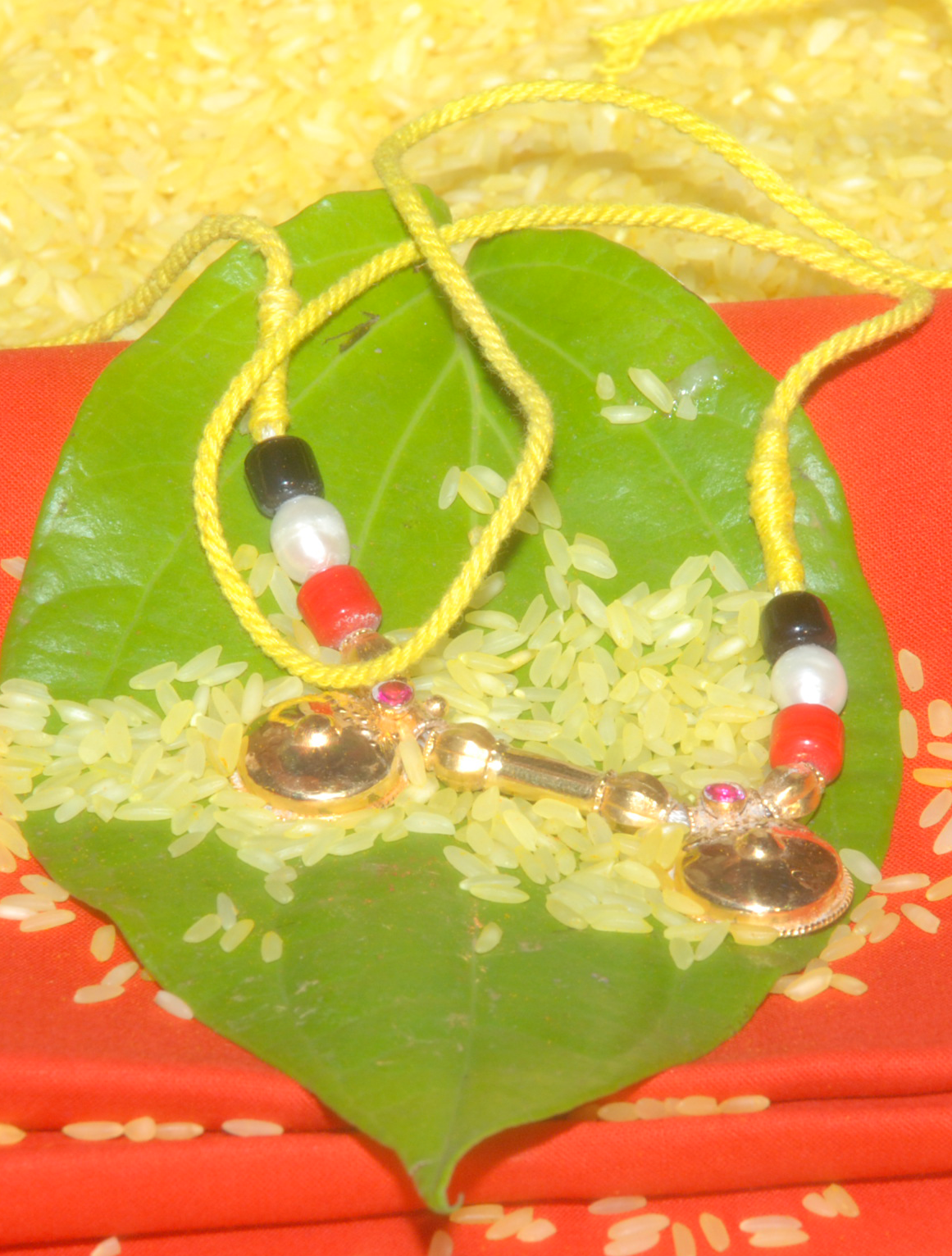 MangalsutraThe sacred necklace tied around the bride's neck to mark her marriage.Nikah halalaA second marriage required for a woman to remarry her first husband after triple talaq.
Good reading and sources
The facts on this page come from the Wikipedia article "Kandyan law", written by its contributors and used under the CC BY-SA 4.0 licence, and from its Wikidata record (CC0). EveryShaadi rewrote the text in its own words, with AI assistance, and compares every page with the article to make sure no passage is copied. It may be reused under the same CC BY-SA 4.0 licence with a link back.
It may contain mistakes. Wedding customs differ from one family, village and community to the next, and the people who keep them know them best. If something is wrong, tell us. Last refreshed 2026-10-05.
More from Sri Lanka
All the traditions of Sri Lanka
🇱🇰 Sri LankaPoruwa ceremony
The Sinhalese wedding ritual performed on a carved wooden platform with betel leaves and milk rice.Rite · The ceremony
🇮🇳 India and 2 moreMangalsutraमङ्गलसूत्रम् (maṅgalasūtram)
The sacred necklace tied around the bride's neck to mark her marriage.Adornment · The ceremony
The same idea elsewhere
Arranged marriage, matchmaking and choosing a partner compared 🇮🇷 Iran and 1 moreNikahnikāḥ (Arabic: نِكَاح)
The Islamic marriage contract that establishes a binding union between two people.Vow · Engagement and betrothal
🇮🇷 Iran and 1 moreNikahnikāḥ (Arabic: نِكَاح)
The Islamic marriage contract that establishes a binding union between two people.Vow · Engagement and betrothal
 🇪🇬 Egypt and 4 moreWaist beads
Strands of glass or seed worn around the hips to mark womanhood and track body changes in West and North Africa.Adornment · Engagement and betrothal
🇮🇶 Mosul, IraqWedding traditions in Iraq
The arranged courtship, religious rites and multi-day celebrations that mark marriage in Iraqi society.Betrothal · Finding a match
🇪🇬 Egypt and 4 moreWaist beads
Strands of glass or seed worn around the hips to mark womanhood and track body changes in West and North Africa.Adornment · Engagement and betrothal
🇮🇶 Mosul, IraqWedding traditions in Iraq
The arranged courtship, religious rites and multi-day celebrations that mark marriage in Iraqi society.Betrothal · Finding a match
 🇨🇳 China and 2 moreChinese pre-wedding customs三書六禮 (sàam syù luhk láih)
The traditional betrothal rituals of the Book of Rites that prepare a Chinese marriage.Betrothal · Finding a match
🇨🇳 China and 2 moreChinese pre-wedding customs三書六禮 (sàam syù luhk láih)
The traditional betrothal rituals of the Book of Rites that prepare a Chinese marriage.Betrothal · Finding a match