Blessings, luck and omensEuropeOrthodox and Eastern Christian
Lazarice
In its own language: лазарице (Serbian), лазаруване (Bulgarian)
A South Slavic procession of young unmarried women who bless homes before Palm Sunday
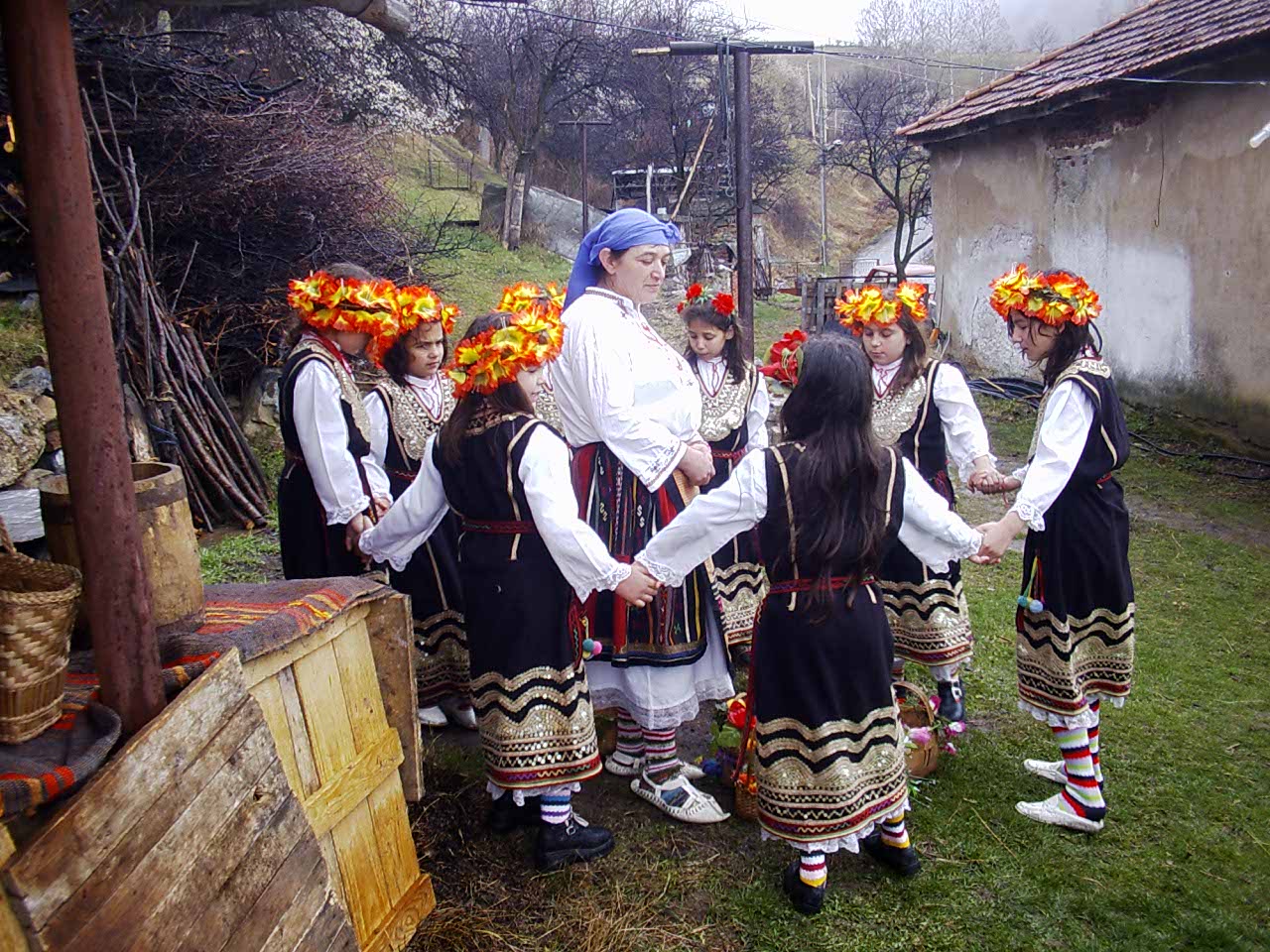
Lazarice is a traditional South Slavic procession performed by unmarried girls on Lazareva Subota, the day before Palm Sunday. The custom is kept in parts of Serbia and Bulgaria, where young women visit villages to sing blessings and accept small gifts from residents.
When is Lazarice kept?
Lazarice is kept on Lazareva Subota, the day before Palm Sunday.
Lazarice is a living tradition in which young unmarried women walk through villages to offer blessings and songs. This rite takes place during the Eastern Orthodox calendar, specifically on Lazareva Subota. Participants wear floral wreaths and move from house to house. The custom connects communities through shared music and ritual acts that promise good fortune for the coming year.
Origins and history
Scholars trace the roots of this practice to the Roman festival known as Rosalia. The Romans introduced these customs to Southeastern Europe following their conquest of the Balkans in the second century before the common era. Later, Slavic tribes settled in the region during the sixth and seventh centuries. These groups adopted elements of the earlier Greek-Roman rituals and adapted them into their own seasonal ceremonies. The tradition evolved over centuries to reflect local beliefs while maintaining its core structure.
How the rite unfolds
The ceremony involves groups of young unmarried women, typically around sixteen years old. They are called lazarki and decorate their hair with colorful flower and ribbon wreaths. The group visits houses across the village, singing specific songs and offering blessings to the household. Residents usually provide small presents or food to the performers. At the end of the route, the women gather near a river and drop their wreaths into the water. It is believed that the first wreath to drift away predicts which girl will marry next.
Social rules and status
Participation carries significant social weight within the community. A woman who has never taken part in this ritual may face restrictions regarding marriage or engagement. Traditionally, groups consist of approximately fourteen participants, though numbers vary by region. The custom remains strong in smaller villages where young women are available to perform it. Large urban centers have largely abandoned the practice due to changing lifestyles and population density.
How Lazarice is kept
Unmarried young women form groups and wear floral wreaths. They walk through villages singing blessing songs at each home. Residents give small gifts or food. The procession ends with the women dropping their wreaths into a river to predict future marriages.
When and where
This custom occurs on Lazareva Subota, which falls the day before Palm Sunday in the Eastern Orthodox calendar. The date shifts annually based on religious calculations.
The practice is found in Serbia and Bulgaria. It survives primarily in rural villages rather than major cities like Sofia or Belgrade.
What Lazarice means
The wreaths represent youth and fertility. Dropping them in the water serves as an omen for marriage timing. The songs bring blessings to the homes and ensure community harmony for the upcoming season.
Who takes part
- Lazarki: Young unmarried women who sing, dance, and bless homes
- Village residents: Provide small gifts and food to the performers
If you are a guest
Residents welcome the procession by listening to the songs. They offer small gifts or food to the young women as a sign of appreciation and to receive the blessings offered at their doorstep.
Then and now
The tradition persists mainly in smaller villages where young unmarried women remain active in community life. Urban areas have largely stopped observing the custom due to modernization and demographic shifts.
On the wedding table
Symbols: Garlands and flowers Water and washing

Questions people ask about Lazarice
When is Lazarice kept?
Lazarice is kept on Lazareva Subota, the day before Palm Sunday.
Who performs Lazarice?
The rite is performed by young unmarried women, typically around sixteen years old. They are known as lazarki and must be unmarried to participate in the procession.
What do the women do with their wreaths?
At the end of the procession, the women drop their floral wreaths into a river. The first wreath to drift away is said to predict which girl will marry first.
See also
 CsárdásA Hungarian folk dance that begins slowly and ends with a fast spin.
 CălușariA traditional Romanian spring dance and male society known for acrobatic leaps and ritual healing.
 AnastenariaA barefoot firewalking ritual performed by Orthodox Christian communities in Greece and Bulgaria.
 VechornytsiA Ukrainian courtship gathering where young people meet, dance and practice matchmaking rituals before the wedding seaso
Good reading and sources
The facts on this page come from the Wikipedia article "Lazarice", written by its contributors and used under the CC BY-SA 4.0 licence, and from its Wikidata record (CC0). EveryShaadi rewrote the text in its own words, with AI assistance, and compares every page with the article to make sure no passage is copied. It may be reused under the same CC BY-SA 4.0 licence with a link back.
It may contain mistakes. Wedding customs differ from one family, village and community to the next, and the people who keep them know them best. If something is wrong, tell us. Last refreshed 2026-10-06.
More from Serbia
All the traditions of Serbia 🇵🇱 Poland and 6 moreKolachколач (kolach), калач (kalach), kołacz, colac, kalács
A braided or ring-shaped bread that marks weddings and major holidays across Eastern Europe.Feast custom · Engagement and betrothal
🇵🇱 Poland and 6 moreKolachколач (kolach), калач (kalach), kołacz, colac, kalács
A braided or ring-shaped bread that marks weddings and major holidays across Eastern Europe.Feast custom · Engagement and betrothal
 🇩🇪 Hanover, Germany and 5 moreBridal crownBrautkrone
A headdress worn by brides in Central and Northern Europe to symbolize purity and status.Attire · The ceremony
🇩🇪 Hanover, Germany and 5 moreBridal crownBrautkrone
A headdress worn by brides in Central and Northern Europe to symbolize purity and status.Attire · The ceremony
 🇷🇸 Serbia and 2 moreKoloКоло
A South Slavic circle dance performed at weddings and social gatherings across the Balkans.Performance · Reception, dance and gifts
🇷🇸 Serbia and 2 moreKoloКоло
A South Slavic circle dance performed at weddings and social gatherings across the Balkans.Performance · Reception, dance and gifts
 🇷🇴 Romania and 7 moreHorahora (Romanian), horo (Bulgarian), oro (Macedonian), horah (Hebrew)
A circle dance held at weddings across Southeast Europe and among Jewish communities worldwide.Performance · Reception, dance and gifts
🇷🇴 Romania and 7 moreHorahora (Romanian), horo (Bulgarian), oro (Macedonian), horah (Hebrew)
A circle dance held at weddings across Southeast Europe and among Jewish communities worldwide.Performance · Reception, dance and gifts
The same idea elsewhere
The wedding procession and the arrival compared 🇸🇿 Ludzidzini Royal Village, Eswatini and 1 moreUmhlanga
The annual Swazi and Zulu gathering where young women cut reeds to preserve chastity and offer tribute labour.Rite · The eve
🇸🇿 Ludzidzini Royal Village, Eswatini and 1 moreUmhlanga
The annual Swazi and Zulu gathering where young women cut reeds to preserve chastity and offer tribute labour.Rite · The eve
 🇮🇳 IndiaGaye holudগায়ে হলুদ
The turmeric ceremony that prepares the Bengali bride and groom for marriageRite · The weeks before
🇮🇳 IndiaGaye holudগায়ে হলুদ
The turmeric ceremony that prepares the Bengali bride and groom for marriageRite · The weeks before
 🇮🇳 IndiaOdia Hindu weddingBahaghara (ଓଡ଼ିଆ ବାହାଘର)
The traditional Hindu marriage ceremony of the Odia people in Odisha, India.Rite · Engagement and betrothal
🇮🇳 IndiaOdia Hindu weddingBahaghara (ଓଡ଼ିଆ ବାହାଘର)
The traditional Hindu marriage ceremony of the Odia people in Odisha, India.Rite · Engagement and betrothal
 🇮🇳 Madurai, IndiaGoluBommai kolu (Tamil), Bommala Koluvu (Telugu), Gombe Habba (Kannada)
A tiered display of dolls and figurines arranged in South Indian homes during the Navaratri festival.Feast custom · The weeks before
🇮🇳 Madurai, IndiaGoluBommai kolu (Tamil), Bommala Koluvu (Telugu), Gombe Habba (Kannada)
A tiered display of dolls and figurines arranged in South Indian homes during the Navaratri festival.Feast custom · The weeks before