Wedding traditions with the colour red
Red is the colour of weddings in much of Asia.
Red is the colour of weddings in much of Asia. It stands for luck, joy, fertility, life and protection, and in China, India, Vietnam and Korea it is the colour of the bride. In the West it is often avoided, which shows how much meaning a colour can carry.
Red in Asia
Chinese brides wear red qipao or qungua, the wedding hall is hung with red double-happiness characters, and guests give hongbao, red envelopes. Indian brides wear red lehengas or silk saris, and the sindoor in the parting of the hair is red. Vietnamese brides wear a red ao dai, and Korean brides wear red dots, yeonji gonji, on the cheeks. In Japan the uchikake may be red, and the bridal umbrella is also red.
Red elsewhere
Red also appears in Armenia, Georgia and Turkey, where the bride may be wrapped in a red veil or have a red ribbon tied at her waist, called the kirmizi kusak in Turkish custom. In the Balkans red and white cloth were used in traditional dress, and in Central Asia red wedding robes and headdresses were common. In Europe white took over in the nineteenth century.
Written by the EveryShaadi desk with AI assistance. Background on The colour red (symbol). Customs differ from place to place and family to family. If this is your tradition and we have it wrong, tell us.
 🇯🇵 Tokyo, JapanMizuhiki水引
Decorative paper cords used to tie wedding gift envelopes in JapanAdornment
 🇮🇳 Bhuj, India and 1 moreBandhani
The intricate tie-dye textile tradition of Gujarat and Rajasthan worn by brides and married women.Attire · Engagement and betrothal
 🇮🇳 IndiaShankha
White conch-shell bangles that mark a Bengali Hindu woman as marriedAdornment · The ceremony
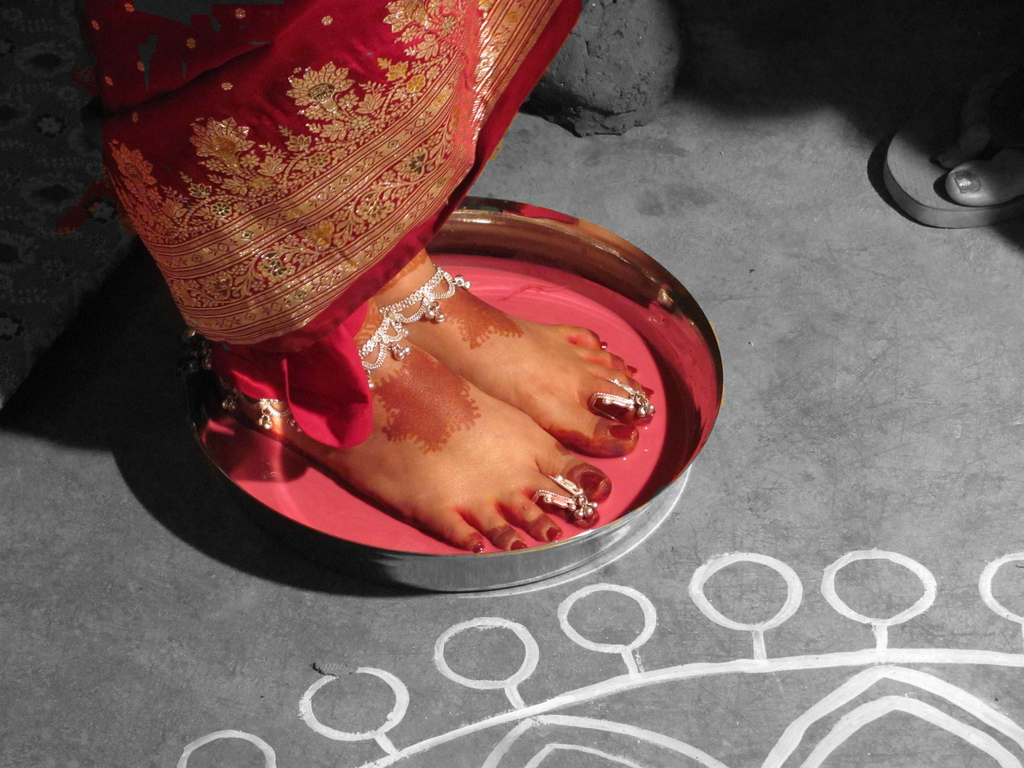 🇮🇳 India and 2 moreAltaআলতা (Bengali), 𑂄𑂪𑂞𑂰 (Bhojpuri)
A red dye applied to hands and feet by women in South Asia for weddings and festivals.Adornment · The weeks before
 🇯🇵 JapanShūgi-bukuro祝儀袋
The decorative envelope used to present monetary gifts at Japanese weddings and other joyous events.Gift custom · Reception, dance and gifts
 🇫🇷 Paris, FranceGlobe de mariée
A glass bell jar used in France to hold the bride's bouquet or crown, later kept as a family memory box.Adornment · Procession and arrival
 🇨🇳 China and 2 moreChinese pre-wedding customs三書六禮 (sàam syù luhk láih)
The six traditional rites from the Book of Rites that guide betrothal, gift exchange, and date selection in Chinese weddBetrothal · Finding a match
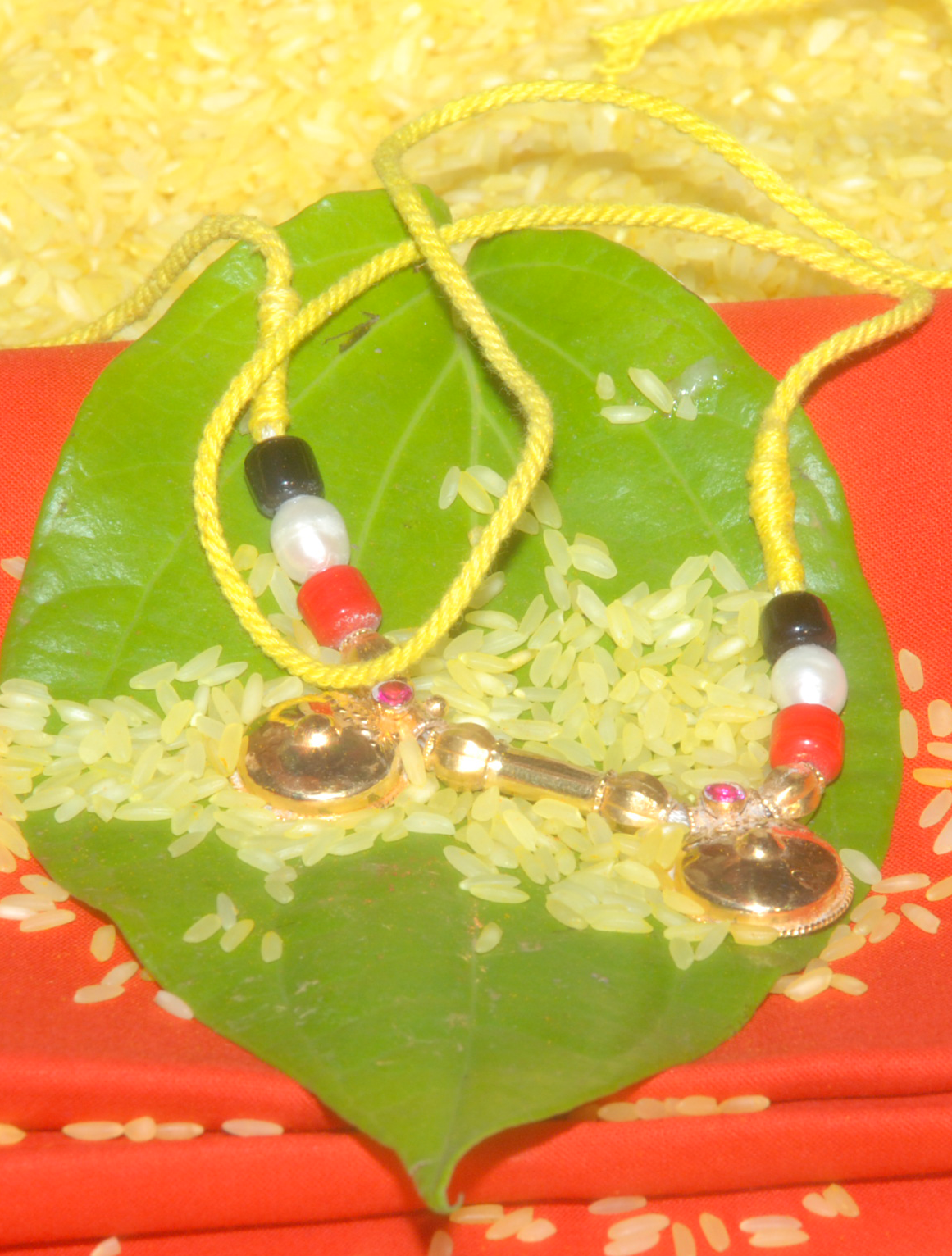 🇮🇳 India and 2 moreMangalsutraमङ्गलसूत्रम् (maṅgalasūtram)
The sacred necklace tied around the bride's neck to mark her marriage.Adornment · The ceremony
 🇮🇳 IndiaGana
A sacred red thread tied to wrists for protection during wedding rituals in parts of India.Adornment · The weeks before
 🇨🇳 China and 3 moreDouble Happiness双喜 (shuāngxǐ)
The red calligraphy symbol made of two joy characters that marks Chinese wedding celebrations.Adornment · The weeks before
 🇮🇳 Hyderabad, IndiaKhara dupattaکھڑا دوپٹہ
The elaborate traditional wedding ensemble worn by Hyderabadi Muslim brides.Attire · The ceremony
 🇮🇳 Delhi, India and 4 moreSindoorसिंदूर (Hindi)
The vermilion powder a Hindu husband applies to his wife's hair parting to mark her marriage.Adornment · Engagement and betrothal
 🇪🇬 Egypt and 5 moreHenna night
The evening before a wedding when the bride and groom are decorated with henna patterns for luck and joyAdornment · The eve
 🇫🇷 France and 1 moreAcrostic ring
A jewelled band where gemstone initials spell a secret romantic word.Adornment · Engagement and betrothal
 🇮🇳 IndiaDejhoor
A hexagonal ear ornament worn by Kashmiri Pandit women to mark their marriage.Adornment · The eve
🇮🇩 Palembang, IndonesiaSeting clothes and Cual cloth
The red velvet top and intricate ikat skirt worn by Bangka Belitung brides and grooms.Attire · The ceremony
 🇮🇳 Patiala, IndiaParanda
A silk thread hair ornament worn by Punjabi women during weddings and festivals.Adornment · The weeks before
 🇯🇵 Kyoto, Japan and 5 moreTeeth blackeningohaguro
A traditional practice of dyeing teeth black to signal adulthood and beauty in parts of Asia and Oceania.Adornment · Engagement and betrothal
 🇮🇩 IndonesiaKawung batikBatik Kawung
A traditional Indonesian textile pattern inspired by the kawung fruit and lotus flower.Attire · The ceremony
🇷🇴 Romania and 3 moreMărțișor
The red and white string charm worn in early spring to welcome the new year.Adornment · The weeks before
 🇰🇷 South KoreaHahoe byeolsingut talnori하회별신굿탈놀이
A rare Korean masked dance-drama performed to appease the village deity Seonangsin in Hahoe.Rite · The weeks before
 🇳🇬 Iseyin, Nigeria and 2 moreYoruba wedding attire
Traditional garments worn by Yoruba couples and guests to mark marriage celebrations.Attire · The ceremony
 🇦🇿 Azerbaijan and 1 moreKelaghayiKəlağayı
A traditional silk headscarf exchanged as a marriage proposal and worn at henna parties in Azerbaijan and Armenia.Attire · Engagement and betrothal
🇨🇳 ChinaHebao荷包 (Hébāo)
A traditional Chinese embroidered pouch used for gifts, medicine, and romantic tokens.Adornment · Engagement and betrothal
 🇧🇬 Bulgaria and 3 moreMartenitsaмартеница
White and red yarn charms worn in the Balkans to welcome spring and wish for good health.Adornment · The weeks before
 🇮🇳 Firozabad, India and 1 moreBangle
A rigid circular bracelet worn by women in South Asia and beyond, often marking marital status or festive occasions.Adornment · The ceremony
Photo credits on this page
The small pictures above come from Wikimedia Commons under free licences. Some are cropped to fit.
- Teeth blackening: momo, CC BY 2.0, source
- Mizuhiki: User:FA2010, Public domain, source
- Sindoor: Masum-al-hasan, CC BY-SA 3.0, source
- Martenitsa: Unknown author, CC BY-SA 2.0, source
- Double Happiness: kanegen, CC BY 2.0, source
- Bangle: schwiki, CC BY-SA 4.0, source
- Acrostic ring: Jlblackmore, CC BY-SA 4.0, source
- Shūgi-bukuro: Nesnad, CC BY 4.0, source
- Globe de mariée: Alain Amet, CC BY 4.0, source
- Yoruba wedding attire: Wolf D., Public domain, source
- Bandhani: RubyGoes, CC BY 2.0, source
- Chinese pre-wedding customs: Pande Putu Hadi Wiguna, Public domain, source
- Vadhu Pravesha: Shounak Ray, CC BY-SA 2.0, source
- Shankha: Salil Kumar Mukherjee, CC BY-SA 4.0, source
- Kelaghayi: Urmen19, CC BY-SA 4.0, source
- Paranda: Biswarup Ganguly, CC BY 3.0, source
- Khara dupatta: Kinshuk Sunil, CC BY 2.0, source
- Kawung batik: Alteaven, CC BY-SA 3.0, source
- Mangalsutra: Ackroydman, CC BY-SA 3.0, source
- Hahoe byeolsingut talnori: Ian Sewell, CC BY-SA 2.5, source
- Henna night: Izzah Zainab, CC BY 2.0, source
- Dejhoor: Unknown author, Public domain, source
- Gana: William J Sisti, CC BY-SA 2.0, source