🇧🇩 Wedding traditions of Bangladesh
6 traditions from Bangladesh, best known first, across 5 cities and towns.
The provided sources focus on Bangladesh's broader cultural landscape rather than specific nuptial customs. They detail musical traditions, cinema, media, and national festivals without covering marriage laws, wedding rituals, or gift exchanges. Readers seeking detailed wedding guidance will find only a glimpse of the country's festive and artistic heritage.
This guide draws exclusively on the supplied text about Bangladesh. Because the material concentrates on general arts, media, and public holidays, it offers no direct details on marriage ceremonies, legal requirements, or seasonal wedding dates. What follows outlines the cultural environment that frames daily life and public celebrations across the region.
Cultural foundations
The Bangladeshi cultural identity developed over many centuries through the blending of several social groups. It shares deep ties with the wider Bengal region of the Indian subcontinent. Historical movements like the Bengal Renaissance during the eighteenth and early nineteenth centuries shaped local literature, philosophy, and visual arts. Communities here have absorbed influences from Islam, Hinduism, Buddhism, and Christianity over time. These layered histories appear in everyday practices, including distinct culinary traditions, regional languages, and shared storytelling. The resulting atmosphere values both spiritual devotion and secular expression, creating a society where multiple faiths and historical periods coexist in modern life.
Music and performance
Local performing arts split into classical, folk, and modern categories. Classical styles show clear links to older South Asian forms, occasionally featuring dance movements similar to Bharatnatyam or Kathak. Folk traditions hold particular importance, with lyrics often exploring spirituality, mysticism, love, and daily life. Singers and lyricists such as Lalon Shah and Hason Raja helped preserve these melodies. Traditional instruments include the bamboo flute known as Bashi, various drums like the tabla and dhol, the single-stringed ektara, the four-stringed dotara, and metal bowls called mandira used for rhythm. Modern musicians also play guitars, saxophones, and western drums alongside older tools. Rock bands emerged in urban centers like Dhaka and Chittagong starting in the nineteen nineties.
Media and film
Journalism in the country remains privately owned and diverse, with more than two hundred newspapers published regularly. State radio operates through Bangladesh Betar, while international services like BBC Bangla and Voice of America reach wide audiences. Television broadcasting includes the state network Bangladesh Television alongside numerous private channels. Press freedom faces ongoing challenges due to government pressure and censorship attempts. Cinematic history began in eighteen ninety-eight when films first screened at the Crown Theatre in Dhaka. The industry produced silent features in the twenties and thirties before releasing its first full-length movie in nineteen thirty-one. By the twenty-first century, annual production reached between eighty and one hundred films, supporting both commercial releases and independent directors who address social themes.
Festivals and holidays
Public celebrations mark the calendar year and bring communities together regardless of religious background. Secular events like Pohela Boishakh, Pohela Falgun, and Victory Day are widely observed. Religious holidays span Muslim observances such as Eid ul-Fitr and Eid ul-Adha, Hindu festivals including Durga Puja and Holi, Buddhist dates like Buddha Purnima, and Christian celebrations such as Christmas. Winter brings food-focused gatherings like Pitha Utshob and Nobanno. During major holidays, schools and offices close for extended periods. Families visit one another, share sweet dishes and savory meals, and exchange greetings. Newspapers release special holiday editions filled with stories and poetry. Rural areas see increased crowds as remote villages welcome visitors for communal feasting and prayer.
The facts in this overview come from the Wikipedia article "Culture of Bangladesh", written by its contributors and used under the CC BY-SA 4.0 licence. EveryShaadi rewrote the text in its own words, with AI assistance, and compares every page with the article to make sure no passage is copied. It may be reused under the same CC BY-SA 4.0 licence with a link back.
A wedding in Bangladesh, stage by stage
The customs written up so far, in the order a wedding unfolds.
Cities, towns and villages of Bangladesh
 🇮🇳 India and 1 moreAlpanaআলপনা (Bengali)
Rice flour floor paintings that bless homes and mark wedding celebrations in Bengal.Adornment · The weeks before
🇮🇳 India and 1 moreAlpanaআলপনা (Bengali)
Rice flour floor paintings that bless homes and mark wedding celebrations in Bengal.Adornment · The weeks before
 🇧🇩 Bangladesh and 1 moreBengali Muslim weddingবাঙালি মুসলিম বিয়ে
A multi-day Bengali Muslim marriage blending Islamic rites with local folk traditions.Rite · The weeks before
🇧🇩 Bangladesh and 1 moreBengali Muslim weddingবাঙালি মুসলিম বিয়ে
A multi-day Bengali Muslim marriage blending Islamic rites with local folk traditions.Rite · The weeks before
 🇮🇳 India and 2 moreLehenga
A long skirt worn as the base of a bridal outfit across the Indian subcontinent.Attire · The ceremony
🇧🇩 Bangladesh and 1 moreBou Bhatবউ ভাত
A feast hosted by the groom's family to welcome the bride into her new home.Feast custom · After the wedding
🇮🇳 India and 2 moreLehenga
A long skirt worn as the base of a bridal outfit across the Indian subcontinent.Attire · The ceremony
🇧🇩 Bangladesh and 1 moreBou Bhatবউ ভাত
A feast hosted by the groom's family to welcome the bride into her new home.Feast custom · After the wedding
 🇮🇳 India and 1 moreAiburo Bhaatআইবুড়ো ভাত
The final bachelor feast for the bride and groom before their Bengali weddingFeast custom · The weeks before
🇮🇳 India and 1 moreAiburo Bhaatআইবুড়ো ভাত
The final bachelor feast for the bride and groom before their Bengali weddingFeast custom · The weeks before
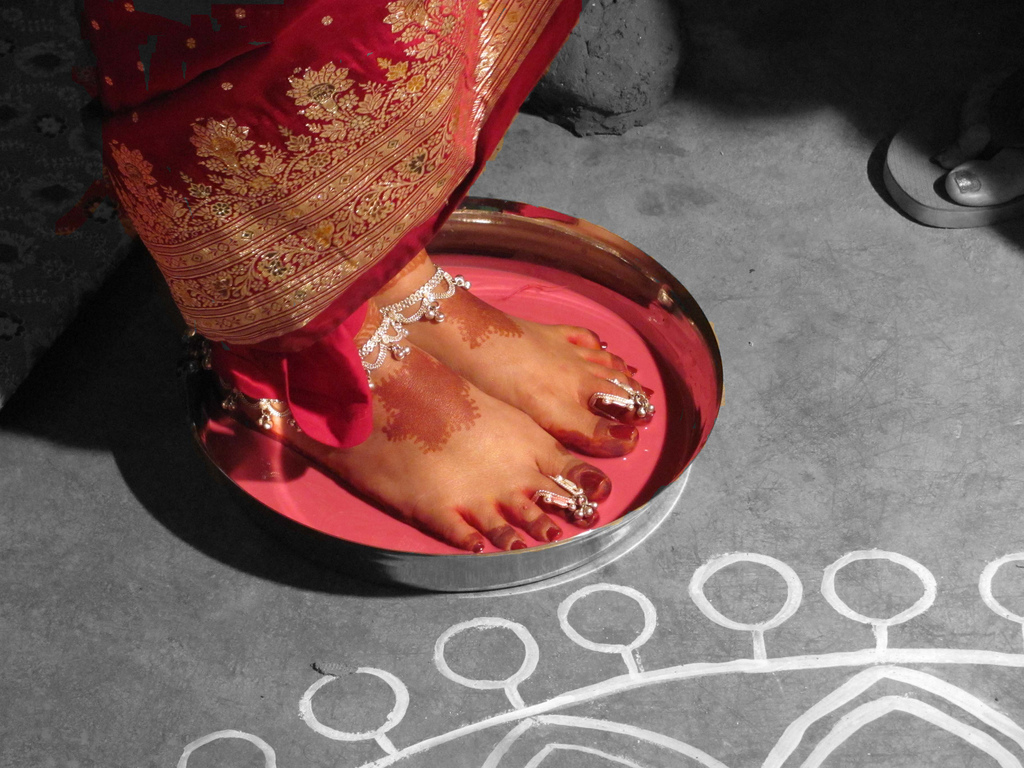 🇮🇳 India and 2 moreAltaআলতা (Bengali)
A red dye applied to hands and feet as an auspicious adornment in South Asian weddings and festivals.Adornment · The weeks before
🇮🇳 India and 2 moreAltaআলতা (Bengali)
A red dye applied to hands and feet as an auspicious adornment in South Asian weddings and festivals.Adornment · The weeks before
Photo credits on this page
The small pictures above come from Wikimedia Commons under free licences. Some are cropped to fit.
- Bengali Muslim wedding: NahidSultan, CC BY-SA 4.0, source
- Aiburo Bhaat: Ranganm2021, CC BY-SA 4.0, source
- Alpana: Tripan123, CC BY-SA 4.0, source
- Lehenga: Iwaqarhashmi, CC BY-SA 4.0, source
- Alta: Shounak Ray, CC BY-SA 2.0, source