🇹🇷 Wedding traditions of Turkey
7 traditions from Turkey, best known first, across 19 cities and towns.
In Turkey, couples must register their union through a civil official to make it legally binding, while religious ceremonies remain purely symbolic. Urban celebrations often follow modern Western patterns, whereas rural gatherings preserve older Anatolian and Ottoman customs shaped by extended family networks. These variations reflect a society where secular state law meets diverse regional traditions.
Marriage in Turkey blends state requirements with regional customs. Couples begin by securing a civil contract, which stands as the only legally valid form of union. Beyond the registry office, ceremonies vary widely across cities and villages. Some families weave Islamic rituals into the day, while others favor secular gatherings. The choice of celebration often mirrors local history, urban lifestyle, and personal preference.
Law and registration
Only civil marriages carry legal weight in Turkey. A licensed official conducts the contract, and religious services performed by Muslim clerics since 2017 hold no official standing. The minimum age for marriage is eighteen. Younger applicants face strict conditions. Seventeen-year-olds need parental approval, while sixteen-year-olds must secure both parental consent and a court ruling. Foreign nationals may also wed under Turkish civil law if they satisfy all local requirements. The resulting certificate serves as an official state document accepted abroad when properly authenticated.
A typical wedding
Daily life and wedding planning shift between city centers and countryside settlements. Modern urban couples frequently adopt Western-style receptions, influenced by decades of secular education and changing gender roles. Rural communities often structure events around extended kinship ties and older Anatolian customs. Families typically host the gatherings, drawing on local music and shared meals rather than formal vendor contracts. The pace of preparation depends on regional norms, with some areas moving quickly through paperwork while others prioritize lengthy family consultations before the ceremony.
Communities
Cultural expression changes noticeably across different ethnic groups and geographic zones. Turkish, Kurdish, Arab, Laz, Albanian, Circassian, and Armenian families each bring distinct linguistic and social habits to wedding days. Regional dialects, food choices, and musical styles mark these differences. Historical layers from Hittite, Roman, Byzantine, and Ottoman periods also surface in local architecture and decorative motifs. While national reforms promoted uniform education and Latin script, everyday celebrations still reflect the multicultural fabric that developed over centuries along the crossroads of Europe and Asia.
Same-sex unions
Turkish law does not recognize marriages between two people of the same sex. Couples seeking legal protection must look to foreign jurisdictions or rely on private agreements. Public opinion remains divided on the matter. A 2015 survey indicated that roughly one quarter of respondents supported legal recognition, while the majority did not. Social attitudes continue to evolve alongside broader discussions about secular governance and minority rights. Until legislation shifts, same-sex partners navigate marriage through alternative legal frameworks outside the country.
The facts in this overview come from the Wikipedia article "Marriage in Turkey", written by its contributors and used under the CC BY-SA 4.0 licence. EveryShaadi rewrote the text in its own words, with AI assistance, and compares every page with the article to make sure no passage is copied. It may be reused under the same CC BY-SA 4.0 licence with a link back.
A wedding in Turkey, stage by stage
The customs written up so far, in the order a wedding unfolds.
 🇹🇷 Kayseri, Turkey and 4 moreHalay
A traditional line and circle dance performed across Turkey and surrounding regions at weddings.Performance · The ceremony
🇹🇷 Kayseri, Turkey and 4 moreHalay
A traditional line and circle dance performed across Turkey and surrounding regions at weddings.Performance · The ceremony
 🇹🇷 TurkeyHoronχορόν (Pontic Greek)
The fast shoulder-shimmying line dance of the Eastern Black Sea Region performed at weddings and festivalsPerformance · The wedding feast
🇹🇷 TurkeyHoronχορόν (Pontic Greek)
The fast shoulder-shimmying line dance of the Eastern Black Sea Region performed at weddings and festivalsPerformance · The wedding feast
 🇮🇳 India and 5 moreDowry
A payment of wealth from the bride's family to the groom or his household at marriage.Gift custom · Engagement and betrothal
🇮🇳 India and 5 moreDowry
A payment of wealth from the bride's family to the groom or his household at marriage.Gift custom · Engagement and betrothal
 🇸🇾 Syria and 3 moreAssyrian wedding
Marriage ceremonies blending ancient Assyrian rites with modern cultural practices among the Assyrian people.Rite · Finding a match
🇸🇾 Syria and 3 moreAssyrian wedding
Marriage ceremonies blending ancient Assyrian rites with modern cultural practices among the Assyrian people.Rite · Finding a match
 🇧🇬 Bulgaria and 5 moreBulgarian wedding musicсватбарска музика
Fast-paced instrumental music played at Bulgarian weddings that blends folk, Romani, and Turkish styles.Performance · The ceremony
🇧🇬 Bulgaria and 5 moreBulgarian wedding musicсватбарска музика
Fast-paced instrumental music played at Bulgarian weddings that blends folk, Romani, and Turkish styles.Performance · The ceremony
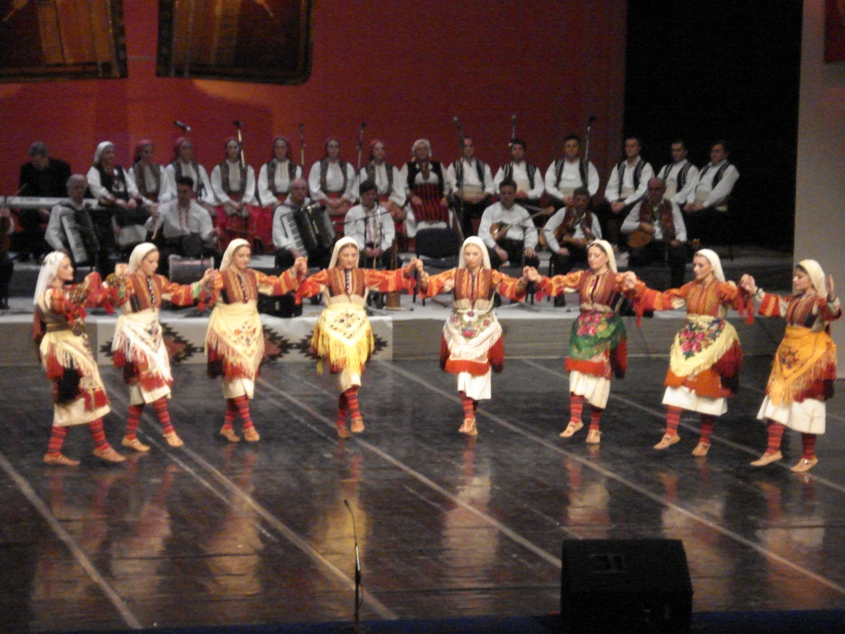 🇷🇴 Romania and 7 moreHorahora (Romanian), horo (Bulgarian), oro (Macedonian), horah (Hebrew)
A circle dance held at weddings across Southeast Europe and among Jewish communities worldwide.Performance · Reception, dance and gifts
🇷🇴 Romania and 7 moreHorahora (Romanian), horo (Bulgarian), oro (Macedonian), horah (Hebrew)
A circle dance held at weddings across Southeast Europe and among Jewish communities worldwide.Performance · Reception, dance and gifts
 🇮🇷 Tehran, Iran and 1 moreIranian weddingمراسم عروسی در ایران
A multi-stage ceremony rooted in Zoroastrianism and Islam that binds families through courtship, feasts, and sacred vowsRite · Finding a match
🇮🇷 Tehran, Iran and 1 moreIranian weddingمراسم عروسی در ایران
A multi-stage ceremony rooted in Zoroastrianism and Islam that binds families through courtship, feasts, and sacred vowsRite · Finding a match
Photo credits on this page
The small pictures above come from Wikimedia Commons under free licences. Some are cropped to fit.
- Iranian wedding: Flickr.com user "avlxyz", CC BY-SA 2.0, source
- Horon: Macukali, Public domain, source
- Bulgarian wedding music: Allen Ruttenberg, CC BY 2.0, source
- Halay: Post of Moldova, Public domain, source
- Hora: Chajeshukarie ( talk ), Public domain, source
- Dowry: Vassili Vladimirovich Pukiryov, Public domain, source
- Assyrian wedding: Yucalyptus, CC0, source