Henna, jewellery and body art
Henna and turmeric, the mangalsutra and the ring, hair, crowns and the painted hand.
Henna, turmeric paste, gold chains, the mangalsutra, crowns and flowers in the hair all decorate the bride and sometimes the groom. Adornment is both beauty and meaning: it marks a person as a bride, protects against the evil eye, and brings family and friends together for hours of shared work.
Henna and turmeric
Henna is applied in North Africa, the Middle East and South Asia, from the Moroccan lilat el henna to the Indian mehndi, the Pakistani mehndi night and the Yemeni and Jewish henna ceremonies. Patterns differ: Moroccan designs are geometric, Indian ones floral and fine, and Gulf styles bold and lacy. In India a tale says the darker the colour, the more the mother-in-law will love the bride. Turmeric paste, haldi, is applied before Hindu weddings to cleanse and bless.
Jewellery that carries a promise
In south India the groom ties the mangalsutra or thali around the bride's neck, and she wears it as a sign of marriage. In many Indian communities toe rings, bangles and the bindi or sindoor also mark a married woman. In Ethiopia and Eritrea gold crosses and coin necklaces are worn, and Bedouin and Berber brides wear heavy silver that is also family savings. In Western weddings the ring is the central piece, and the something old, new, borrowed and blue rhyme gives a small ritual to a pin or a ribbon.
What is changing
Some couples now apply henna to both partners, or to guests, and the designs include names, initials or a hidden date. Men increasingly wear jewellery and rings. Ethical sourcing of gold and diamonds is a growing concern, and lab-grown stones and recycled gold have become common choices.
Written by the EveryShaadi desk with AI assistance. Background on Henna, jewellery and body art (kind of custom). Customs differ from place to place and family to family. If this is your tradition and we have it wrong, tell us.
 🇬🇧 United Kingdom and 1 moreGimmal ring
A split band of two or three hoops that join to form a single wedding ring.Adornment · Engagement and betrothal
 🇮🇳 Bhuj, India and 1 moreBandhani
The intricate tie-dye textile tradition of Gujarat and Rajasthan worn by brides and married women.Attire · Engagement and betrothal
 🇩🇪 Hamburg, Germany and 3 moreWimpelווימפל
A linen sash made from a baby boy's circumcision cloth that binds the Torah scroll.Adornment · The weeks before
 🇯🇵 Tokyo, JapanMizuhiki水引
Decorative paper cords used to tie wedding gift envelopes in JapanAdornment
 🇮🇳 IndiaShankha
White conch-shell bangles that mark a Bengali Hindu woman as marriedAdornment · The ceremony
 🇪🇬 Egypt and 3 moreWaist beads
Beads worn round the waist or hips, from coming-of-age rites to the Igbo bride's attireAdornment · The weeks before
 🇮🇳 India and 1 moreAlpanaআলপনা
Rice flour floor paintings that mark weddings and festivals in BengalAdornment · The weeks before
 🇨🇳 China and 3 moreDouble Happiness双喜 (shuāngxǐ)
The red calligraphy symbol made of two joy characters that marks Chinese wedding celebrations.Adornment · The weeks before
 🇫🇷 France and 1 moreAcrostic ring
A gemstone band where the initials spell a romantic word like dearest or loveAdornment · Engagement and betrothal
 🇮🇹 ItalyFede ring
A clasped-hands ring symbolising faith and union in betrothal and marriageAdornment · Engagement and betrothal
 🇺🇸 United States and 5 moreEngagement ring
A ring given to mark a promise to marry, usually worn on the left hand in Western cultures.Adornment · Engagement and betrothal
 🇯🇵 JapanShūgi-bukuro祝儀袋
The decorative envelope used to present monetary gifts at Japanese weddings and other joyous events.Gift custom · Reception, dance and gifts
 🇮🇳 IndiaGana
A sacred red thread tied to wrists for protection during wedding rituals in parts of India.Adornment · The weeks before
 🇫🇷 Paris, FranceGlobe de mariée
A glass bell jar used in France to hold the bride's bouquet or crown, later kept as a family memory box.Adornment · Procession and arrival
 🇨🇳 China and 2 moreChinese pre-wedding customs三書六禮 (sàam syù luhk láih)
The six traditional rites from the Book of Rites that guide betrothal, gift exchange, and date selection in Chinese weddBetrothal · Finding a match
 🇮🇪 Galway, Ireland and 2 moreCladdagh ringFáinne an Chladaigh
An Irish ring with clasped hands, a heart and a crown that signals love, loyalty and friendship.Adornment · Engagement and betrothal
 🇻🇳 VietnamPhu Thê CakeBánh phu thê
A Vietnamese mung bean cake exchanged by the couple to wish for a happy marriageFeast custom · The ceremony
 🇬🇧 United Kingdom and 3 moreBridal bouquet
The handheld flower arrangement carried by the bride during her wedding ceremony.Attire · The ceremony
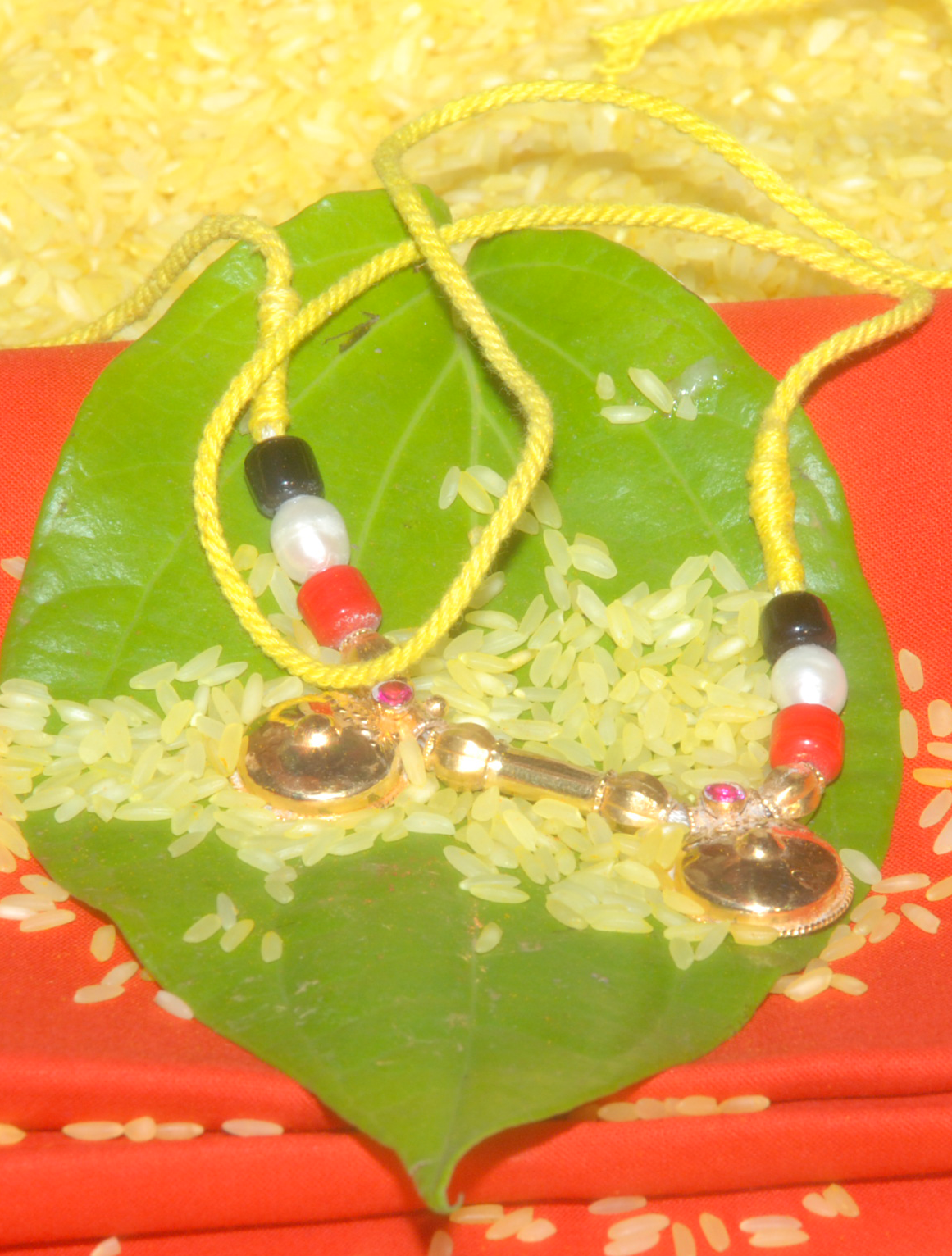 🇮🇳 India and 2 moreMangalsutraमङ्गलसूत्रम् (maṅgalasūtram)
The sacred necklace tied around the bride's neck to mark her marriage.Adornment · The ceremony
 🇮🇳 India and 1 moreMehndi
The henna body art applied to brides and guests before a South Asian weddingAdornment · The weeks before
 🇬🇷 Greece and 4 moreWedding ring
A metal finger ring that signals its wearer is married.Adornment · Engagement and betrothal
🇮🇳 IndiaSakharpuda
The Maharashtrian engagement where sugar and coconuts seal the promise of marriage.Betrothal · Engagement and betrothal
 🇺🇸 United StatesWedding cake topper
A small figurine placed on top of a wedding cake to represent the couple.Adornment · Reception, dance and gifts
 🇨🇳 China and 3 moreMarriage coin charm夫妇和合花钱 (fū fù hé hé huā qián)
Numismatic charms from East Asia that use marriage symbols or erotic imagery to wish couples fertility and harmony.Adornment · Engagement and betrothal
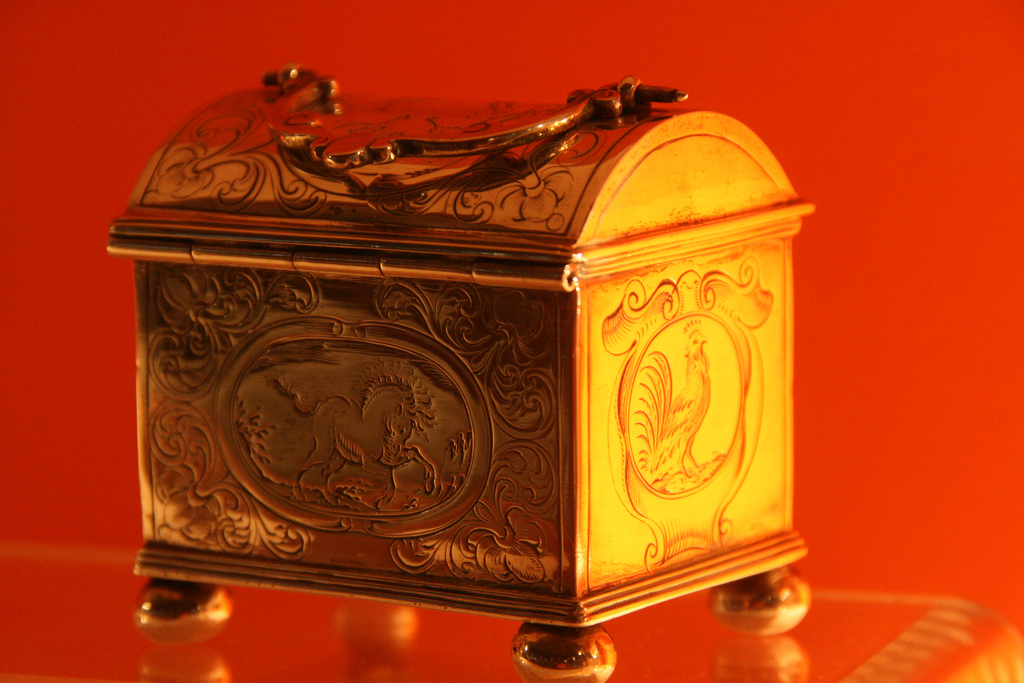 🇳🇱 NetherlandsKnottekistje
A silver Frisian box that replaced a knotted cloth as the token of engagement.Betrothal · Engagement and betrothal
 🇮🇳 Hyderabad, IndiaKhara dupattaکھڑا دوپٹہ
The elaborate traditional wedding ensemble worn by Hyderabadi Muslim brides.Attire · The ceremony
 🇬🇧 Edinburgh, United KingdomLuckenbooth brooch
A Scottish heart-shaped silver token of love and protection worn at weddings.Adornment · Engagement and betrothal
🇳🇬 NigeriaFattening room
A traditional Nigerian retreat where Efik women are secluded to learn skills and gain weight before marriage.Betrothal · Engagement and betrothal
 🇪🇬 Egypt and 2 moreHenna ceremonyليلة الحناء
A pre-wedding gathering where the bride and guests receive henna body art for luck and protection.Adornment · The eve
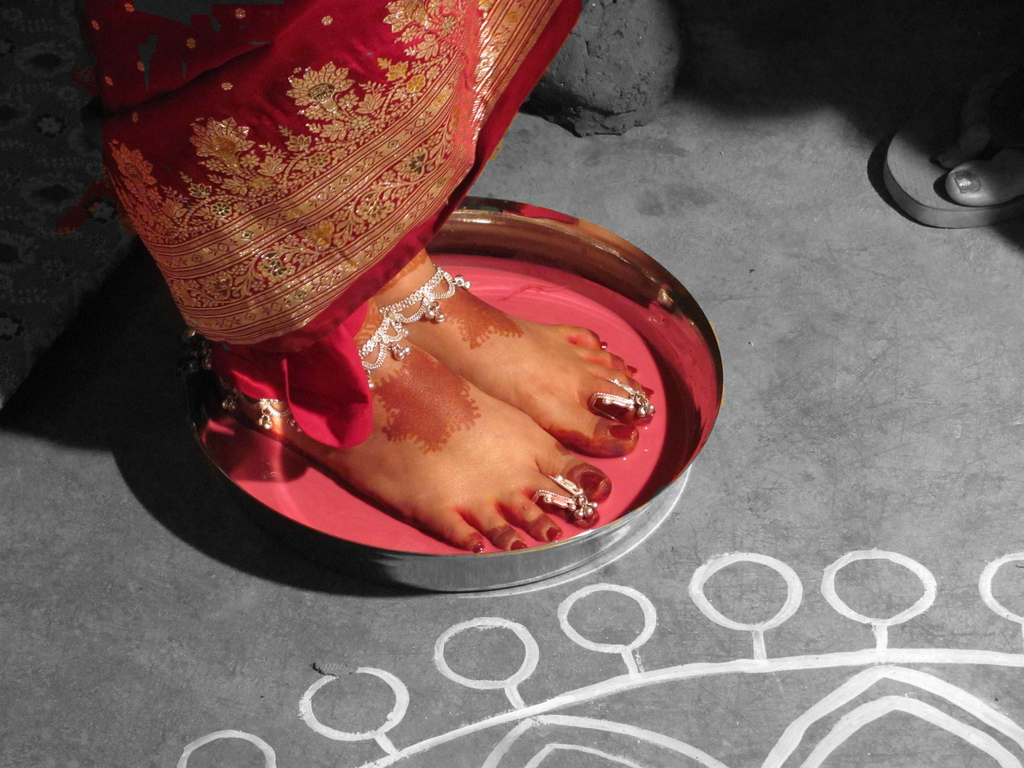 🇮🇳 India and 2 moreAltaআলতা (Bengali), 𑂄𑂪𑂞𑂰 (Bhojpuri)
A red dye applied to hands and feet by women in South Asia for weddings and festivals.Adornment · The weeks before
 🇳🇵 Nepal and 2 moreKhata
A ceremonial scarf offered to show respect and welcome at weddings and other gatherings in Tibet and Nepal.Adornment · Reception, dance and gifts
 🇮🇳 Delhi, India and 4 moreSindoorसिंदूर (Hindi)
The vermilion powder a Hindu husband applies to his wife's hair parting to mark her marriage.Adornment · Engagement and betrothal
 🇪🇬 Egypt and 5 moreHenna night
The evening before a wedding when the bride and groom are decorated with henna patterns for luck and joyAdornment · The eve
 🇫🇷 France and 2 moreBonbonniere
A small decorative container holding sweets given as a wedding favor in several countries.Feast custom · Reception, dance and gifts
 🇮🇳 IndiaDejhoor
A hexagonal ear ornament worn by Kashmiri Pandit women to mark their marriage.Adornment · The eve
🇫🇷 France and 1 moreAcrostic ring
A jewelled band where gemstone initials spell a secret romantic word.Adornment · Engagement and betrothal
 🇮🇪 Galway, Ireland and 1 moreMarriage stone
A carved stone bearing the initials and date of a newly married couple, placed on a building to mark their union.Adornment · After the wedding
🇮🇷 Bojnord, Iran and 1 moreTurkmen embroidery
Intricate silk embroidery on wedding and daily wear that marks territorial identity and family skill.Attire · The weeks before
 🇦🇿 Azerbaijan and 1 moreKelaghayiKəlağayı
A traditional silk headscarf exchanged as a marriage proposal and worn at henna parties in Azerbaijan and Armenia.Attire · Engagement and betrothal
 🇮🇳 Patiala, IndiaParanda
A silk thread hair ornament worn by Punjabi women during weddings and festivals.Adornment · The weeks before
 🇨🇾 Pano Lefkara, CyprusLefkara laceLefkaritika
The intricate white cotton embroidery from Cyprus that forms a bride's essential dowry collection.Attire · Engagement and betrothal
 🇮🇩 IndonesiaKawung batikBatik Kawung
A traditional Indonesian textile pattern inspired by the kawung fruit and lotus flower.Attire · The ceremony
 🇯🇵 Kyoto, Japan and 5 moreTeeth blackeningohaguro
A traditional practice of dyeing teeth black to signal adulthood and beauty in parts of Asia and Oceania.Adornment · Engagement and betrothal
🇷🇴 Romania and 3 moreMărțișor
The red and white string charm worn in early spring to welcome the new year.Adornment · The weeks before
 🇰🇷 South KoreaHahoe byeolsingut talnori하회별신굿탈놀이
A rare Korean masked dance-drama performed to appease the village deity Seonangsin in Hahoe.Rite · The weeks before
 🇳🇬 Iseyin, Nigeria and 2 moreYoruba wedding attire
Traditional garments worn by Yoruba couples and guests to mark marriage celebrations.Attire · The ceremony
 🇨🇳 China and 1 moreTuanshan團扇 (tuánshàn)
A rigid silk fan held by the bride to hide her face before revealing it to the groom.Adornment · The ceremony
🇮🇩 Palembang, IndonesiaSeting clothes and Cual cloth
The red velvet top and intricate ikat skirt worn by Bangka Belitung brides and grooms.Attire · The ceremony
Photo credits on this page
The small pictures above come from Wikimedia Commons under free licences. Some are cropped to fit.
- Teeth blackening: momo, CC BY 2.0, source
- Mizuhiki: User:FA2010, Public domain, source
- Tuanshan: 猫猫的日记本, CC BY-SA 3.0, source
- Sindoor: Masum-al-hasan, CC BY-SA 3.0, source
- Double Happiness: kanegen, CC BY 2.0, source
- Acrostic ring: Jlblackmore, CC BY-SA 4.0, source
- Fede ring: Anonymous ( Europe ) Unknown author, Public domain, source
- Engagement ring: Photo by Derek Ramsey ( Ram-Man ), CC BY-SA 2.5, source
- Shūgi-bukuro: Nesnad, CC BY 4.0, source
- Bonbonniere: TitineH, CC BY-SA 4.0, source
- Gimmal ring: Geni, CC BY-SA 4.0, source
- Globe de mariée: Alain Amet, CC BY 4.0, source
- Yoruba wedding attire: Wolf D., Public domain, source
- Bandhani: RubyGoes, CC BY 2.0, source
- Chinese pre-wedding customs: Pande Putu Hadi Wiguna, Public domain, source
- Wimpel: Wikipedia Loves Art participant " The_Grotto ", CC BY-SA 2.5, source
- Vadhu Pravesha: Shounak Ray, CC BY-SA 2.0, source
- Claddagh ring: Royalcladdagh, CC BY-SA 3.0, source
- Shankha: Salil Kumar Mukherjee, CC BY-SA 4.0, source
- Phu Thê Cake: JeanFousrou52, CC BY-SA 4.0, source
- Bridal bouquet: James Vick's Sons (Rochester, N.Y.); Henry G. Gilbert Nursery and Seed, No restrictions, source
- Mehndi: AKS.9955, CC BY-SA 4.0, source
- Marriage stone: Kim Traynor, CC BY-SA 3.0, source
- Waist beads: Amuzujoe, CC BY-SA 4.0, source
- Marriage coin charm: Scott Semans, CC BY 3.0, source
- Wedding cake topper: Andy Mabbett, CC BY-SA 3.0, source
- Knottekistje: mwibawa, CC BY-SA 2.0, source
- Lefkara lace: Cyprus Tourism CH, CC BY 2.0, source
- Luckenbooth brooch: Walker14806, CC BY-SA 4.0, source
- Khata: Wiki-uk, CC BY 3.0, source
- Kelaghayi: Urmen19, CC BY-SA 4.0, source
- Paranda: Biswarup Ganguly, CC BY 3.0, source
- Khara dupatta: Kinshuk Sunil, CC BY 2.0, source
- Kawung batik: Alteaven, CC BY-SA 3.0, source
- Wedding ring: CLW at English Wikipedia, Public domain, source
- Mangalsutra: Ackroydman, CC BY-SA 3.0, source
- Hahoe byeolsingut talnori: Ian Sewell, CC BY-SA 2.5, source
- Alpana: Tripan123, CC BY-SA 4.0, source
- Henna night: Izzah Zainab, CC BY 2.0, source
- Dejhoor: Unknown author, Public domain, source
- Gana: William J Sisti, CC BY-SA 2.0, source
- Henna ceremony: No author provided, CC0, source