Wedding traditions with the colour red
Red is the colour of weddings in much of Asia.
Red is the colour of weddings in much of Asia. It stands for luck, joy, fertility, life and protection, and in China, India, Vietnam and Korea it is the colour of the bride. In the West it is often avoided, which shows how much meaning a colour can carry.
Red in Asia
Chinese brides wear red qipao or qungua, the wedding hall is hung with red double-happiness characters, and guests give hongbao, red envelopes. Indian brides wear red lehengas or silk saris, and the sindoor in the parting of the hair is red. Vietnamese brides wear a red ao dai, and Korean brides wear red dots, yeonji gonji, on the cheeks. In Japan the uchikake may be red, and the bridal umbrella is also red.
Red elsewhere
Red also appears in Armenia, Georgia and Turkey, where the bride may be wrapped in a red veil or have a red ribbon tied at her waist, called the kirmizi kusak in Turkish custom. In the Balkans red and white cloth were used in traditional dress, and in Central Asia red wedding robes and headdresses were common. In Europe white took over in the nineteenth century.
Written by the EveryShaadi desk with AI assistance. Background on The colour red (symbol). Customs differ from place to place and family to family. If this is your tradition and we have it wrong, tell us.
 🇦🇿 Nakhchivan, AzerbaijanAzerbaijani wedding traditionsAzərbaycanın toy adətləri
A multi-stage family ceremony in Azerbaijan featuring matchmaking, dowry exchange, and henna rituals.Rite · Finding a match
 🇮🇳 Bengaluru, India and 3 moreDowry system in Indiaदहेज (Hindi), ज़ीज़ (Urdu)
The transfer of cash and goods from the bride's family to the groom's family as a condition of marriage.Gift custom · Engagement and betrothal
 🇨🇳 China and 4 moreChinese wedding door games堵门游戏 (dǔmén yóuxì)
Challenges set by bridesmaids for the groom at the bride's home to prove his devotion.Play · Engagement and betrothal
 🇲🇦 Tangier, MoroccoNegafanggafa (Tamazight); ziyyāna (Arabic)
The traditional Moroccan bridal dresser who manages the bride's appearance and wedding rituals.Attire · The weeks before
 🇻🇳 VietnamTraditional Vietnamese weddingLễ cưới truyền thống Việt Nam
The multi-stage ceremony of betrothal, engagement and union that marks a marriage in Vietnam.Attire · Finding a match
🇮🇳 India and 1 moreLeirum Pheeꯂꯩꯔꯨꯝ ꯐꯤ
A traditional Meitei shawl given as a wedding gift from parents to daughtersAttire · Engagement and betrothal
🇨🇳 China and 1 moreGhost marriage冥婚 (mínghūn)
A union arranged by families for deceased individuals to ensure harmony in the afterlife and continuity of the lineage.Rite · After the wedding
 🇮🇳 India and 1 moreAnand Karajਅਨੰਦ ਕਾਰਜ
The Sikh wedding rite where the couple circles the Guru Granth Sahib to four hymns of union.Rite · Procession and arrival
 🇮🇳 Kanchipuram, India and 1 moreWedding sari
The traditional draped garment worn by brides in South Asia for their marriage ceremony.Attire · The ceremony
 🇮🇳 India and 2 moreHindu weddingvivaha (विवाह)
The traditional marriage ceremony for Hindus, centered on sacred fire and seven vows.Rite · Engagement and betrothal
 🇳🇬 NigeriaLefe
The presentation of gifts from the groom to the bride in Hausa weddings.Gift custom · The weeks before
 🇯🇵 Tokyo, JapanShinto weddingShinzen kekkon (神前結婚)
A Shinto purification ritual where couples exchange sake and offer prayers to the spirits.Rite · The ceremony
 🇺🇦 Kyiv, Ukraine and 2 moreOchipokочіпок
The embroidered cap that covers a Ukrainian bride's hair to mark her new status as a married womanAttire · The ceremony
 🇬🇧 United Kingdom and 3 moreCare cloth
A linen or silk sheet held over the couple during a Christian blessing to symbolize their shared yoke.Rite · The ceremony
 🇨🇳 ChinaXiuhefu秀禾服
A modern two-piece Chinese bridal outfit inspired by Qing dynasty styles and popularized by a 2001 television drama.Attire · The ceremony
 🇹🇴 Tonga and 2 moreTaʻovala
The woven pandanus mat worn around the waist for formal occasions and weddings in Tonga.Attire · The weeks before
 🇬🇧 United Kingdom and 3 moreWedding dress
The formal attire worn by the bride during her wedding ceremony.Attire · The ceremony
 🇮🇳 Hyderabad, IndiaKhara dupattaکھڑا دوپٹہ
The elaborate traditional wedding ensemble worn by Hyderabadi Muslim brides.Attire · The ceremony
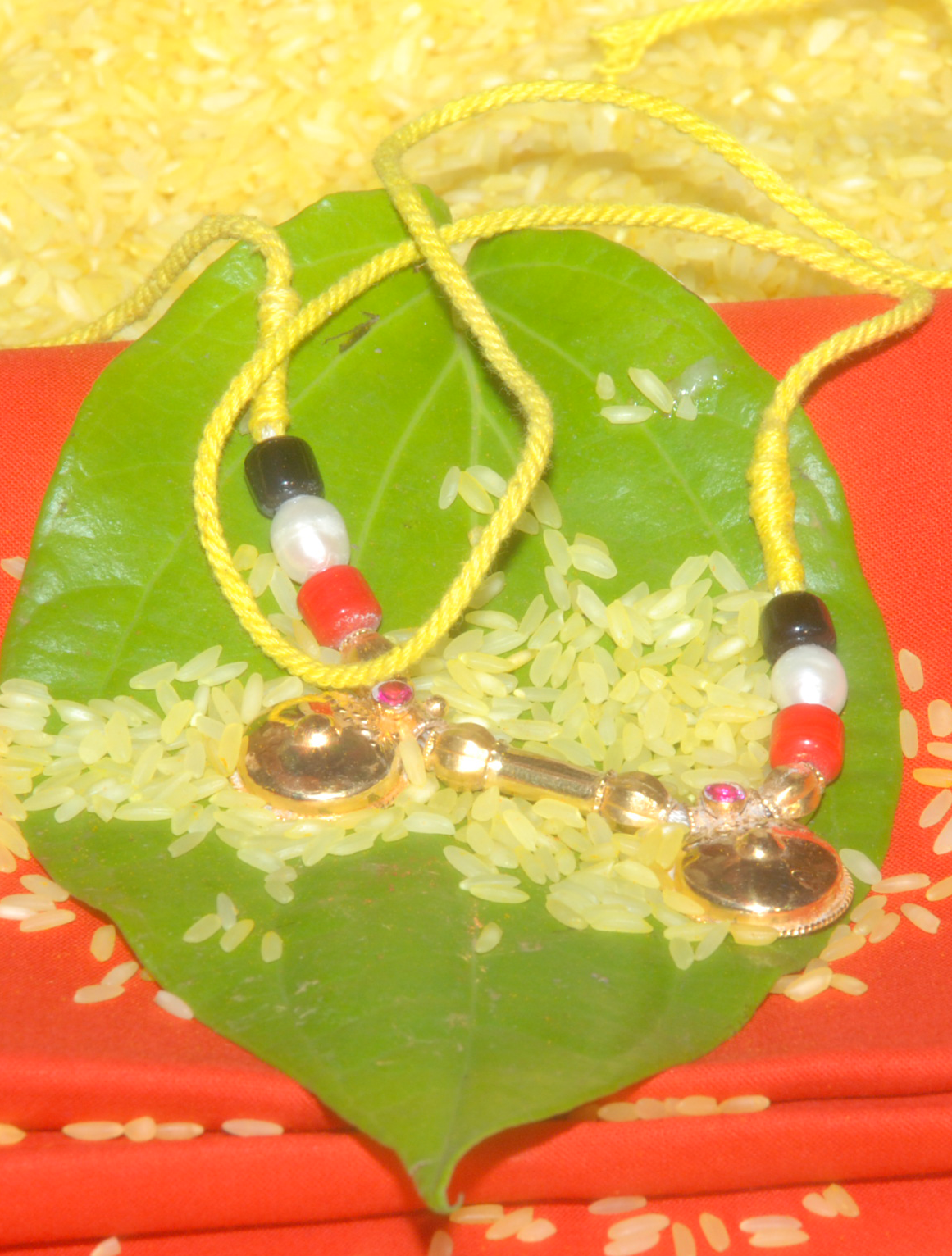 🇮🇳 India and 2 moreMangalsutraमङ्गलसूत्रम् (maṅgalasūtram)
The sacred necklace tied around the bride's neck to mark her marriage.Adornment · The ceremony
🇧🇳 BruneiBrunei Malay wedding
The sequence of ceremonies that mark the engagement and marriage of Brunei Malays.Rite · Finding a match
 🇨🇳 China and 6 moreRed envelope红包 (hóngbāo)
A gift of money in a red paper sleeve exchanged at weddings and holidays to bring good luck.Gift custom · The wedding feast
 🇬🇧 United Kingdom and 5 moreWedding superstitions
Traditional beliefs about luck and omens that shape wedding rituals across culturesAttire · The weeks before
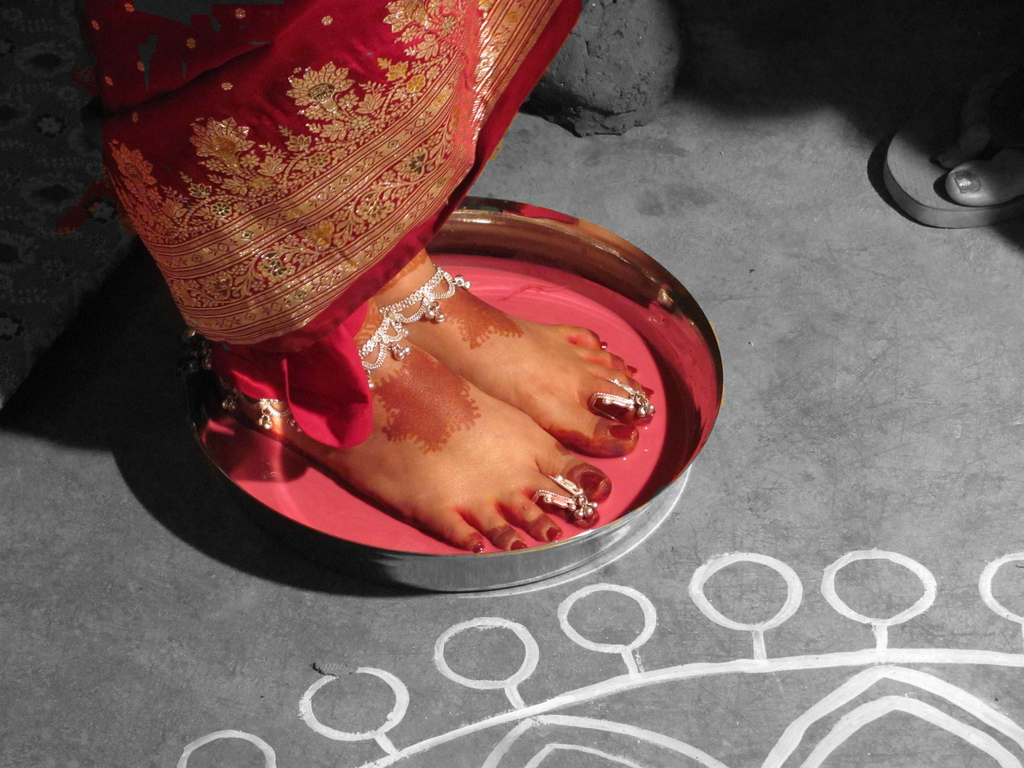 🇮🇳 India and 2 moreAltaআলতা (Bengali), 𑂄𑂪𑂞𑂰 (Bhojpuri)
A red dye applied to hands and feet by women in South Asia for weddings and festivals.Adornment · The weeks before
 🇮🇳 India and 1 moreIndian wedding invitationskankotri, laganapatrikā, Nimantraṇa patra/Patrikā (निमन्त्रण पत्र/पत्रिका)
Invitation cards that announce Indian marriages and carry religious symbols to bless the union.Attire · The weeks before
 🇮🇳 IndiaOdia Hindu weddingBahaghara (ଓଡ଼ିଆ ବାହାଘର)
The traditional Hindu marriage ceremony of the Odia people in India.Rite · Engagement and betrothal
 🇨🇳 Guangdong, China and 2 moreQungua裙褂
A two-piece embroidered jacket and skirt worn by Cantonese brides for their wedding ceremony.Attire · The ceremony
 🇮🇳 India and 2 moreLehenga
An ankle-length skirt from the Indian subcontinent, often worn as part of a gagra choli for weddings.Attire · The ceremony
 🇮🇳 IndiaGana
A sacred red thread tied to wrists for protection during wedding rituals in parts of India.Adornment · The weeks before
🇮🇪 Ireland and 3 moreBachelor's Day
The custom that lets women propose to men on Leap DayBetrothal · Engagement and betrothal
 🇮🇳 Delhi, India and 4 moreSindoorसिंदूर (Hindi)
The vermilion powder a Hindu husband applies to his wife's hair parting to mark her marriage.Adornment · Engagement and betrothal
 🇪🇬 Egypt and 5 moreHenna night
The evening before a wedding when the bride and groom are decorated with henna patterns for luck and joyAdornment · The eve
 🇮🇳 India and 5 moreWedding veil
A cloth covering the head or face worn by brides and grooms to mark marriage.Attire · The ceremony
 🇮🇳 IndiaDejhoor
A hexagonal ear ornament worn by Kashmiri Pandit women to mark their marriage.Adornment · The eve
 🇫🇷 France and 1 moreAcrostic ring
A jewelled band where gemstone initials spell a secret romantic word.Adornment · Engagement and betrothal
 🇷🇴 Romania and 4 moreCălușariCălușarii
A traditional Romanian spring dance and male society known for acrobatic leaps and ritual healing.Performance · The weeks before
 🇬🇷 Greece and 1 moreAnastenariaΑναστενάρια (Greek), Нестинарство (Bulgarian)
A barefoot firewalking ritual performed by Orthodox Christian communities in Greece and Bulgaria.Rite · The weeks before
 🇵🇱 Poland and 5 moreTuroń
A horned effigy that visits homes during Carnival to wish for fertility and collect gifts.Blessing · The weeks before
 🇮🇳 Madurai, IndiaGoluBommai kolu (Tamil), Bommala Koluvu (Telugu), Gombe Habba (Kannada)
A tiered display of dolls and figurines arranged in South Indian homes during the Navaratri festival.Feast custom · The weeks before
 🇰🇿 Kazakhstan and 2 moreKimeshekкимешек (Kazakh/Karakalpak), элечек (Kyrgyz)
The traditional white headgear worn by married women with children in Central AsiaAttire · After the wedding
 🇮🇳 Delhi, India and 2 moreKarva Chauthकरकचतुर्थी (Karakachaturthī)
A Hindu festival where married women fast from sunrise to moonrise for their husband's health and life.Betrothal · The weeks before
 🇩🇪 GermanyLandshut WeddingLandshuter Hochzeit
A four-year historical pageant in Bavaria re-enacting the 1475 royal marriage of George and Hedwig.Setting · Engagement and betrothal
 🇮🇹 Viterbo, ItalyMacchina di Santa Rosa
The annual procession in Viterbo where men carry a towering structure to honor their patron saint.Blessing · Procession and arrival
 🇳🇬 Nigeria and 1 moreOkpu Aguokpu agụ
A traditional knitted cap worn by Igbo men at weddings and ceremonies to signal status and heritage.Attire · The ceremony
 🇩🇪 GermanyBollenhut
A straw hat with woolen pompoms worn by women in specific Black Forest villages as part of their traditional dress.Attire · The weeks before
🇲🇷 MauritaniaT'heydinnالتهيدين (al-T'haydīn)
A Mauritanian Moorish epic performance of poetry and music kept by griot families.Performance · Reception, dance and gifts
 🇺🇬 UgandaEkitaguriro
A traditional Ankole dance celebrating cattle and community milestones like marriage.Performance · The wedding feast
 🇬🇷 Corfu, GreeceBotidesμπότηδες
The throwing of clay pots filled with water from balconies in Corfu on Holy Saturday to mark the Resurrection.Blessing · The ceremony
 🇭🇺 Hungary and 2 moreEaster sprinkling in Hungaryhúsvéti locsolás
An Easter Monday custom where boys sprinkle water or perfume on girls and receive painted eggs in return.Betrothal · The weeks before
Photo credits on this page
The small pictures above come from Wikimedia Commons under free licences. Some are cropped to fit.
- Turoń: Museum: The Seweryn Udziela Ethnographic Museum in Kraków, CC0, source
- Sindoor: Masum-al-hasan, CC BY-SA 3.0, source
- Landshut Wedding: Oktobersonne, CC BY-SA 4.0, source
- Easter sprinkling in Hungary: Matyófolk, CC BY-SA 4.0, source
- Okpu Agu: Justice kelechi achinefu, CC0, source
- Acrostic ring: Jlblackmore, CC BY-SA 4.0, source
- Traditional Chinese wedding dress: Tunere, CC BY-SA 4.0, source
- Laavaan: Ashish 100, CC BY 2.0, source
- Kimeshek: https://www.flickr.com/photos/kjfnjy/, CC BY 2.0, source
- Bollenhut: Unknown author, Public domain, source
- Ekitaguriro: Aubry Arihona, CC BY-SA 4.0, source
- Vadhu Pravesha: Shounak Ray, CC BY-SA 2.0, source
- Botides: Gkaridis0, CC BY 4.0, source
- Azerbaijani wedding traditions: Azim Azimzadeh, Public domain, source
- Dowry system in India: Unknown author, Public domain, source
- Chinese wedding door games: elfgoh, CC BY-SA 2.0, source
- Negafa: Amine.elbahij, CC BY-SA 4.0, source
- Traditional Vietnamese wedding: Gabrielle M. Vassal, Public domain, source
- Wedding veil: David Ring, CC0, source
- Wedding sari: Tarquin Binary, CC BY-SA 2.5, source
- Hindu wedding: Dinesh Cyanam, CC BY-SA 2.0, source
- Lefe: Useendk, CC BY-SA 4.0, source
- Shinto wedding: Jakub Hałun, CC BY-SA 4.0, source
- Anastenaria: Artkostov, CC BY-SA 4.0, source
- Ochipok: Unknown author, CC0, source
- Karva Chauth: Iamwiki001, CC BY-SA 4.0, source
- Care cloth: Unknown author, Public domain, source
- Golu: Ksiva21, CC BY-SA 4.0, source
- Taʻovala: James Foster, CC BY-SA 2.5, source
- Wedding dress: Statens historiska museer, CC BY 2.5, source
- Khara dupatta: Kinshuk Sunil, CC BY 2.0, source
- Mangalsutra: Ackroydman, CC BY-SA 3.0, source
- Red envelope: Oldie~commonswiki, Public domain, source
- Wedding superstitions: Anonymous Unknown author, Public domain, source
- Henna night: Izzah Zainab, CC BY 2.0, source
- Indian wedding invitations: Onef9day, CC BY 3.0, source
- Odia Hindu wedding: Aditya Mahar, CC BY-SA 3.0, source
- Qungua: Fduyjfroea Homz, CC BY-SA 4.0, source
- Macchina di Santa Rosa: Amras Carnesîr, CC BY-SA 3.0, source
- Călușari: El bes, CC BY 3.0, source
- Lehenga: Iwaqarhashmi, CC BY-SA 4.0, source
- Dejhoor: Unknown author, Public domain, source
- Gana: William J Sisti, CC BY-SA 2.0, source