Wedding dress and clothing
What the couple and the guests wear, and why: the white dress, the red sari, the kimono, the kente.
What the couple and their guests wear is the most visible part of a wedding. Dress carries meaning in its colour, cloth, cut and the person who makes or lends it. There is no single wedding outfit. There is a red sari, a white gown, a kimono, a hanbok, a kente cloth and a suit, each rooted in a place and often in a family.
Colour and cloth
White became the fashion for Western brides after Queen Victoria wore it in 1840, though it was not the universal choice before. In India red is the traditional colour of the bride, in a silk sari, lehenga or the Banarasi weave, and in China red is used for luck, in the qipao or the two-piece qungua. In Japan the shiromuku is white and the uchikake over it may be red or gold. In Ghana and Nigeria families may choose coordinated kente or aso ebi cloth. In Morocco the bride may change outfits several times in the amariya chair.
The groom and the guests
Grooms wear sherwanis in North India, barong tagalog in the Philippines, the kilt in Scotland, the morning coat in formal English weddings, and the dishdasha or bisht in the Gulf. Guests follow rules too: no white at a Western wedding, no black at many Asian ones, a head covering at a Sikh gurdwara or a Greek church, and bright colour at a Nigerian celebration where matching cloth shows the family you belong to.
What is changing
Brides wear colours other than white, rent or borrow dresses, restyle a mother's outfit, or wear trousers. Same-sex couples choose from every tradition. Fast fashion and sustainability concerns have pushed more people to rent or alter existing garments. Handloom weavers and embroiderers have also benefited from a renewed interest in heritage fabric.
Written by the EveryShaadi desk with AI assistance. Background on Wedding dress and clothing (kind of custom). Customs differ from place to place and family to family. If this is your tradition and we have it wrong, tell us.
 🇮🇩 IndonesiaUlosᯥᯞᯘᯬ᯲
The hand-woven Batak textile that binds couples and signifies familial warmth in North Sumatra.Attire · The ceremony
 🇮🇳 Kanchipuram, IndiaKanchipuram silk sari
The silk sari from Kanchipuram that brides across southern India wearAttire
 🇲🇾 Malaysia and 2 moreTengkolokتڠكولوق
A folded songket headwrap worn by Malay and Indonesian grooms at weddingsAttire · The ceremony
 🇪🇹 Addis Ababa, Ethiopia and 1 moreZuria
The ankle-length dress with woven hem bands worn by Tigrinya and Amhara women for weddings and holidays.Attire · The ceremony
 🇲🇱 MaliWeddings in Mali
Multi-day Malian wedding customs blending Islamic, civil and traditional rites with bazin attire and henna.Feast custom · Engagement and betrothal
 🇰🇷 South KoreaJokduri족두리
A traditional Korean silk coronet worn by brides and noblewomen for formal occasions.Attire · The ceremony
🇮🇳 IndiaMadisarமடிசார் (Madisar)
The nine-yard sari drape worn by Tamil Brahmin women for weddings and religious ritesAttire · The ceremony
 🇳🇬 Nigeria and 3 moreGeleGèlè
The towering Yoruba headtie that elevates the wearer and honors the sacred head.Attire · Procession and arrival
 🇩🇿 Algiers, AlgeriaKarakou
A fitted velvet jacket with gold and silver embroidery from AlgiersAttire · The ceremony
 🇮🇩 IndonesiaBeskapꦧꦼꦱ꧀ꦏꦥ꧀
The formal black jacket worn by Javanese men at weddings and official ceremonies.Attire · The ceremony
 🇦🇹 Vienna, Austria and 2 moreViennese waltzWiener Walzer
The fast rotary ballroom dance that originated in Austria and defines the traditional waltz.Performance · Reception, dance and gifts
🇮🇳 Lucknow, India and 1 moreAchkanअचकन (Hindi), اچکن (Urdu)
A knee-length jacket worn by grooms and men on formal occasions in the Indian subcontinent.Attire · Engagement and betrothal
🇵🇦 PanamaTamborito
A Panamanian courtship dance performed in a circle with drums and female chorusPerformance · The wedding feast
 🇷🇺 Russia and 2 moreRushnykрушник (Ukrainian), ручнік (Belarusian), ручник/рушник (Russian)
A sacred embroidered cloth that marks life stages and guides the couple during East Slavic wedding ceremonies.Attire · Procession and arrival
🇮🇳 Kuthampully, IndiaKasavuകസാവ്
The handwoven cotton and silk garments with gold borders worn in Kerala weddings.Attire · The weeks before
 🇪🇬 Egypt and 3 moreWaist beads
Beads worn round the waist or hips, from coming-of-age rites to the Igbo bride's attireAdornment · The weeks before
 🇲🇾 Malaysia and 4 moreBaju Kurungباجو كوروڠ
A traditional blouse and skirt worn by Malay women for weddings and official ceremonies.Attire · The ceremony
 🇲🇽 Oaxaca, Mexico and 1 moreHuipilhuīpīlli
The traditional tunic worn by indigenous women in Mexico and Central America for weddings and daily life.Attire · The weeks before
🇺🇦 UkraineSong about the RushnykПісня про рушник (Pisnia pro rushnyk)
A Ukrainian song that celebrates the embroidered cloth used in weddings and family life.Performance · The ceremony
 🇮🇹 Rome, ItalyAncient Roman wedding
A veiled Roman bride, omens checked, was led from her family home to her groom's house.Rite · The weeks before
 🇪🇸 Spain and 3 moreMantilla
A lace or silk veil worn over the head and shoulders by women in Spain and Latin America for church and weddings.Attire · The weeks before
🇳🇬 Lagos, Nigeria and 2 moreOwanbeÓwàńbẹ̀
The extravagant Yoruba celebration where music, fashion, and money spraying mark life's milestones.Feast custom · Reception, dance and gifts
 🇼🇸 Samoa and 3 more'Ie tōga
The treasured woven mats exchanged at Samoan weddings and ceremoniesAttire · The ceremony
 🇳🇬 Lagos, Nigeria and 2 moreAso ebiAsọ-Ẹbí
Matching outfits worn by groups to show unity at Yoruba celebrationsAttire · The weeks before
 🇳🇬 Iseyin, Nigeria and 2 moreAso okeAṣọ òkè
Hand-woven cloth worn by the Yoruba for weddings and formal gatheringsAttire · The ceremony
 🇮🇳 Bhuj, India and 1 moreBandhani
The intricate tie-dye textile tradition of Gujarat and Rajasthan worn by brides and married women.Attire · Engagement and betrothal
 🇬🇭 Ghana and 2 moreKente clothnwentoma
Hand-woven silk and cotton strips from Ghana that mark weddings and graduationsAttire · The ceremony
 🇮🇩 Palembang, Indonesia and 3 moreSongketᬲᭀᬂᬓᬾᬢ᭄
Gold-threaded handwoven silk worn by brides and grooms in Indonesia and MalaysiaAttire · The ceremony
 🇮🇳 India and 1 moreToe ring
A silver ring worn on the second toe to mark a Hindu woman as married.Attire · The ceremony
 🇦🇹 Austria and 4 moreDirndl
The traditional Alpine dress of bodice, skirt and apron worn by women in German-speaking regions.Attire · The weeks before
 🇺🇸 United States and 2 moreMarriage proposal
The act of asking a partner to marry, often involving a ring and marking the start of an engagement.Betrothal · The weeks before
 🇮🇳 India and 1 moreMayian
A pre-wedding cleansing ritual in Punjabi culture where turmeric paste is applied to the couple.Blessing · The weeks before
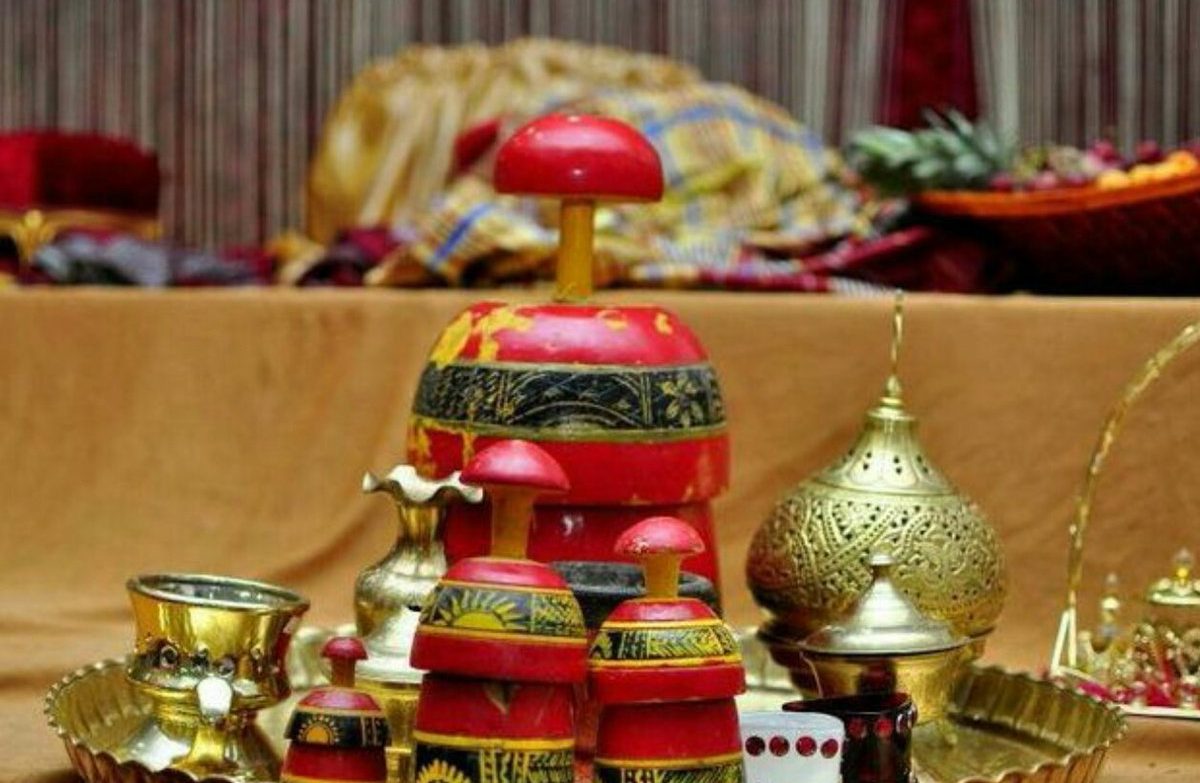 🇸🇩 SudanJirtigالجَرْتِقْ
A Sudanese rite where the groom is symbolically crowned as king before the wedding procession.Rite · The weeks before
 🇰🇷 South Korea and 1 moreHwarot활옷
The traditional Korean red and blue robe worn by brides during the ceremony and pyebaek.Attire · The ceremony
 🇨🇳 China and 1 moreTraditional Chinese wedding dress
The wedding attire worn by Han Chinese couples, from the fengguan xiapei to the qunguaAttire · The ceremony
 🇨🇳 ChinaHonggaitou紅蓋頭
The red bridal veil worn by Han Chinese brides to cover their faces before the wedding night.Attire · Procession and arrival
🇮🇳 India and 1 moreChuraचूड़ा (Hindi)
The red and white bangle set worn by brides in North India to mark her new status as a married woman.Attire · The weeks before
 🇻🇳 VietnamTraditional Vietnamese weddingLễ cưới truyền thống Việt Nam
The multi-stage ceremony of betrothal, engagement and union that marks a marriage in Vietnam.Attire · Finding a match
 🇫🇷 France and 1 moreGarter toss
The groom removes the bride's garter and throws it to unmarried men at the reception.Play · Reception, dance and gifts
 🇲🇳 MongoliaDeel
The traditional long robe worn by Mongol people for daily life and special occasions like weddings.Attire · The ceremony
 🇮🇳 IndiaWedding mandapaVivaha Mandapa (विवाह मण्डप)
The temporary Hindu and Jain wedding pavilion where the main rites are performed under a sacred canopy.Setting · The ceremony
 🇨🇳 ChinaFengguan xiapei凤冠霞帔
The traditional Han Chinese wedding ensemble of a phoenix crown and embroidered robes worn by brides in the Ming and QinAttire · The ceremony
 🇲🇦 Tangier, MoroccoNegafanggafa (Tamazight); ziyyāna (Arabic)
The traditional Moroccan bridal dresser who manages the bride's appearance and wedding rituals.Attire · The weeks before
🇮🇳 India and 1 moreLeirum Pheeꯂꯩꯔꯨꯝ ꯐꯤ
A traditional Meitei shawl given as a wedding gift from parents to daughtersAttire · Engagement and betrothal
 🇬🇧 United Kingdom and 3 moreBridal bouquet
The handheld flower arrangement carried by the bride during her wedding ceremony.Attire · The ceremony
 🇮🇳 IndiaIndian wedding clothes
Traditional garments worn by Indian couples and guests across multiple days of celebrationAttire · The weeks before
🇮🇳 IndiaTelugu Hindu weddingతెలుగు వివాహ వేడుక
The traditional marriage rite of the Telugu people in India, centered on seven sacred vows around a fire.Rite · Engagement and betrothal
 🇰🇷 South Korea and 1 morePyebaek폐백
A Korean post-ceremony ritual where the couple bows to the groom's parents and shares symbolic foods.Blessing · After the wedding
Photo credits on this page
The small pictures above come from Wikimedia Commons under free licences. Some are cropped to fit.
- Tengkolok: Riski Syahputra, CC BY-SA 4.0, source
- Viennese waltz: Sigismund von Dobschütz, CC BY-SA 3.0, source
- Aso oke: Wolf D., Public domain, source
- Jokduri: derivative work: Caspian blue ( talk ) Korean_dance-Jinju_pogurakmu-01, CC BY-SA 2.0, source
- Pyebaek: halfGoku, CC BY-SA 2.0, source
- Beskap: Kris, Photographer of the Press, Media and Information Bureau of the P, Public domain, source
- Toe ring: Wikiss, CC BY-SA 3.0, source
- Kente cloth: ZSM, CC BY-SA 3.0, source
- Aso ebi: SUPREME LACE, CC BY-SA 4.0, source
- Gele: Royalesignature, CC BY-SA 4.0, source
- Deel: Marcin Konsek, CC BY-SA 4.0, source
- Honggaitou: kanegen, CC BY 2.0, source
- Traditional Chinese wedding dress: Tunere, CC BY-SA 4.0, source
- Hwarot: Unknown author, No restrictions, source
- Kanchipuram silk sari: McKay Savage, CC BY 2.0, source
- Weddings in Mali: HawaG, CC BY-SA 4.0, source
- Ulos: Boy Lawson, CC BY-SA 3.0, source
- Songket: Rijksmuseum, CC0, source
- Bandhani: RubyGoes, CC BY 2.0, source
- Mayian: Rakzika, CC BY-SA 4.0, source
- Rushnyk: Pavlo Boyko, CC BY-SA 2.0, source
- Ancient Roman wedding: Meister der Aldobrandinischen Hochzeit, Public domain, source
- Bridal bouquet: James Vick's Sons (Rochester, N.Y.); Henry G. Gilbert Nursery and Seed, No restrictions, source
- Indian wedding clothes: Lee Jordan, CC BY-SA 2.0, source
- 'Ie tōga: Sarah Kelemen, CC BY 2.0, source
- Karakou: Bachounda, CC BY-SA 4.0, source
- Fengguan xiapei: Unknown author, CC0, source
- Wedding mandapa: Unknown author, CC BY-SA 3.0, source
- Negafa: Amine.elbahij, CC BY-SA 4.0, source
- Garter toss: MorningTea, CC BY-SA 4.0, source
- Traditional Vietnamese wedding: Gabrielle M. Vassal, Public domain, source
- Waist beads: Amuzujoe, CC BY-SA 4.0, source
- Jirtig: Alzain Mohammed, CC BY-SA 4.0, source
- Baju Kurung: Ministry of Information official photographer, Public domain, source
- Huipil: Gift in memory of Elizabeth Ege Freudenheim, No restrictions, source
- Marriage proposal: Victorgrigas, CC BY-SA 3.0, source
- Dirndl: High Contrast, CC BY 3.0 de, source
- Mantilla: Museu Valencià d'Etnologia, CC BY-SA 2.0, source
- Zuria: Kurt Bauschardt, CC BY-SA 2.0, source